Woo Sang-ho, a member of the National Assembly's Foreign Affairs and Unification Committee from the Democratic Party of Korea, criticized reports that the resignation of Kim Seong-han, the National Security Office chief at the Presidential Office, was decisively caused by the omission of requests for performances by BLACKPINK and Lady Gaga, saying, "They replaced the national security chief of a country because of BLACKPINK and Lady Gaga? It's a laughingstock worldwide."
On the 30th, Woo said on MBC's "Kim Jong-bae's Focus" program, "When someone at the level of National Security Office chief suddenly resigns, such cases are usually seen as conflicts," expressing his view.
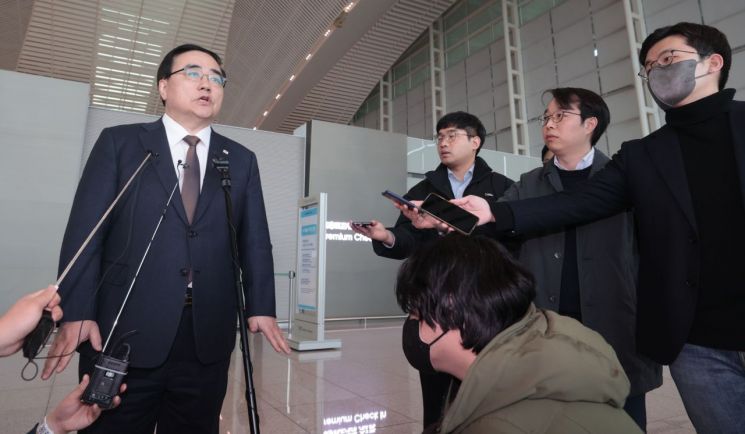
Kim, who had recently been rumored to be dismissed, abruptly resigned the day before, sparking debate over the reasons behind it. While there are rumors of discord with Kim Tae-hyo, the First Chief, reports also claim that the omission of the U.S. side's request for a BLACKPINK performance was the decisive factor. Woo supported the discord theory.
He said, "The diplomatic secretary under the (National Security Office chief) also resigned, and for example, the protocol secretary?authentic diplomats have all resigned now," adding, "Because all the authentic diplomats are quitting at once, while the non-diplomat lines remain intact. Then it should be seen that the authentic diplomat line lost to the non-diplomat line."
Woo said, "They fired the national security chief, diplomatic secretary, and protocol secretary of a country just because they didn't report whether a cultural event was established? Do you believe that?" and added, "That is thoroughly the responsibility of the company practically managing the event, so why should the national security chief, diplomatic secretary, and protocol secretary be held accountable?"
Woo offered an analysis that the background of this resignation involves a factional conflict surrounding the Korea-Japan summit. He said, "This issue, especially when replacing lines at this level, at least in my view, cannot happen without factional conflict. From what I have heard, this seems to be the aftermath of the Korea-Japan summit," and "Professional diplomatic lines who have long served as diplomats expressed considerable concern about how the Korea-Japan summit was pushed forward."
He pointed out, "Because there is no way to reach a diplomatic settlement like that," and "This is not a matter of conservative or progressive politics, but an approach to the summit that violates the traditional diplomatic line rules that have been conducting Korea-Japan diplomacy, and especially the one-sided concessions would not have been pushed by the traditional diplomatic line."
Woo said, "It is very insulting and rude that the Japanese side is playing media games, and continuous breaches of diplomatic conventions are happening, but the Ministry of Foreign Affairs is left to clean up the mess," and "I see this as leading to conflict between the diplomatic line within the National Security Office and the non-diplomatic line."
While some analyze that Kim was effectively dismissed, Woo interpreted it as a voluntary resignation. He explained that Kim's statement the day before about improving Korea-Japan relations as his achievement was in that context. He said, "Wasn't this person even called President Yoon Seok-youl's mentor in diplomacy and security? Anyway, this was a consideration to minimize damage and shock to the Yoon Seok-youl administration," and "Judging from their relationship, President Yoon would not dismiss National Security Office chief Kim Seong-han over such a matter." Kim was also a classmate of President Yoon in elementary school.
He added, "Even though the president tried to persuade him while eating, he resigned because he thought he could no longer endure it," and "He used a kind of rhetoric to minimize damage when stepping down."
© The Asia Business Daily(www.asiae.co.kr). All rights reserved.
![Clutching a Stolen Dior Bag, Saying "I Hate Being Poor but Real"... The Grotesque Con of a "Human Knockoff" [Slate]](https://cwcontent.asiae.co.kr/asiaresize/183/2026021902243444107_1771435474.jpg)










