Police Stations Handling Only Intoxicated Person Reports
Police Duty to Protect Intoxicated Persons Legally Established
"All Staff Mobilized for Intoxicated Person Response... Work Paralyzed"
Experts "Guidelines Needed for Detention of Intoxicated Persons"
At 12 p.m. on the 30th of last month, the National Workplace Police Council (JWPC) held a one-person protest at the Government Sejong Complex, urging the resolution of issues related to intoxicated individuals. They demanded that the government take responsibility and respond to the problem of intoxicated persons. In a statement, JWPC said, "We have to put aside other emergency reports to take care of intoxicated individuals," and called for a government-wide effort to solve the issue.
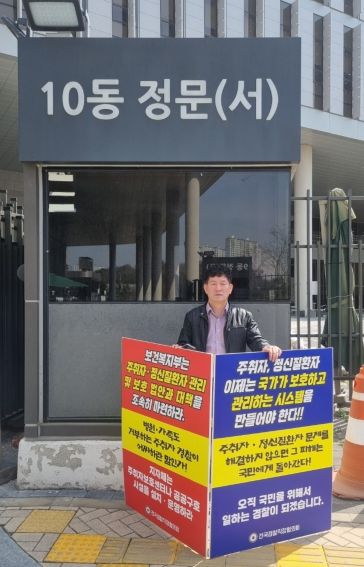 At around 12 PM on the 30th, the National Workplace Police Council (JWPC) held a solo protest in front of the Government Sejong Complex, urging the resolution of issues related to intoxicated individuals. / Photo by National Workplace Police Council
Every night, police officers across the country are pouring their law enforcement efforts into dealing with intoxicated citizens. As of last year, there were approximately 980,000 112 emergency calls related to intoxicated individuals nationwide. With 2,031 police substations and precincts (as of the end of 2020) across the country, this amounts to about 81,000 requests per month for handling intoxicated persons. Frontline officers at each police substation and precinct say, "Excessive nighttime police resources are consumed dealing with intoxicated individuals, making it difficult to maintain necessary public safety," and they unanimously agree that improvements to the intoxicated person protection and management system are urgently needed.
Despite paying attention to intoxicated person reports, accidents continue to occur. Two frontline officers from the Dongdaemun Police Station in Seoul are scheduled to appear before the Seoul Metropolitan Police Agency’s disciplinary committee soon. The disciplinary action is due to their alleged neglect of a man in his 50s who was lying on a roadway in Huigyeong-dong, Dongdaemun-gu, Seoul, while heavily intoxicated in the middle of the night in January. The man was left unattended and was run over by a vehicle, resulting in his death. The officers reportedly responded immediately after receiving a report that "a drunken man was lying on the road," but the man strongly refused police assistance, saying, "Don't touch me, stay away." During that brief moment, a passing vehicle failed to see the man lying down and caused the accident. At the time of the accident, the officers were about 10 meters away from the man.
In November of last year, a man in his 60s died from hypothermia on the stairs of a multi-family house in Suyu-dong, Seoul, after becoming intoxicated. Police officers who responded to a report that the man had collapsed due to intoxication escorted him to his front door, but he did not enter the house and fell asleep on the stairs, ultimately dying in the -7°C cold snap. Two officers who responded were booked on charges of professional negligence resulting in death.
980,000 Intoxicated Person Reports in One Year... "Police Need Authority and Duty to Respond"
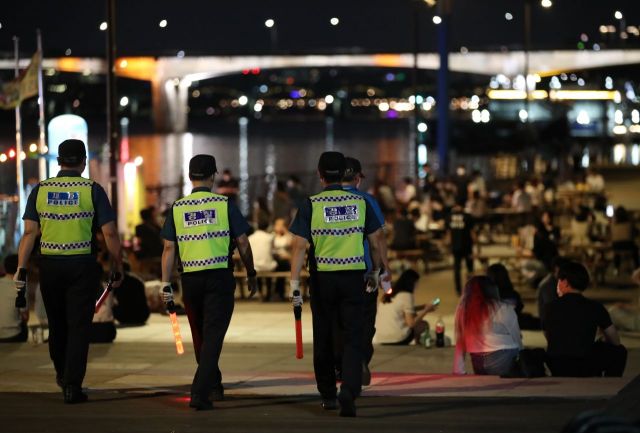
Protecting intoxicated individuals is a legal duty of the police. According to the Police Duties Execution Act, when police officers find intoxicated persons, they must either protect them at the police station or request emergency assistance from health care institutions or public relief agencies. However, frontline officers point out that "although there is a manual for protecting intoxicated persons, it is unrealistic and impossible to follow."
In the past, police stations had intoxicated person stabilization rooms to manage intoxicated individuals, but these were abolished in 2009 due to human rights controversies over their resemblance to detention cells. In 2011, the 'Intoxicated Person Emergency Medical Center' system was established, installing such centers in emergency rooms of 18 hospitals nationwide, but in reality, it is ineffective.
The police 'Intoxicated Person Protection Measures Manual' states that "simple intoxicated persons are not subject to medical institution protection measures, and officers should distinguish between simple intoxication and unconscious intoxication, checking breathing and heartbeat in unconscious cases and transporting them to medical institutions." Medical institutions that must treat emergency patients at night find it difficult to accommodate simple intoxicated persons and allocate medical personnel.
A police officer who worked at a police substation in the Gangnam entertainment district said, "Ultimately, all we can do is take intoxicated persons to the substation, give them an injection, and wait for them to sober up." Another officer working in Gyeonggi Province said, "When a violent intoxicated person comes in, all substation staff work together to restrain them," adding, "If another emergency call comes in during that time, it is difficult to respond promptly."
Experts have pointed out that police should be granted authority and duty to actively respond to intoxicated persons. Professor Lee Geon-su of the Department of Police Science at Baekseok University said, "Police should be able to immediately detain intoxicated persons who verbally or physically assault officers. This will lead to improvements in police work processes," adding, "However, clear standards and guidelines must be established to prevent excessive human rights violations."
© The Asia Business Daily(www.asiae.co.kr). All rights reserved.


















