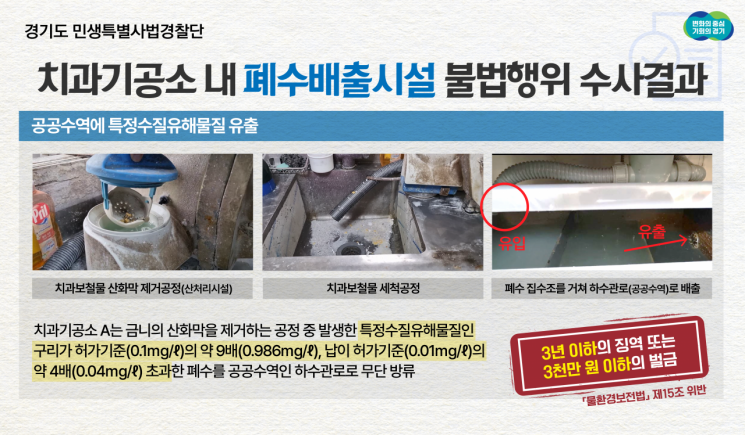
The Gyeonggi-do Special Judicial Police Unit uncovered 30 dental laboratories that committed illegal acts such as unauthorized discharge of wastewater containing specific water quality hazardous substances into public waters during the medical device manufacturing process.
Most of the dental laboratories detected this time discharged all wastewater into public waters (sewage pipes) after removing only plaster, judging that there were no specific water quality hazardous substances due to the nature of their products (artificial teeth).
From the 6th of last month to the 10th of this month, the Gyeonggi-do Special Judicial Police conducted wastewater pollution tests on 224 dental laboratories in the province, focusing on large-scale businesses and those suspected of unauthorized wastewater discharge.
As a result of the tests, specific water quality hazardous substances such as lead and copper were detected above permitted standards in 30 dental laboratories.
Based on academic data from 2018 indicating that heavy metals are generated during the casting body pickling process in dental laboratories, the Gyeonggi-do Special Judicial Police began collecting information from 2022. Subsequently, during an investigation last year into illegal wastewater discharge facilities within knowledge industry centers, it was confirmed that wastewater from two dental laboratories contained lead, antimony, and other specific water quality hazardous substances exceeding permitted standards.
Accordingly, the Gyeonggi-do Special Judicial Police expanded the scope of investigation to all dental laboratories in the province.
For the detected companies, the Special Judicial Police will conduct additional investigations to identify which processes generate specific water quality hazardous substances, and take measures such as process changes and facility improvements to prevent these substances from being discharged into public waters. They also plan to calculate the volume of wastewater discharged and, if it exceeds permitted standards, file additional charges for illegal installation and operation of unauthorized wastewater discharge facilities.
According to the current Water Environment Conservation Act, those who install or operate unauthorized wastewater discharge facilities face imprisonment of up to 7 years or fines up to 70 million KRW, and those who discharge specific water quality hazardous substances into public waters face imprisonment of up to 3 years or fines up to 30 million KRW.
Hong Eun-gi, head of the Gyeonggi-do Civil Affairs Special Judicial Police Unit, stated, "Through the first planned investigation by the Gyeonggi-do Special Judicial Police into dental laboratories, which have been a blind spot in environmental pollution enforcement, we have led the industry to improve awareness of environmental issues and make facility improvements, encouraging self-help efforts within the industry." He added, "We will actively uncover and continuously investigate environmental illegal acts that have been neglected for decades, like this investigation."
Meanwhile, following this investigation, the Gyeonggi-do Dental Laboratory Association has formed an advisory group including university professors and launched a comprehensive self-assessment of environmental pollutant discharge within dental laboratories.
© The Asia Business Daily(www.asiae.co.kr). All rights reserved.
![From Hostess to Organ Seller to High Society... The Grotesque Scam of a "Human Counterfeit" Shaking the Korean Psyche [Slate]](https://cwcontent.asiae.co.kr/asiaresize/183/2026021902243444107_1771435474.jpg)
















