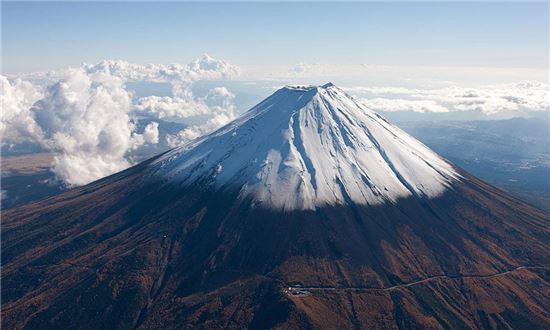
 Mount Fuji, Japan.
In the event of a large-scale eruption of Mount Fuji in Japan, evacuation plans have been changed to recommend evacuation on foot instead of by car.
According to Kyodo News on the 29th, the Mount Fuji Volcanic Disaster Prevention Council, which includes the prefectures of Shizuoka, Yamanashi, and Kanagawa, announced a new evacuation plan report reflecting the latest research related to the eruption of Mount Fuji.
The council expects lava flows to reach affected areas within 24 hours of an eruption and recommends that residents in these areas evacuate on foot. Previously, evacuation by vehicle was the basic premise of the evacuation plan, but it was changed to prevent delays caused by blocked roads after an eruption.
However, residents and the elderly in areas where lava flows are not expected to reach within 24 hours are advised to evacuate by vehicle.
The council also included estimates of the expected damage scale based on the size of the Mount Fuji eruption in the report. Assuming an explosion of the same scale as the 1707 "Hoei eruption," it predicted that Tokyo and the metropolitan area would be paralyzed by volcanic ash accumulating in urban areas within three hours of the eruption. The amount of volcanic ash is estimated to be ten times the waste generated by the 2011 Great East Japan Earthquake.
Accordingly, the council recommended staying indoors if ash falls after the Mount Fuji eruption. It also mentioned stockpiling about one week's worth of food, masks, helmets, and other supplies for indoor evacuation.
Mount Fuji is the highest mountain in Japan, with a total height of 3,776 meters. Over the past 5,600 years, Mount Fuji has erupted 180 times, with 96% of these eruptions being relatively small in scale. The most recent eruption of Mount Fuji was recorded in 1707.
© The Asia Business Daily(www.asiae.co.kr). All rights reserved.
![Clutching a Stolen Dior Bag, Saying "I Hate Being Poor but Real"... The Grotesque Con of a "Human Knockoff" [Slate]](https://cwcontent.asiae.co.kr/asiaresize/183/2026021902243444107_1771435474.jpg)















