Jangseong-gun, Jeollanam-do announced on the 29th that it conducted education on the prevention of rice bacterial leaf blight for rice farmers.
When infected with bacterial leaf blight, the color change of the leaves becomes clearly visible. The edges turn white and dry, and the borders turn yellow. Photosynthesis is impaired, resulting in about a 30% decrease in yield, and the quality of the rice also deteriorates.
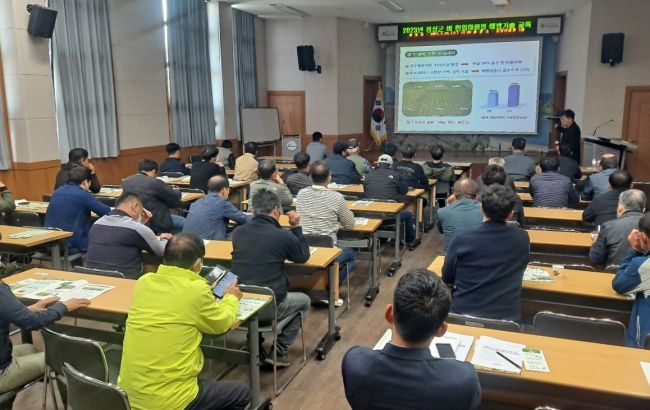 Jangseong-gun conducted education on the prevention of rice bacterial leaf blight for rice farmers on the 29th.
 [Photo by Jangseong-gun]
It mainly occurs in hot and humid environments and often breaks out from early July after typhoons or the rainy season. In the Jangseong area, it began to occur after the heavy rains in 2020.
On this day, the county invited Dr. Lee In, an expert in rice pests and diseases, to hold a session to learn about the causes and prevention methods of bacterial leaf blight.
The pathogen of rice bacterial leaf blight overwinters in weeds or rice straw and invades the rice leaves through paddy water when the weather warms up.
Once it occurs, it has a dormancy period of three years, so efforts must be made to prevent it in advance, such as maintaining the paddy ridges and drainage channels.
A county official said, "Due to recent abnormal weather, various pests and diseases are occurring, so caution is required," adding, "We will minimize damage from pests and diseases through farmer education, precise monitoring, and preemptive control measures."
Jangseong = Asia Economy Honam Reporting Headquarters, Reporter Jo Hangyu baekok@asiae.co.kr
© The Asia Business Daily(www.asiae.co.kr). All rights reserved.
![Clutching a Stolen Dior Bag, Saying "I Hate Being Poor but Real"... The Grotesque Con of a "Human Knockoff" [Slate]](https://cwcontent.asiae.co.kr/asiaresize/183/2026021902243444107_1771435474.jpg)
















