Mammoth DNA Injected into Diploid Cells for Cultivation
Weighs 400g, Slightly Smaller than a Soccer Ball
Founder: "Not an April Fool's Joke, a Real Innovation"
An Australian cultured meat company has attracted global attention by replicating cells from a 'mammoth' to create meatballs. The company reportedly prepared this unique event to promote the advantages of artificial cultured meat.
According to foreign media including CNN in the US, the Australian cultured meat startup 'Vow' exhibited 'Mammoth Meatballs' on the 28th (local time) at the Science Center in Amsterdam, Netherlands.
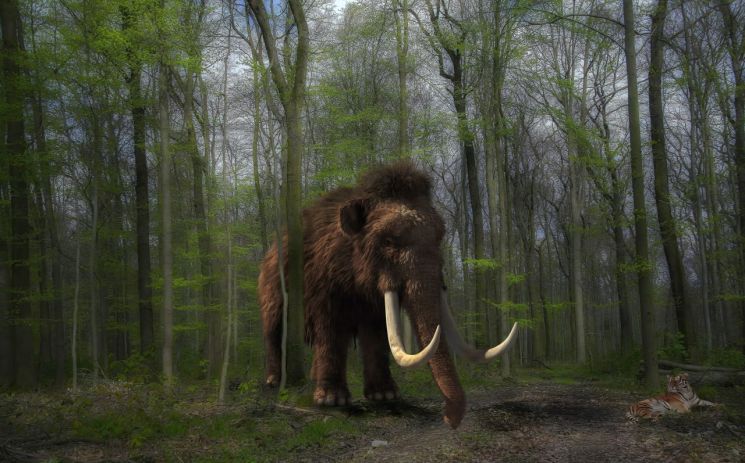
These meatballs were cultured from cells of a mammoth that went extinct over 4,000 years ago. Vow previously restored the mammoth's DNA using publicly available information on mammoth cell genetic data. Missing genetic information was supplemented with that of the African elephant, known as the mammoth's closest relative, to complete the sequence.
Subsequently, Vow inserted the completed genetic information into sheep cells and cultured them in the laboratory. As a result, they succeeded in culturing enough meat to make one large meatball. The total weight reaches 400g, slightly smaller than a soccer ball.
Tim Noakesmith, founder of Vow, emphasized that the 'Mammoth Meatball' is "not an April Fool's joke" but a "genuine innovation."
The Mammoth Meatball is not intended for tasting. It is a one-time project designed to promote cultured meat as the "future of meat" and to encourage public discussion. James Lyle, Vow's Chief Scientific Officer (CSO), told CNN, "It's time we start thinking about how we get our food," expressing hope that this project will help cultured meat technology become more widely known.
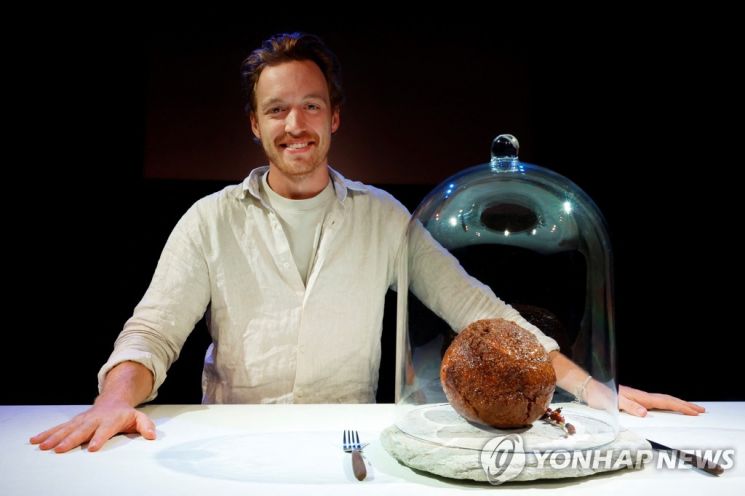 Tim Knoxsmith, founder of Australian cultured meat startup 'Bawoo,' unveiled cell-cultured meatballs based on mammoth DNA on the 28th (local time) at the 'NEMO' Science Museum in Amsterdam, Netherlands.
 [Image source=Reuters Yonhap News]
However, CNN judged that the Mammoth Meatball cannot strictly be considered "mammoth meat." This is because it was created by injecting mammoth genetic information into sheep cells. CNN explained, "It may be a stretch to call it mammoth meat. More precisely, it is lab-cultured sheep meat containing a tiny amount of mammoth DNA."
In this regard, Ernst Wolftang, a professor at the University of Queensland, Australia, also stated, "From a genomic perspective, it is closer to sheep meat with just one mammoth gene among 25,000 sheep genes."
Meanwhile, cultured meat refers to meat artificially cultured in a laboratory using genetic information taken from living animal cells. It is considered a future technology capable of mass-producing meat without raising livestock.
For this reason, cultured meat technology is also regarded as a potential savior to combat climate change. Cattle, which have been a staple of human civilization, emit large amounts of methane gas as they grow. If beef can be replaced with cultured meat, it could reduce methane emissions, one of the main causes of climate change.
© The Asia Business Daily(www.asiae.co.kr). All rights reserved.


















