"China to Apply Again for Semiconductor Equipment Regulation Exemption"
Park Jung-ho, Vice Chairman of SK Hynix, expressed that he would consider applying for subsidies under the U.S. Semiconductor Support Act. Regarding the export restrictions on semiconductor equipment to China, he said the company would strive to extend the grace period in the future.
After attending the 75th shareholders' meeting held at the SUPEX Center at the headquarters in Icheon, Gyeonggi Province on the 29th, Vice Chairman Park told reporters, "We plan to establish an advanced package factory," and added, "(Regarding the subsidy application) we will consider it." Although the subsidy application conditions are stringent, he intends to review the details.
Earlier, SK Hynix announced a $15 billion investment plan to build an advanced package factory and a research and development (R&D) center in the U.S. The company has already announced that it will select the site for the advanced package factory within the first half of the year. The U.S. has declared that it will provide subsidies to semiconductor companies investing locally through the Semiconductor Support Act.
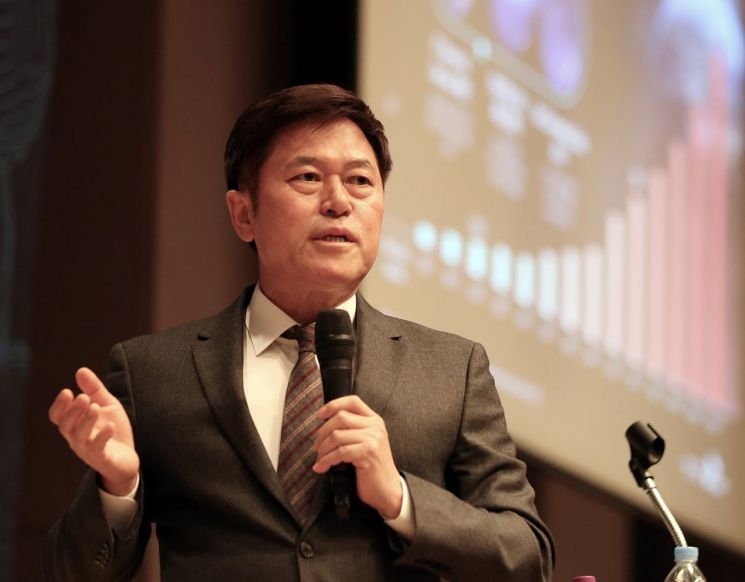
Vice Chairman Park said, "Packaging technology has become important," and added, "Customers are demanding HBM (High Bandwidth Memory), and since many customers are in the U.S., it would be good to build the advanced package factory there."
Regarding the export restriction grace period on semiconductor equipment to China, which ends in October, Vice Chairman Park said the company plans to apply for an additional extension. He explained, "It is advantageous to buy time unconditionally until the Yongin cluster is established," and added, "We will apply again in a year."
Previously, the U.S. regulated exports of equipment necessary for producing advanced memory and logic semiconductors to China in October last year. However, companies with semiconductor production plants in China, such as SK Hynix, Samsung Electronics, and Taiwan's TSMC, were granted a one-year grace period for the restrictions.
Meanwhile, SK Hynix announced that amid the semiconductor industry downturn and ongoing production cuts, it is increasing the operating rate of factories producing advanced server products. The targets are DDR5 DRAM products, expected to undergo a full-scale generational shift this year, and HBM products, which have seen a surge in demand due to issues like ChatGPT.
Kwack No-jung, President of SK Hynix, said, "Since demand for some DDR5 products is tight, we are increasing the operating rate for certain products," and added, "The same applies to HBM."
Regarding capital expenditures (CAPEX), SK Hynix's position is to systematically plan future investments by product. At this shareholders' meeting, the company announced plans to strengthen cost competitiveness through 'CAPEX discipline.'
Vice Chairman Park said in this regard, "In the case of NAND, CAPEX can account for up to 80% of sales. Some companies control it so that it does not exceed 50%," and added, "We intend to set up discipline in this area."
© The Asia Business Daily(www.asiae.co.kr). All rights reserved.
![Clutching a Stolen Dior Bag, Saying "I Hate Being Poor but Real"... The Grotesque Con of a "Human Knockoff" [Slate]](https://cwcontent.asiae.co.kr/asiaresize/183/2026021902243444107_1771435474.jpg)
















