The Highlight of Ssangryong Exercise... Showcasing ROK-US Marine Joint Operational Capability
North Korea Severely Criticizes ROK-US Joint Exercises... Indicating Leadership Pressure
The South Korean and U.S. navies and marine corps conducted amphibious assault training covering both sea and air as part of the joint landing exercise 'Ssangryong Training.' North Korea vehemently opposed the joint U.S.-South Korea exercises through state media, harshly criticizing them. It is interpreted that the North Korean leadership feels significant pressure as large-scale joint exercises, which had been suspended during the previous administration, have been revived.
On the 29th, the South Korean and U.S. navies and marine corps carried out the 'Decisive Action' phase, considered the highlight of Ssangryong Training, in the waters and airspace around Pohang City, Gyeongbuk Province, showcasing their joint and combined forces and joint amphibious operation capabilities.
South Korea-U.S. Marine Corps 'Charge Forward'... Core Amphibious Operation Conducted
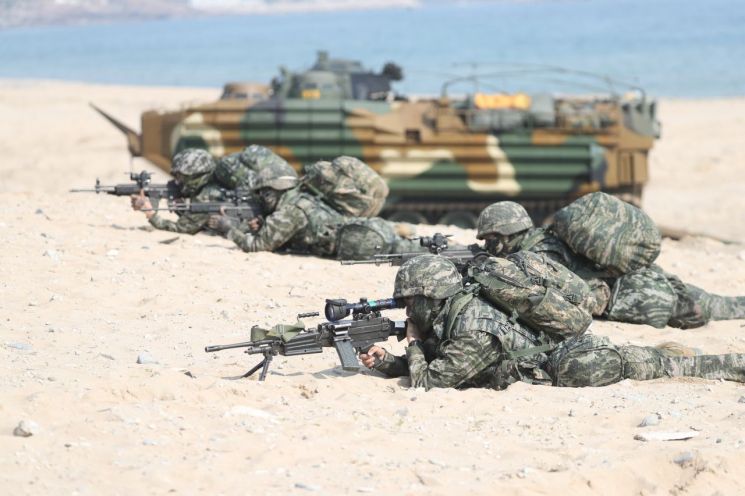
The 'Decisive Action' phase is the critical stage of an amphibious operation where a large-scale landing force simultaneously lands on the coastline, representing the core phase of the landing operation.
The exercise involved a division-level landing force, over 30 vessels including the large transport ship (LPH) Dokdo and the amphibious assault ship (LHD) USS Makin Island, more than 70 aircraft such as F-35 fighters, Army Apache attack helicopters (AH-64), and Marine Corps Marineon assault helicopters, as well as over 50 amphibious assault vehicles (KAAV), creating a large-scale joint and combined force atmosphere resembling actual combat.
The training began with airstrikes by South Korean Air Force and U.S. Marine Corps fighter jets, guided by South Korean and U.S. Marine reconnaissance units that had infiltrated enemy lines, British Marine Commandos, and Navy Special Warfare (UDT) teams. The maritime assault units aboard the Dokdo and USS Makin Island, among other South Korean and U.S. Navy landing ships, boldly charged the enemy coast riding Korean amphibious assault vehicles (KAAV) and air-cushioned landing craft (LCAC).
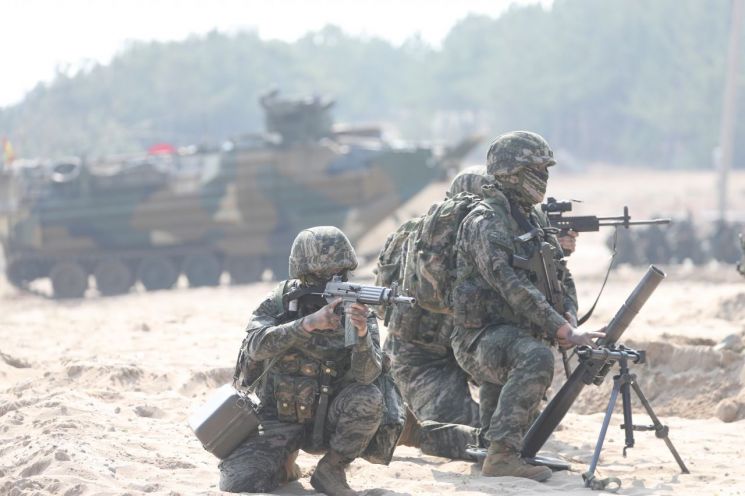
The air and sea assault units launched from landing ships and land bases infiltrated enemy territory aboard South Korean Marine Corps Marineon (MUH-1) and U.S. Marine Corps Osprey (MV-22) aircraft. Subsequently, under the fire support of joint and combined aircraft and naval vessels, the South Korean and U.S. Marines landed on enemy territory, maneuvered to secure the beachhead (the point connecting the outer perimeter of the landing force's objective), and completed their mission as key forces of the South Korea-U.S. combined forces.
The 'Decisive Action' phase training was presided over by Chairman of the Joint Chiefs of Staff Kim Seung-gyeom, and attended by key military officials including General Paul LaCamera, Commander of the ROK-U.S. Combined Forces Command, Navy Chief of Staff Lee Jong-ho, Deputy Commander of the ROK-U.S. Combined Forces Command Ahn Byung-seok, Marine Corps Commandant Kim Gye-hwan, as well as around 200 people including members of the National Assembly, local government heads, and veterans association representatives.
Colonel Yoo Chang-hoon, who participated in the exercise as the landing force brigade commander, emphasized, "The South Korean and U.S. Marine Corps will further strengthen the combined defense posture, fully prepared to immediately retaliate against any provocation by the enemy." U.S. Marine Corps Lieutenant Colonel Eric Olson, deputy commander of the landing force, stressed, "Through the 2023 Ssangryong Training, the navies and marine corps of both countries verified their joint amphibious operation capabilities and interoperability, strengthening the combined defense posture on the Korean Peninsula and the ROK-U.S. alliance."
Did North Korean Leadership Feel the Pressure?... State Media Mobilized for Harsh Criticism
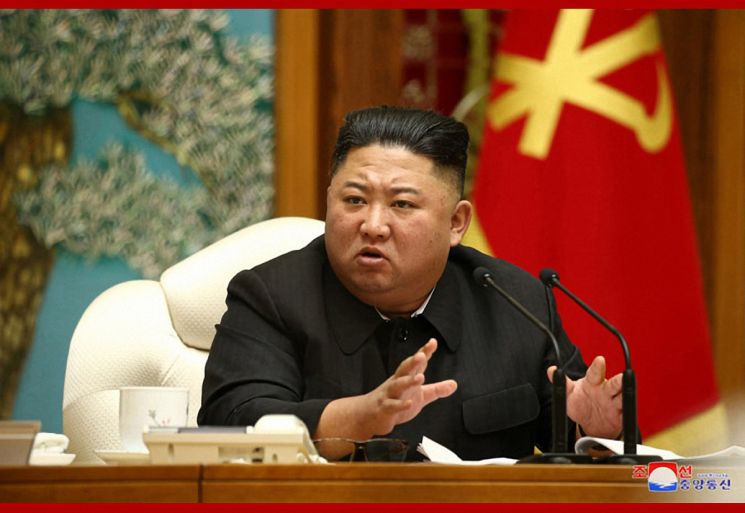
On the same day, North Korea harshly criticized the joint U.S.-South Korea exercises through state media. The Workers' Party organ Rodong Sinmun stated, "Voices continuously resound, showing the absolute power of Heroic Korea, forged a thousandfold over generations against our arch-enemies, and the taste of invincible self-defense," threatening, "We will never forgive the enemies and will mercilessly punish them."
Considering that North Korea has mainly engaged in anti-U.S. and anti-South Korea propaganda through external propaganda media, the explicit criticism broadcast through state media accessible to all citizens is unusual. This is interpreted as evidence that the North Korean leadership feels significant pressure from the joint U.S.-South Korea exercises.
Regarding the tactical nuclear warheads unveiled the previous day, North Korea also boasted, "Our people embraced them with great excitement," and "The path we have taken to strengthen our self-defensive military power was absolutely right a million times over," suggesting that this hostile rhetoric aims to foster internal unity by emphasizing external threats.
The U.S. and South Korea conducted the 'Freedom Shield (FS)' joint exercise from the 13th to the 23rd, and since the 20th, have been conducting the large-scale amphibious exercise 'Ssangryong Training.' Additionally, the U.S. nuclear-powered aircraft carrier USS Nimitz entered the Busan operational base the day before. Furthermore, after successfully completing the amphibious assault on this day, the South Korean and U.S. Marine Corps plan to conclude the training by the 3rd of next month, focusing on tasks to improve combat power integration and interoperability.
© The Asia Business Daily(www.asiae.co.kr). All rights reserved.



















