'Dictator' or 'Father of the Nation'... Conflicting Evaluations of Rhee Syngman
Yoon Seems to End the Founding Day Controversy
Lee Memorial Hall Construction... Sparks Debate Over 'Founding President' Title
Recently, the Ministry of Patriots and Veterans Affairs announced plans to build the 'President Rhee Syngman Memorial Hall,' sparking signs of a renewed 'Foundation Day debate.'
The construction of the 'President Rhee Syngman Memorial Hall' aims to reassess former President Rhee Syngman, known as the 'Father of the Nation.' On the 26th of last month, Park Min-sik, head of the Ministry of Patriots and Veterans Affairs, emphasized Rhee's contributions at the '148th Anniversary Celebration of Dr. Rhee Syngman's Birth,' held at Ewha Jang in Jongno-gu, Seoul, organized by the Rhee Syngman Founding President Memorial Association.
He stated, "The founding president was branded a historical villain and suffered in obscurity for a long time," adding, "It is time to honestly and calmly reexamine the achievements of founding president Rhee Syngman, regardless of political camps."
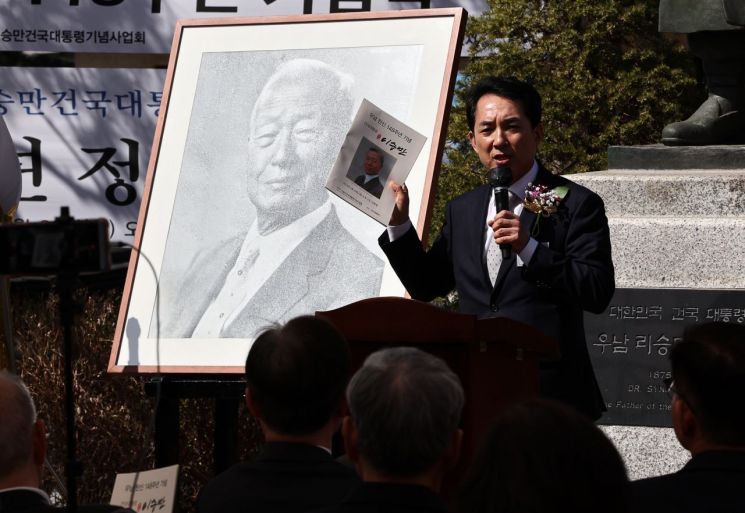 On the afternoon of the 26th, Park Min-sik, the Commissioner of the Ministry of Patriots and Veterans Affairs, delivered a congratulatory speech at the 148th anniversary ceremony of former President Syngman Rhee's birth held at Ihwa-jang, Jongno-gu, Seoul.
 [Image source=Yonhap News]
Former President Rhee's historical legacy is sharply divided between being seen as a 'dictator ousted by the April 19 Revolution' or the 'Father of the Nation.' Due to these conflicting evaluations, voices from the hardline conservative camp argue that even his contributions are undervalued. In reality, it is difficult to find memorial facilities dedicated to him. Currently, what remains are Ewha Jang in Jongno-gu, Seoul, where he lived during his lifetime, and the guesthouses in Hwajinpo, Gangwon, and Jeju where he briefly stayed.
The news of the memorial hall's construction was welcomed by the conservative camp. Hwang Kyo-ahn, former leader of the United Future Party and chairman of the Rhee Syngman Founding President Memorial Association, appeared on CBS Radio's 'Park Jae-hong's One-on-One' on the 28th of last month and said, "(President Rhee Syngman) is the president who established the Republic of Korea," adding, "He created a market economy and laid the foundation for the country's prosperity. More importantly, he played a crucial role in concluding the Korea-US Mutual Defense Treaty, which ultimately led to the Korea-US alliance. He is fully deserving of respect."
Amid the divided evaluations of former President Rhee's achievements, there are also voices opposing the construction of the memorial hall. Former Minister of Justice Choo Mi-ae criticized on Facebook on the 28th, saying, "President Rhee's greatest fault was turning the country into one without wartime operational control, creating a hole in military sovereignty," and added, "President Rhee fled quickly from a country at war without intending to fight and transferred wartime operational control just 20 days after the outbreak of the war."
She continued, "(Our country) is the world's sixth-largest military power but lacks military sovereignty even during wartime," pointing out, "A Korea-US military alliance without wartime operational control is like underwear without elastic bands."
Meanwhile, President Yoon Suk-yeol effectively quelled the Foundation Day debate by recognizing the legitimacy of the Shanghai Provisional Government established on April 11, 1919, in his Liberation Day speech last year. President Yoon defined the independence movement as a struggle to realize liberal democratic values and stated that the founding of the Republic of Korea, industrialization, and democratization are all extensions of the independence movement.
This statement was seen as an attempt to embrace the progressive camp around the value of 'freedom' and resolve the Foundation Day controversy, but by promoting the construction of the memorial hall, it appears to bolster the conservative camp's claim of Rhee Syngman as the founding president.
However, concerns remain that the emphasis on former President Rhee's achievements related to the memorial hall construction could lead to a renewed 'Foundation Day debate.' This is because the progressive and conservative camps have clear differences in their views on the founding date.
Since the 2000s, both camps have repeatedly clashed over the founding date. The progressive camp holds that the root of the nation's founding is April 13, 1919, when the Provisional Government of the Republic of Korea was established, while the conservative camp claims August 15, 1948, the date of the establishment of the Rhee Syngman government, as the founding day. Because the perceived founding date determines which camp holds the legitimacy of the Republic of Korea, it is an inevitably contentious issue.
© The Asia Business Daily(www.asiae.co.kr). All rights reserved.

















