Unending University 'Discipline Culture'
46% of Students Report "Human Rights Violations"
Concerns Over Future Networking and Employment Impact
As social distancing measures have eased, university campus life has returned, but some harmful practices of 'disciplining' between senior and junior students have reemerged. Experts suggest strengthening human rights policies within universities.
"If you’re not going to do department work, just drop out"… Excessive university discipline
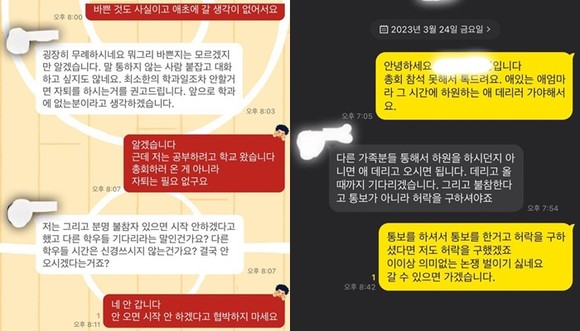 A nursing student from a certain university posted in the department chatroom [Image source=Online Community]
On the 28th, a post exposing the so-called 'strict discipline culture' within a university sparked controversy on an online community. A, who identified themselves as a nursing student at a university in a provincial area, revealed that the student council forced attendance at classroom cleaning, general meetings, and other department events.
In a group chat among university students that A shared, the student council emphasized, "No absences allowed for personal reasons. Since the nursing department shares the space, there are no exceptions for adult learners, returning students, or transfer students."
A claimed, "Suddenly, we were ordered to clean a dusty, unused classroom on a floor that hasn’t been used for years," adding, "Those who didn’t participate in cleaning were threatened with having their names reported to professors, resulting in disadvantages."
In some cases, students with children were pressured with statements like, "Have your child picked up by another family member, or bring the child with you." When students explained personal difficulties in attending, they were verbally abused with remarks such as, "If you’re not going to do department work, we recommend you drop out."
"Concerns over negative impact on connections and employment"?The never-ending vicious cycle
 In 2019, a report emerged that a senior at a university in Chungbuk gave 'eolcharyeo' disciplinary training to juniors, sparking controversy. [Image source=Online Community]
Controversies over discipline culture in universities are not new. In August last year, students at a private university in Chungnam gathered juniors to perform physical punishment called 'eolcharyeo.' In 2019, a report surfaced from a university in Chungju, Chungbuk, about a harmful practice where freshmen were prohibited from wearing wireless earphones.
During the COVID-19 pandemic, when social distancing was strengthened and university classes shifted to online lectures, this discipline culture somewhat subsided. However, as face-to-face lectures resumed and campus life returned, these harmful practices resurfaced.
Discipline culture was widespread even before COVID-19. According to a 2020 study by the Korea Institute of Criminology titled 'Research on the Actual Conditions and Improvement Measures of Violence and Human Rights Violations in Universities,' a survey of 1,902 undergraduate and graduate students found that 46.4% of respondents had experienced human rights violations at least once in university.
The main types of violations included ▲forced participation in events and social gatherings, ▲interference or restrictions in seminars, academic exchanges, or small group activities, and ▲forced unwanted drinking.
Why does the discipline culture persist without being eradicated? Victims responded that "the most important factor is the culture where negative impacts on personal connections and rumors can affect future employment and academic careers." This means they fear being ostracized within their department or suffering damage to their university activities and academic performance.
"University human rights centers still insufficient… Need for budget and scale improvements"
Experts emphasize the need to enhance efforts to operate human rights centers within universities. Currently, domestic universities are evaluated as lacking the capacity to investigate incidents of human rights violations and provide relief to victims.
In a report titled 'Research on the Operation Status and Improvement Measures of University Human Rights Centers,' the National Human Rights Commission stated, "Many human rights centers established within universities currently fall short of meeting basic requirements as human rights organizations, such as legal basis, independence, guaranteed accessibility, clear jurisdiction, operational efficiency, and accountability," adding, "To restore the fundamental functions of university human rights centers, improvements in basic working conditions and institutional operations are necessary, including organizational scale, budget support, and securing stable status for members."
© The Asia Business Daily(www.asiae.co.kr). All rights reserved.


















