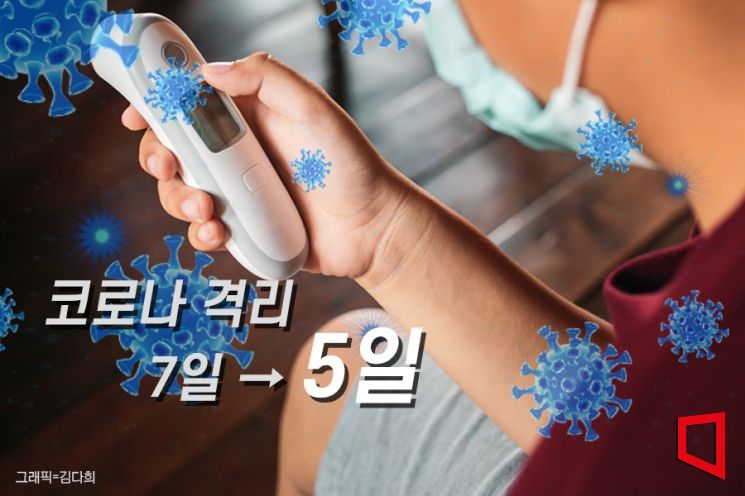
In early May, the mandatory isolation period for COVID-19 confirmed cases is expected to be shortened from 7 days to 5 days. On the 29th, the Korea Disease Control and Prevention Agency (KDCA) announced a "COVID-19 Crisis Level Adjustment Roadmap" at the Central Disaster and Safety Countermeasures Headquarters meeting chaired by Prime Minister Han Duck-soo, outlining a plan to fully return to normal life in three stages.
The specific timing for entering Stage 1, which shortens the isolation obligation, will be decided after holding a crisis assessment meeting considering the 15th International Health Regulations Emergency Committee of the World Health Organization (WHO) scheduled for early May and the U.S. lifting its state of emergency on May 11. Regarding the maintenance of isolation as a mandatory measure rather than a recommendation, an official from the quarantine authorities explained, "Since protection of residents in infection-vulnerable facilities and high-risk groups for COVID-19 remains necessary, the majority opinion was that isolation of confirmed cases is still needed for the time being." At this time, the COVID-19 crisis level will be downgraded from "Severe" to "Caution." With the transition to Stage 1, daily COVID-19 statistics reporting will switch to a weekly basis, similar to major countries such as the U.S., France, the U.K., and Italy.
However, the indoor mask-wearing mandate will continue in medical institutions, pharmacies, and infection-vulnerable facilities, which are the last remaining places with such requirements. Costs for various supports including COVID-19 testing fees, hospitalization treatment fees, living support payments, paid leave payments, therapeutics, vaccinations, and quarantine supplies will also be maintained as they are currently.
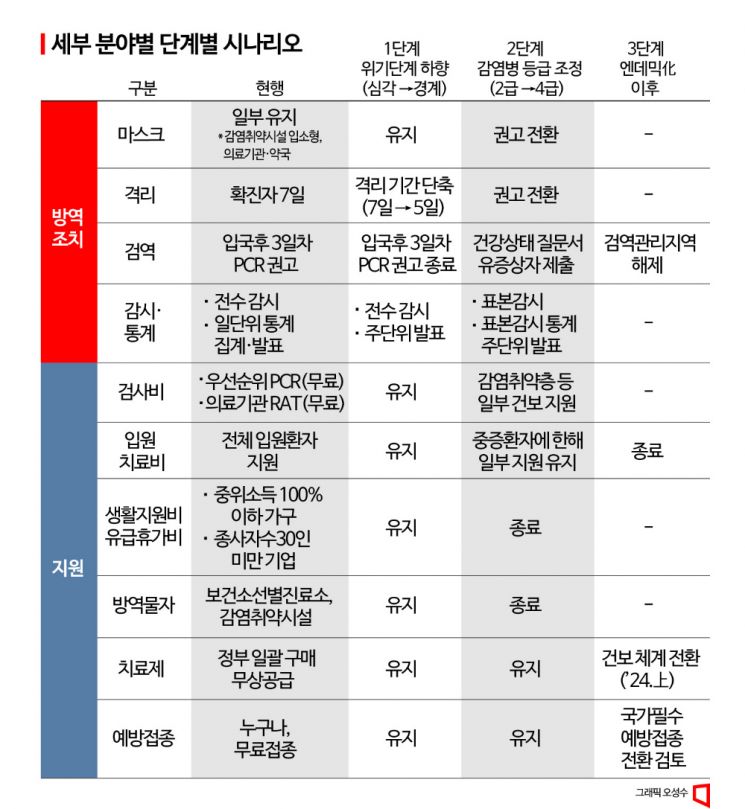
In Stage 2, the current Level 2 classification of COVID-19 as an infectious disease will be adjusted to Level 4, the same as influenza. Indoor mask-wearing and mandatory isolation upon confirmation will be changed to full recommendations. Screening clinics set up outside medical institutions and public health centers will be removed. COVID-19 will be integrated into the general healthcare system, and hospitalization treatment fees will no longer be supported for the general public.
However, the quarantine authorities plan to maintain testing and treatment for infection-vulnerable groups for the time being and partially support hospitalization treatment fees for severe patients. At this stage, various supports such as living support payments (for households below 100% of median income), paid leave support (for companies with fewer than 30 employees), and quarantine supplies will end. A quarantine official said, "Looking at the U.S. and Japan, which prepared for endemic earlier, they allowed 2 to 3 months for the medical community to prepare when transitioning stages and proceeded slowly. Since the variant surveillance system will also change to be like influenza, there is a concern that sensitive responses to outbreak situations may not be possible, so measures to strengthen the surveillance system in advance must be taken."
Stage 3 is the final stage after COVID-19 becomes endemic. The quarantine authorities expect the timing to be around next year. Upon entering this stage, support for hospitalization treatment fees will be completely terminated, and therapeutics that were provided free of charge to high-risk confirmed patients will be transitioned to the health insurance system. This means that patients may incur out-of-pocket expenses for COVID-19 treatment. The COVID-19 vaccination, which has been free for all citizens until now, will be reviewed for transition to the National Immunization Program (NIP). Accordingly, free vaccination may be provided only to certain age groups, while others may have to pay around 30,000 to 40,000 KRW, similar to influenza vaccinations.
The quarantine authorities stated that after lowering the crisis level, if there is a larger scale of infection spread than last summer's outbreak, previously lifted quarantine measures could be reintroduced. For example, indoor mask-wearing could be reinstated in some facilities, or screening clinics could be increased in response to a surge in COVID-19 testing demand. Vaccination and therapeutic administration for high-risk groups could also be actively recommended, as was done during last winter's outbreak.
© The Asia Business Daily(www.asiae.co.kr). All rights reserved.
![Clutching a Stolen Dior Bag, Saying "I Hate Being Poor but Real"... The Grotesque Con of a "Human Knockoff" [Slate]](https://cwcontent.asiae.co.kr/asiaresize/183/2026021902243444107_1771435474.jpg)












