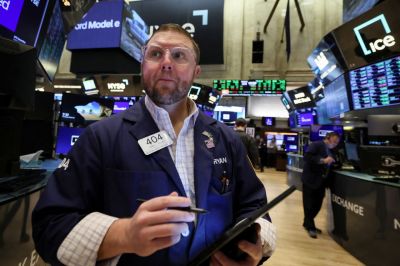
Major indices on the U.S. New York stock market showed mixed trends near the opening on the 28th (local time), as concerns over the banking sector crisis somewhat eased, while pressure from rising Treasury yields persisted.
As of 10 a.m. at the New York Stock Exchange (NYSE), the Dow Jones Industrial Average was up 30.49 points (0.09%) from the previous close, trading around the 32,462 level. Meanwhile, the large-cap-focused S&P 500 index fell 10.69 points (0.27%) to around 3,966, and the tech-heavy Nasdaq index dropped 83.99 points (0.71%) to about 11,684.
Currently, within the S&P 500, sectors sensitive to interest rates such as technology, telecommunications, and consumer discretionary are declining, while the other eight sectors including energy and financials are showing gains. First Republic Bank, identified as the 'second Silicon Valley Bank (SVB),' continued its upward trend following gains the previous day. The SPDR S&P Regional Banking ETF was trading up about 0.5%.
China's Alibaba rose about 9% following an announcement of a corporate restructuring to split into six business groups. Each of the six independent groups will operate under a CEO and pursue independent financing and initial public offerings (IPOs). Lyft gained about 5% after announcing that co-founders CEO Logan Green and President John Zimmer will step down from day-to-day management. Walgreens Boots Alliance rose about 3% on better-than-expected earnings.
On the other hand, interest rate-sensitive tech stocks showed weakness. Alphabet (Google) fell about 2%, Meta dropped around 1.9%, and Nvidia and AMD continued declines in the 2-3% range. Tesla slipped more than 1% after news emerged that U.S. transportation authorities have launched an investigation into a defect causing seat belts to loosen.
Investors are closely watching Treasury yield movements while awaiting the start of congressional hearings on the SVB-related banking crisis in both the U.S. House and Senate, speeches by Federal Reserve officials this week, and key economic data releases including the Personal Consumption Expenditures (PCE) price index. Economic media outlet CNBC reported, "With the two-year Treasury yield rising above 4%, investors are focusing on fears that higher rates could push the economy into recession."
Treasury yields in the New York bond market are on the rise. The two-year Treasury yield, sensitive to monetary policy, is trading around 4.03%, while the 10-year yield stands near 3.56%.
This week, numerous events expected to impact market volatility are scheduled. The Senate Banking Committee and the House Financial Services Committee will hold back-to-back hearings over two days starting today on the banking crisis that spread following the recent SVB collapse. Michael Barr, Vice Chair for Supervision at the Fed, is expected to testify. Other Fed officials scheduled to speak this week include Governors Philip Jefferson, Lisa Cook, Christopher Waller, New York Fed President John Williams, Boston Fed President Susan Collins, and Richmond Fed President Thomas Barkin.
Economic indicators such as the Fed's preferred inflation gauge, the February Personal Consumption Expenditures (PCE) price index, and the finalized U.S. fourth-quarter GDP growth rate will also be released. The PCE price index is estimated to have risen 4.7% year-over-year and 0.4% month-over-month. The finalized fourth-quarter GDP growth figure is critical, as it may be revised downward from the preliminary 2.9% annualized rate released in January and the 2.7% revised figure published last month.
The market is currently divided between expectations of a rate hold and a baby step (0.25 percentage point rate hike). According to the Chicago Mercantile Exchange (CME) FedWatch tool, as of this morning, federal funds futures reflect a 50.8% probability that the Fed will hold rates steady at the May FOMC meeting, while the probability of a baby step hike stands at 49.2%.
J.P. Morgan strategist Hugh Johnson said, "The market's expectation of a hold is correct," but added that a rate cut within the year would require a significant economic shock, making it unlikely. BlackRock Investment Institute's Chief Strategist Wei Li forecasted, "There will be no rate cuts this year."
U.S. housing prices for January, released today, declined from the previous month as the housing market slowed due to rising mortgage rates. The S&P CoreLogic Case-Shiller Home Price Index fell 0.2% month-over-month, marking the seventh consecutive month of decline. On a year-over-year basis, prices rose 3.8%.
European stock markets are showing gains. The UK's FTSE index is up about 0.2% from the previous close. Germany's DAX index rose 0.05%, and France's CAC index increased 0.04%, all trading near flat levels. In the French market, bank stocks are seeing declines following news that French prosecutors have conducted raids on five banks including BNP Paribas.
© The Asia Business Daily(www.asiae.co.kr). All rights reserved.

















