Government Expresses Concerns Over Grain Act Side Effects at Cabinet Meeting
Ministry of Agriculture and Food: "Costs 1.4 Trillion Won by 2030"
Factors Hindering Crop Diversification
Ministry of Economy and Finance: "Budget Size Large Compared to Agricultural Output"
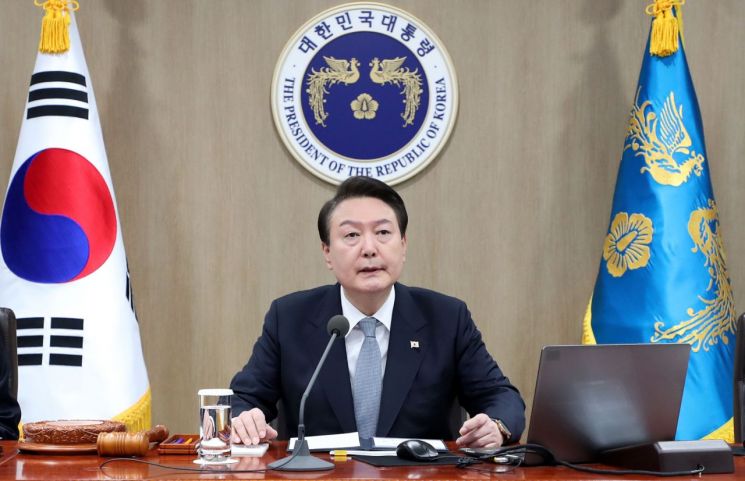
President Yoon Suk-yeol reiterated on the 28th that after receiving a government report expressing concerns about side effects related to the amendment of the Grain Management Act, he would "make a decision after thorough consideration through collecting opinions via various channels, including party-government consultations."
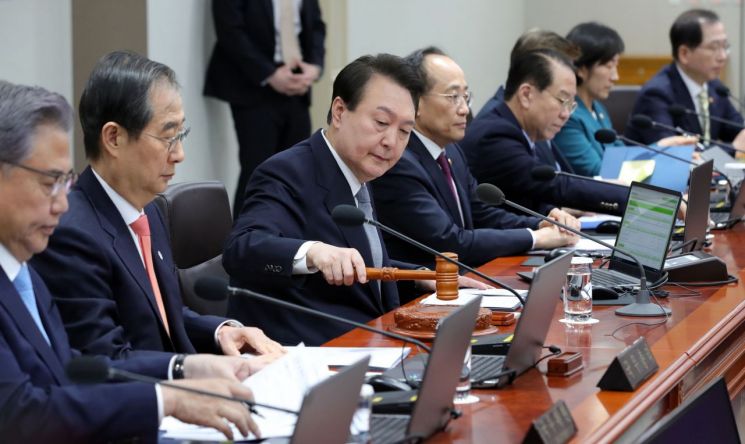
At the Cabinet meeting that day, regarding the report on the amendment of the Grain Management Act by Deputy Prime Minister and Minister of Economy and Finance Choo Kyung-ho and Minister of Agriculture, Food and Rural Affairs Jeong Hwang-geun, President Yoon said, "I respect the opinions of the Cabinet members," according to Lee Do-woon, spokesperson for the presidential office, during a briefing at the Yongsan Presidential Office.
Minister Jeong, the minister in charge of the Grain Management Act, reported, "If this bill is implemented, the already chronic oversupply of rice production will worsen, reaching an excess production of 630,000 tons by 2030, requiring a massive government expenditure of 1.4 trillion won to purchase it. There are serious concerns about side effects that could hinder agricultural development, such as rice price decline, threats to food security, and fairness controversies with other crops. It is necessary to discuss this again in the National Assembly."
According to the Ministry of Agriculture, Food and Rural Affairs, the 1.4 trillion won to be spent on government grain purchases in 2030 is a budget that could build more than 300 smart farms of 1 hectare (about 3,000 pyeong) each, and it exceeds the budget for research and development (R&D) in the agriculture and food sector.
Furthermore, the ministry stated, "To fundamentally achieve rice supply-demand balance, we are promoting a reduction in rice production, which is decreasing in consumption, through the strategic crop direct payment system and activation of the rice flour industry, while expanding production of wheat, soybeans, and rice flour, which are important for food security. However, if the bill is implemented, it will make it difficult for rice farmers to switch to other crops, making it hard to achieve the results of the government's supply-demand stabilization policies," predicting negative outcomes.
Minister Jeong also added, "As of this morning, 33 farmers' organizations have issued statements opposing the bill. Major agricultural organizations have also expressed strong regret and opposition, requesting reconsideration due to concerns about the bill's side effects, yet the bill was passed unilaterally without reflecting these opinions."
Deputy Prime Minister Choo also pointed out, "If the Grain Management Act amendment is implemented, rice accounts for 16.9% of agricultural production value, but the rice-related budget will be disproportionately and unbalanced, exceeding 30%."
Deputy Prime Minister Choo explained that the government has been focusing financial investment on transforming the rice-centered agricultural structure through support for non-rice crop cultivation (68.9 billion won annually from 2018 to 2020), introduction of the strategic crop direct payment system (112.1 billion won in 2023), and expansion of smart agriculture investment, and that the implementation of the Grain Management Act amendment would nullify these efforts.
Choo emphasized, "Currently, the government’s grain purchase price is 2,677 won per kilogram, but after three years of storage, when sold for ethanol production, it is only 400 won per kilogram, causing a significant financial loss. Over the past decade, per capita rice consumption has decreased from 69.8 kg in 2012 to 56.7 kg last year. With mandatory purchases, the market value of stored grain will continue to decline, leading to wasteful fiscal expenditure," stressing the need for reconsideration by the National Assembly.
Despite the reports from Cabinet members, President Yoon is interpreted to have reiterated his intention to carefully consider the amendment, as the reform of the working hours system allowing up to 69 hours per week has faced strong public backlash, and the Grain Management Act amendment is also expected to cause repercussions.
In his closing remarks at the Cabinet meeting that day, President Yoon said, "Although our party (People Power Party) has been the ruling party since last year, party-government consultations have not been properly conducted," emphasizing the importance of such consultations, according to the spokesperson.
He continued, "The President said that all policies need to be viewed from the perspective of the MZ generation and youth, as the MZ generation leads public opinion not only for their own generation but for all generations," adding, "especially, if a specific direction is set and pushed through during the opinion-gathering process, it will backfire. The party and government should discuss several proposals from a zero-based perspective; it would be problematic if the answer is predetermined."
Earlier, on the 26th, the presidential office stated regarding the exercise of the veto power on the Grain Management Act amendment, "We will listen carefully to the positions of farmers and those affiliated with organizations and make a comprehensive judgment."
© The Asia Business Daily(www.asiae.co.kr). All rights reserved.
![Clutching a Stolen Dior Bag, Saying "I Hate Being Poor but Real"... The Grotesque Con of a "Human Knockoff" [Slate]](https://cwcontent.asiae.co.kr/asiaresize/183/2026021902243444107_1771435474.jpg)

















