"Boosting Stock Price through Performance Maximization and Shareholder Returns"
Yu Young-sang, CEO of SK Telecom, stated that the expansion of 5G mid-tier plans will not necessarily be detrimental to the company's performance.
At the 39th shareholders' meeting held on the 28th at the T Tower headquarters in Euljiro, Seoul, CEO Yu said, "From experience, when prices go down, demand tends to increase, so I don't think the diversification of 5G mid-tier plans will be unilaterally unfavorable to our performance," adding, "We will have to observe various situations going forward to know for sure."
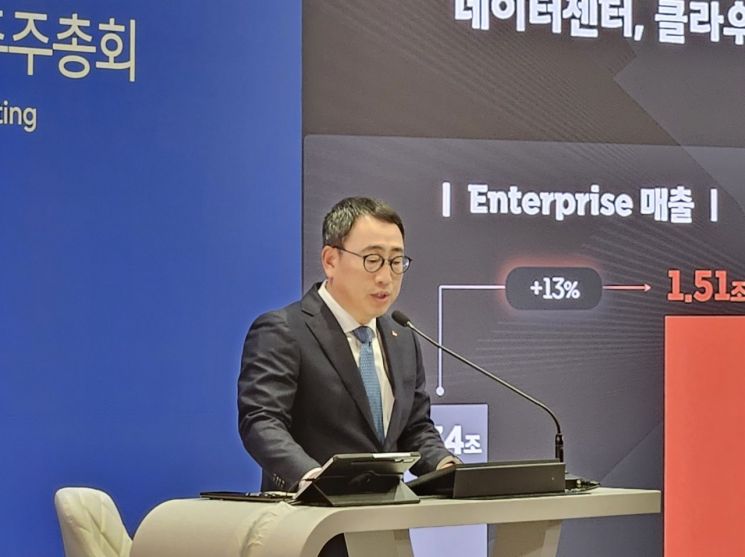 Yu Young-sang, CEO of SK Telecom, is presenting last year's performance at the 39th General Meeting of Shareholders held on the 28th at the T Tower headquarters in Euljiro, Seoul.
 [Photo by Oh Su-yeon]
Earlier, on the 23rd, SK Telecom announced that it will launch a '5G Customized Plan' on May 1, which allows customers to combine any of four additional data options with the existing 5G mid-tier plan (Basic Plus) according to their preferences.
CEO Yu said, "There are complaints that the 5G plans are expensive, but there are also complaints about the lack of variety, so we focused on diversification rather than just lowering prices," adding, "From that perspective, I believe customer needs will be met to some extent. There will also be some effect of price reduction." He also added, "I think the government’s regulation has been appropriately addressed in terms of the pricing plans."
In response to a shareholder’s question about measures to boost SK Telecom’s stock price amid its weakness, CEO Yu said, "Looking back at last year, the first year after the corporate split, operating profit grew double digits, and although contributions from data centers and cloud businesses were smaller compared to telecommunications, we steadily nurtured businesses that show results. Unfortunately, these achievements have not been reflected in the stock price," citing global macroeconomic instability and significant corrections in global stock markets as the causes. He continued, "We are considering ways to maximize business performance and, on the other hand, actively implement shareholder return policies to support the stock price."
Regarding competition strategies with major AI companies amid the spotlight on ChatGPT, he stated that SK Telecom will utilize AI across all business areas to innovate business models, collaborate with global telecom companies to jointly develop AI services on a global scale, and pursue market leadership and technology internalization by partnering with global AI companies such as OpenAI while simultaneously developing proprietary technologies.
When asked about the global expansion plans for the AI assistant service A. (A-dot), CEO Yu said, "A-dot’s global expansion faces different cultural barriers compared to the metaverse platform ifland," adding, "We are thinking of creating a global common platform by forming alliances with global telecom companies and combining various technologies and services such as ChatGPT, then providing services tailored to each local environment."
Regarding the direction of the robotics business, he replied, "We are focusing on collaborative robot businesses. For example, in logistics centers, robots combined with SK Telecom’s vision AI perform transportation tasks that humans used to do," adding, "It is a field we can excel in and has business potential, so we will continue to pay attention and proceed accordingly."
On SK Telecom’s role in the Urban Air Mobility (UAM) consortium, he explained, "We clearly intend to become an operator in the domestic UAM market," elaborating, "Just as in the telecommunications business where a mobile operator builds the network, purchases devices, sells them to customers, and collects fees, we plan to acquire the business rights, operate the entire service, introduce aircraft, and collect fees in a similar structure." Regarding business direction, he said, "Korea is likely to adopt UAM very quickly. We are thinking more about tourism than urban areas," citing examples such as Jeju Island UAM tourism modeled after helicopter tours in Hawaii.
© The Asia Business Daily(www.asiae.co.kr). All rights reserved.

















