Exceptional Benefits for Hyundai Motor Production Workers
'Hope' for Small and Medium Manufacturing Industry Employees
400 positions to be filled. Approximately 300,000 views on the recruitment announcement website.
This is the popularity of the recently closed application period for Hyundai Motor Group's technical (production) positions. The frenzy extended beyond manufacturing workers to office workers and even public officials submitting their resumes.
Hyundai Motor, the largest completed car manufacturer in Korea, offers exceptional welfare benefits for production workers. Retirement age is guaranteed, and retirees can continue working as contract employees. For job seekers and workers at small and medium-sized manufacturing companies, it is seen as a 'life-changing opportunity.'
Submitting Applications Despite No Chance... 'Hope for Production Workers'
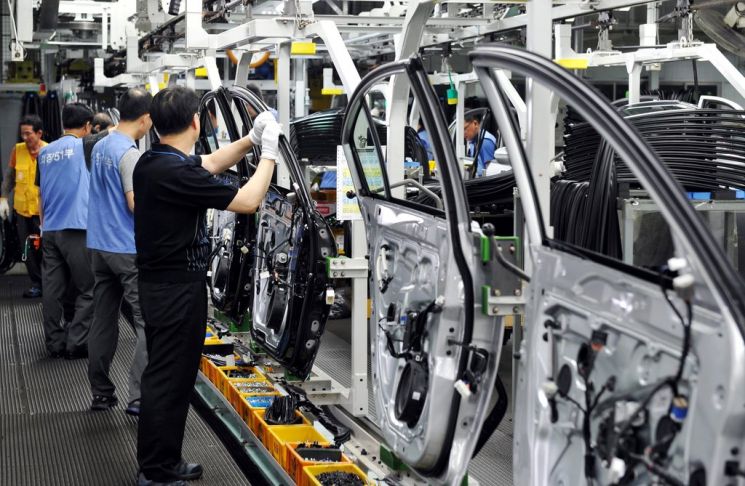 Workers are operating on the automobile production line at Hyundai Motor Company's Ulsan plant. [Image source=Yonhap News]
How did Hyundai Motor's production positions become the 'last hope' for hundreds of thousands of Korean workers? It is evaluated as a reflection of the social perception that joining a large corporation is the only escape for workers suffering from poor working conditions in small and medium-sized enterprises.
Recently, a video titled "A 40-something Factory Worker Who Applied for Hyundai Motor Production Position with Zero Chance" was uploaded on YouTube. The creator of the video is Mr. A, in his 40s, who has worked for over 10 years at a mold manufacturing company. He described Hyundai Motor's recruitment announcement as the industry's 'big event' and said, "Almost no one around me was unaware of this."
Mr. A said he applied to Hyundai Motor without much expectation because competition for large corporation jobs is extremely fierce. His stance is, "But (from a production worker's perspective) you just can't not apply." For domestic production workers who endure up to 12-hour shifts per day and years of frozen wages, the possibility of joining a large corporation is the only consolation.
Mr. A's candid confession resonated with many netizens. The video surpassed 500,000 views in just a few days. Comments included, "I work in production, but our industry is really tough," "I hope you get to wear Hyundai Motor's work uniform," and "I also submitted my application. Let's meet at the factory after joining."
Practically Frozen Wages for Four Years... Polarization in Domestic Manufacturing
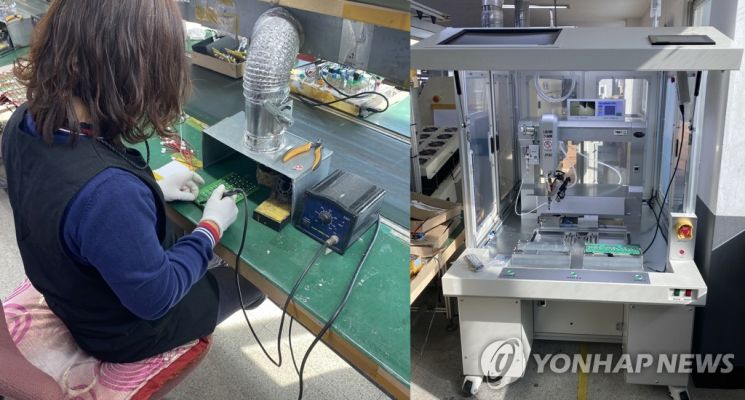 The root industry refers to casting, mold, plastic working, welding, surface treatment, heat treatment, and so on.
 [Image source=Yonhap News]
Hyundai Motor's treatment of production workers is exceptional even by large corporation standards. As of 2021, the average annual salary is 96 million KRW, retirement age is guaranteed at 60, and contract work for one year after retirement is possible. Lifetime discounts apply when purchasing Hyundai Motor products (up to 30% during employment, 25% after retirement), and shifts are two-shift day and night without overnight work. On various employment-related online communities, it is even nicknamed 'King Production' (King + Production).
However, such welfare benefits are a dream for most production workers in Korea, except for some large corporations. Ninety-nine percent of Korean companies are small and medium-sized enterprises, and their workers account for 83% of the total workforce (Statistics Korea, 2019). Small and medium manufacturing companies are concentrated in certain fields known as 'root industries,' including casting, mold making, plastic processing, welding, surface treatment, and heat treatment.
Root industries are not sectors that manufacture finished products for export like Hyundai Motor, Samsung Electronics, or LG. They belong to the 'supply chain' that produces parts required by large corporations. As a result, their performance depends on the business conditions of export companies, and heavy workloads and overtime to meet delivery deadlines are mandatory. The gap between peak and off-peak seasons is severe, and workers must endure lean periods without orders.
According to the 'Root Industry Status Survey Report' published by Statistics Korea, about 720,000 people worked in root industries last year. The average monthly salary was 2.9 million KRW, a 12.8% increase from 2.57 million KRW four years ago, but compared to the wage growth of large corporation workers during the same period, the relative sense of deprivation has intensified. Considering the inflation surge over the past two years, real wages are close to frozen.
Because of this, the annual average turnover rate is quite high at 8% (about 57,000 people). Especially labor workers mainly engaged in production (13.2%) and skilled workers (10.1%) leave to find other jobs. This is why the chronic manpower supply problem in the root industry sector is worsening.
Decreasing Large Corporation Production Jobs... This May Be the Last Chance
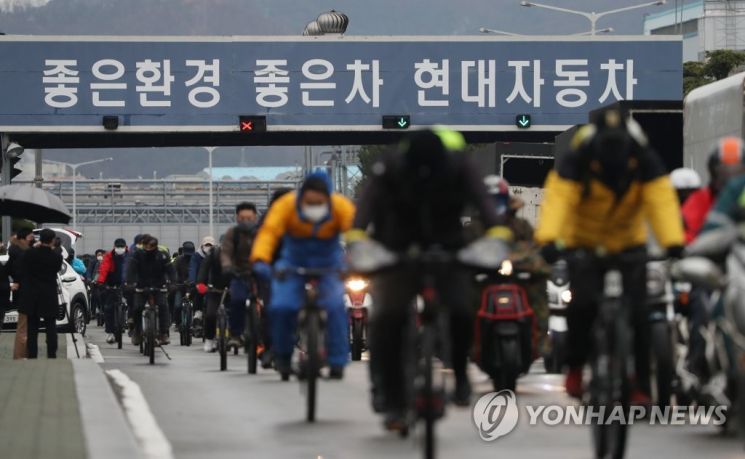
The anxiety that this may be the 'last chance' to join a large corporation in the completed car industry is also fueling the popularity of Hyundai Motor's production positions. Currently, Hyundai Motor is in a transitional period shifting from internal combustion engine vehicles to eco-friendly vehicles such as electric cars.
Compared to the complex internal combustion engine vehicles requiring numerous parts, electric vehicles have a relatively simple structure, making automation easier. This means Hyundai Motor's demand for production workers may decrease further.
This Hyundai Motor production recruitment is the first in 10 years. Previously, Kia Motors also hired 138 production workers last year, attracting 49,432 applicants and recording a competition rate of 360 to 1.
As competition intensifies for large corporation production jobs, the entry barriers for recruitment tests are also rising. Hyundai Motor plans to conduct various tests including first and second interviews, aptitude tests, and written exams for this recruitment.
© The Asia Business Daily(www.asiae.co.kr). All rights reserved.



















