Korean and Math, Common + Elective Subjects Without Division Between Humanities and Sciences
Choose 2 Subjects from 17 Inquiry Subjects Without Division by Field
The College Scholastic Ability Test (CSAT) will be held on November 16 this year.
The Ministry of Education and the Korea Institute for Curriculum and Evaluation announced the basic plan for the 2024 CSAT on the 28th.
This year’s CSAT will maintain the 'common + elective subjects' system in the Korean, Mathematics, and Vocational Inquiry sections, aligned with the 2015 revised curriculum, just like last year. Students can choose 2 subjects out of 17 social and science inquiry subjects.
CSAT registration will be open from August 24 to September 8, and applicants can register at their current high school, their alma mater, or a location designated by the superintendent of education of their jurisdiction. The period for objections to questions and answers is from November 16 to 20. The official answer announcement will be on November 28, and the score notification date is December 8.
An official objection system for questions and answers will be operated, and detailed application periods, procedures, and methods will be announced with the implementation plan on July 3.
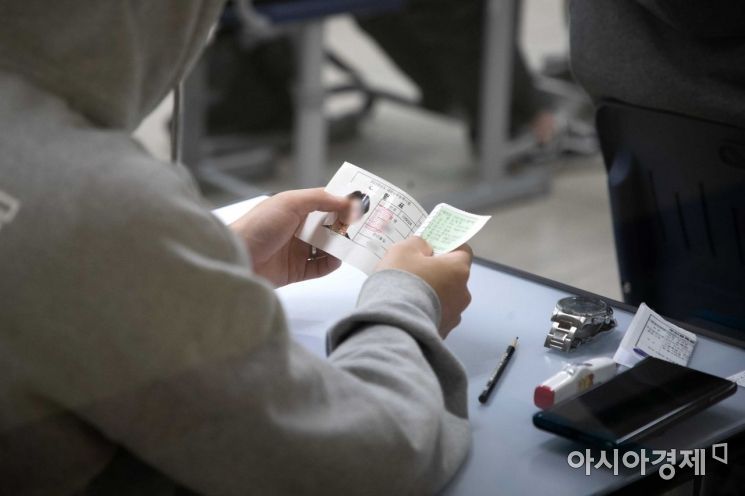 On the morning of the 17th, when the 2023 College Scholastic Ability Test was held, examinees were waiting for the exam to start at the test site set up at Gyeongbok High School in Seoul. Photo by Joint Press Corps
This year’s CSAT will feature questions of appropriate difficulty so that students who have faithfully received school education and supplemented it with EBS-linked textbooks and lectures can solve the problems. Additionally, questions will be set according to the content and level of the 2015 revised curriculum across all areas and subjects, and after the CSAT, educational curriculum-based achievement criteria for each question will be disclosed.
The linkage rate between EBS CSAT textbooks and lectures and the CSAT questions will be maintained at around 50%. However, the plan is to increase the perceived linkage by focusing on concepts and principles that are important in the curriculum.
As in previous years, Korean will have 'Reading and Literature' as common subjects, and students can choose one from the elective subjects (Speech and Writing, Language and Media). Mathematics will have 'Mathematics I and Mathematics II' as common subjects, and students will choose one from Probability and Statistics, Calculus, or Geometry to take the exam. In English, out of a total of 45 questions, 17 are listening comprehension questions, which will be conducted within 25 minutes.
For inquiry subjects, students can choose 2 subjects from 17 social and science subjects without distinction between the two fields. In the vocational inquiry section, students can select 2 subjects out of 6, taking the common subject ‘Successful Career Life’ and one elective subject from 5 subjects by field. Even if the number of elective subjects increases, students must choose subjects required by the universities, departments, or majors they intend to enter.
Also, as in last year, the Korean History section is mandatory, and those who do not take it will have their entire scores invalidated. For the Korean History and Inquiry sections, answer sheets for Korean History and inquiry subjects will be provided separately to examinees.
Meanwhile, the Korea Institute for Curriculum and Evaluation will conduct the June mock test on June 1 and the September mock test on September 6.
© The Asia Business Daily(www.asiae.co.kr). All rights reserved.

















