Federation of Korean Industries Requests Analysis from Kim Yangpaeng, Senior Researcher at Korea Institute for Industrial Economics and Trade
"Attracting Investment, Restoring Government Dialogue Channels, Operating Control Tower"
Korean semiconductor companies are increasing research and development (R&D) and facility investments in Japan and attracting Japanese advanced companies to domestic clusters. They are maintaining dialogue channels between the two countries and operating a control tower for new industries.
This is a proposal included in the report titled "Measures to Promote New Industry Cooperation between Korea and Japan," prepared by Kim Yang-peng, a senior researcher at the Korea Institute for Industrial Economics and Trade, commissioned by the Federation of Korean Industries and released on the 28th.
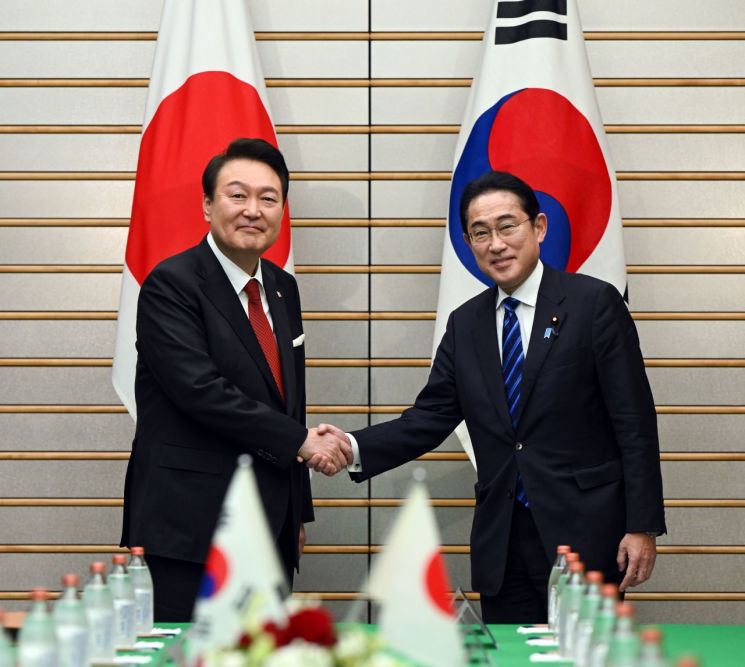 President Yoon Suk-yeol and Japanese Prime Minister Fumio Kishida shaking hands while posing for a commemorative photo before the expanded Korea-Japan summit held at the Prime Minister's Official Residence in Tokyo, Japan, on the afternoon of the 16th.
 [Image source=Yonhap News]
The report diagnosed that both countries must focus on increasing added value in next-generation semiconductors, electric vehicles and batteries, and mobility sectors. Both governments are putting effort into fostering related industries.
In semiconductors, next-generation semiconductors that have evolved beyond existing products in terms of function and materials must be developed ahead of competing countries. It is necessary to advance memory semiconductor functions, fuse memory and non-memory semiconductors, and develop semiconductors made from raw materials other than silicon.
Korea is ahead of Japan in manufacturing technology, while Japan has strong competitiveness in materials and components. The report urged active sharing of Korea’s manufacturing and Japan’s materials and components know-how to jointly develop core technologies. Increasing R&D and facility investments between the two countries is also an important task. The Korea Institute for Industrial Economics and Trade stated, "Since domestic companies such as Samsung Electronics have previously co-developed technologies with Japanese companies like Sony and Toshiba, this is an achievable goal."
In batteries, dependence on core materials and components accounts for 70% of costs. Given Japan’s high level of materials technology, cooperation is expected to be highly effective. The report mentioned last month’s joint groundbreaking of a battery plant in Ohio, USA, by LG Energy Solution and Honda. It is expected that such cooperative projects will become more active if bilateral relations normalize.
In mobility, the demand for new technologies is so high that there will be many opportunities for technological cooperation. There is strong demand for convergence and fusion services that apply ICT (Information and Communication Technology) innovation technologies in the transportation sector. The report suggested that the two countries can create synergy in areas such as autonomous driving, high-definition map (HD map) creation, batteries, MaaS (Mobility as a Service) platforms, and quantum computing technologies.
The problem is politics. Relations between the two countries deteriorated after Japan imposed export restrictions in retaliation for the Korean Supreme Court’s forced labor compensation ruling in 2019. However, since the Korea-Japan summit on the 16th, discussions on lifting export restrictions have begun, showing signs of recovery in bilateral relations.
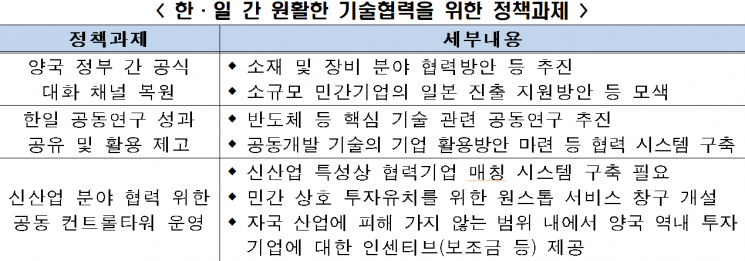
The report emphasized that to properly carry out private sector technological cooperation, trust must be built that "political risks" will not affect economic relations between the two countries. It proposed policy tasks such as restoring official government dialogue channels, enhancing sharing and utilization of Korea-Japan joint research outcomes, and operating a joint control tower in new industry sectors.
Choo Kwang-ho, head of the Economic and Industrial Headquarters at the Federation of Korean Industries, said, "Relations between Korea and Japan weakened considerably after the 2019 freeze," adding, "If the two countries cooperate closely amid rapidly changing external environments such as global supply chain restructuring and climate change, they can secure competitive advantages in new industry sectors."
© The Asia Business Daily(www.asiae.co.kr). All rights reserved.
![From Bar Hostess to Organ Seller to High Society... The Grotesque Con of a "Human Counterfeit" [Slate]](https://cwcontent.asiae.co.kr/asiaresize/183/2026021902243444107_1771435474.jpg)

















