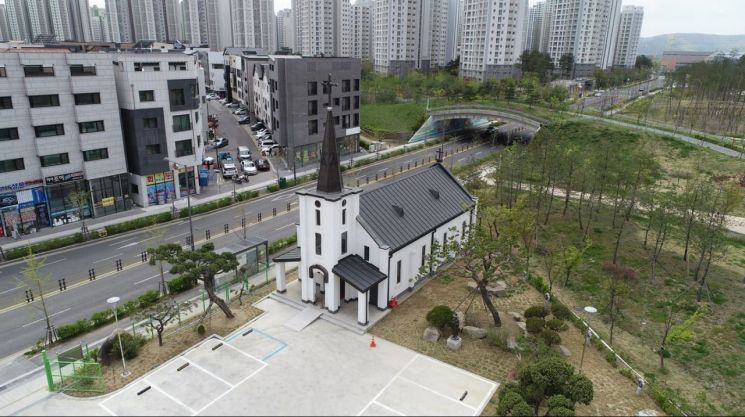
Gyeonggi Province has designated three modern cultural heritage items as Gyeonggi-do Registered Cultural Heritage, including Hanam Gusan Catholic Church, artist Lee Hae-jo's 'Gumagum', and artist Oh Cheon-seok's 'Geumbangul', which contain the lives and traces of the residents.
On the 16th, Gyeonggi Province held the Registered Cultural Heritage Subcommittee of the Gyeonggi Cultural Heritage Committee and announced on the 28th that it had finalized the registration of these three items as Gyeonggi-do Registered Cultural Heritage.
Hanam Gusan Catholic Church was built in 1956 through the voluntary participation and fundraising of local residents and believers. Although it has a simple form, it well reflects the historical and social values shared by the village community during the post-war restoration period and the era of Korean society at that time.
Although it faced demolition due to inclusion in the Hanam Misa Residential District, citizens united their efforts and succeeded in preserving its original form by relocating it 200 meters away while maintaining its original state.
'Gumagum' by Lee Hae-jo, held by the Academy of Korean Studies, is a standalone book published by Daehan Seorim in December 1908. It is a work by Dongnong Lee Hae-jo, one of the pioneers of modern Korean fiction.
Through a composition close to modern creative techniques, it emphasizes the importance of modern education and law, and is evaluated as a modern record that well reveals enlightenment ideas.
'Geumbangul' by Oh Cheon-seok, also held by the Academy of Korean Studies, is the oldest existing translated fairy tale collection. It is the first edition published in August 1921 by Cheonwon Oh Cheon-seok, compiling 10 fairy tales including 'The Little Match Girl' and 13 illustrations, and is highly valued as cultural heritage for the study of modern children's literature, modern language, and translation style.
In particular, the copy held by the Academy of Korean Studies is more rare because, unlike copies held by other institutions, its cover is intact and undamaged.
Hong Seong-deok, head of the Cultural Heritage Division of the province, said, "The cultural heritage registered this time is meaningful as it characteristically shows the regionality of Gyeonggi Province, as traces of the lives of our ancestors who endured turbulent times," adding, "We will strive to discover various fields of modern cultural heritage and widely promote their value."
Meanwhile, unlike traditional cultural heritage managed as national and city/provincial designated cultural heritage, the province has been selecting modern cultural heritage (cultural heritage created over 50 years ago) since 2021 to manage those that have no proper protection method if they fail to be registered as national registered cultural heritage.
© The Asia Business Daily(www.asiae.co.kr). All rights reserved.

















