Agreement with Ulsan, Daegu, and Gwangju Institute of Science and Technology
Establishment of Integrated Bachelor's and Master's Semiconductor Contract Department
490 Graduates Annually from 7 Contract Departments by 2029
Samsung Electronics has established new contract departments to respond to the increasing demand for semiconductor personnel, which is expected to grow to approximately 127,000 over the next decade. The company has signed agreements with three science and technology institutes?Ulsan National Institute of Science and Technology (UNIST), Daegu Gyeongbuk Institute of Science and Technology (DGIST), and Gwangju Institute of Science and Technology (GIST)?to nurture a total of 500 talents over the next five years.
Through this initiative, Samsung Electronics plans to cultivate experts in the process field who will help overcome the limitations of semiconductor miniaturization. The company also expressed expectations that this will contribute to balanced regional development while overcoming the concentration of the semiconductor industry centered in the Seoul metropolitan area.
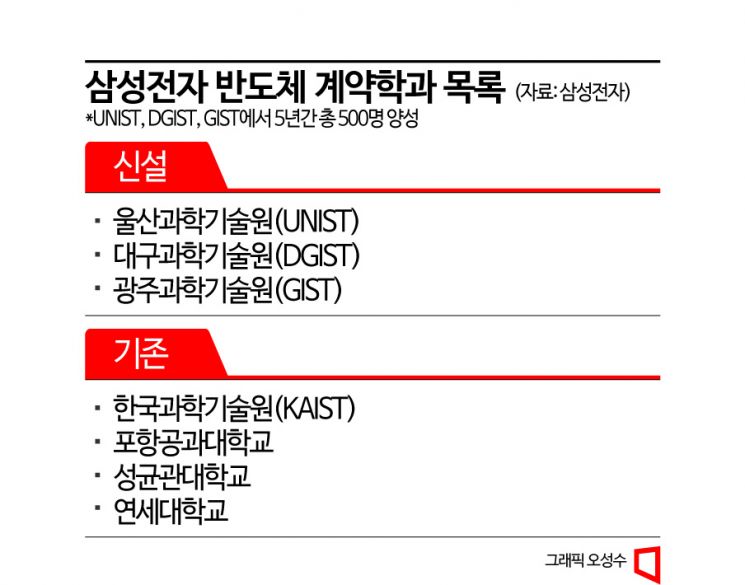
"Cultivating Experts in the Process Field"... Nurturing 100 Talents Annually in Regional Areas
On the 27th, Samsung Electronics signed an agreement to establish semiconductor contract departments with three science and technology institutes located in Ulsan, Daegu, and Gwangju to systematically train semiconductor experts, strengthen the national semiconductor ecosystem, and contribute to balanced regional development.
Samsung Electronics, along with UNIST, DGIST, and GIST, will select new students starting in the second half of this year and officially operate the contract departments from March next year. The number of students selected annually will be 40 at UNIST, 30 at DGIST, and 30 at GIST, totaling 100 students per year. The education period will be five years in total.
The newly established departments will operate as the first integrated bachelor's and master's semiconductor contract department program. As overcoming the limits of semiconductor miniaturization has emerged as an industry challenge, the program will focus on training talents centered on semiconductor process control technology education. Hands-on training such as semiconductor cleanroom practice and interdisciplinary courses will be provided.
Samsung Electronics explained that with the establishment of these contract departments, it has created a system to evenly nurture talents in key semiconductor fields such as design, software, and process. Samsung Electronics Chairman Lee Jae-yong said, "We must grow together with local communities," adding, "Especially in difficult and challenging times, we should prepare for the future more boldly and actively."
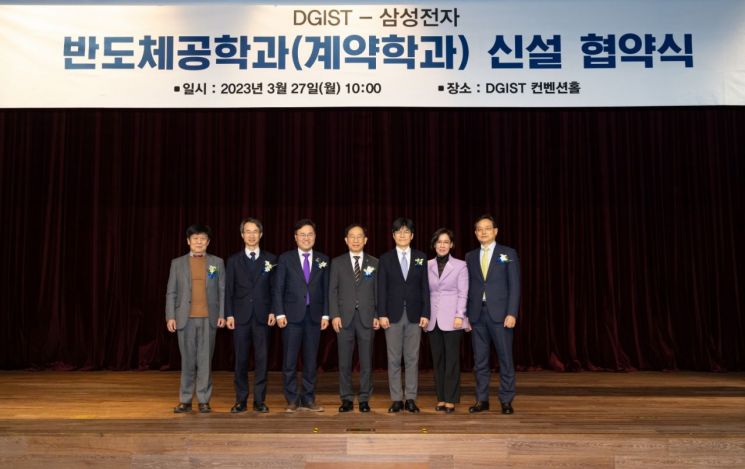 From the left, Kim Chil-min, Vice President of DGIST; Kim Jong-han, Vice Mayor of Daegu Metropolitan City; Hong Seok-jun, Member of the National Assembly; Guk Yang, President of DGIST; Nam Seok-woo, President of Samsung Electronics Manufacturing Division; Lee In-seon, Member of the National Assembly; and Kim Wan-pyo, Head of Win-Win Research at Samsung Global Research, are taking a commemorative photo after the signing ceremony.
 [Photo by Samsung Electronics]
Establishing a Base for Nurturing Non-Metropolitan Talents... "Expectations for Balanced Regional Development"
With the establishment of these contract departments, Samsung Electronics has set up a system for nurturing talents in non-metropolitan areas such as Ulsan, Daegu, and Gwangju. The company explained that this marks an opportunity to build a nationwide semiconductor talent infrastructure. The three science and technology institutes?UNIST, DGIST, and GIST?are expected to serve as "regional semiconductor talent nurturing hubs," cultivating local semiconductor experts and deploying them to advanced industrial sites.
Samsung Electronics believes that these efforts can alleviate the concentration of outstanding talents in the Seoul metropolitan area among domestic and international semiconductor companies. The company also added that this can realize a "virtuous cycle system of talent development and industrial growth," where semiconductor industry ecosystems outside the metropolitan area grow together. In the past, Samsung Electronics has made efforts to secure regional talents, such as maintaining a 35% selection rate of graduates from local universities during new employee recruitment.
Song Jae-hyuk, Chief Technology Officer (CTO) of Samsung Electronics' Device Solutions Division, said, "With the establishment of these contract departments, we have created bases for systematically nurturing semiconductor talents not only in Seoul, Daejeon, and Pohang but also in Daegu, Gwangju, and Ulsan." He added, "This will greatly help continuously securing talents worthy of the status of a semiconductor powerhouse and achieving balanced regional development."
The three science and technology institutes also see the establishment of these contract departments as beneficial for semiconductor talent development and regional growth. Park Rae-gil, Acting President of GIST, said, "We hope the semiconductor contract departments will greatly contribute to the balanced regional development of Korea's semiconductor industry and the cultivation of creative talents."
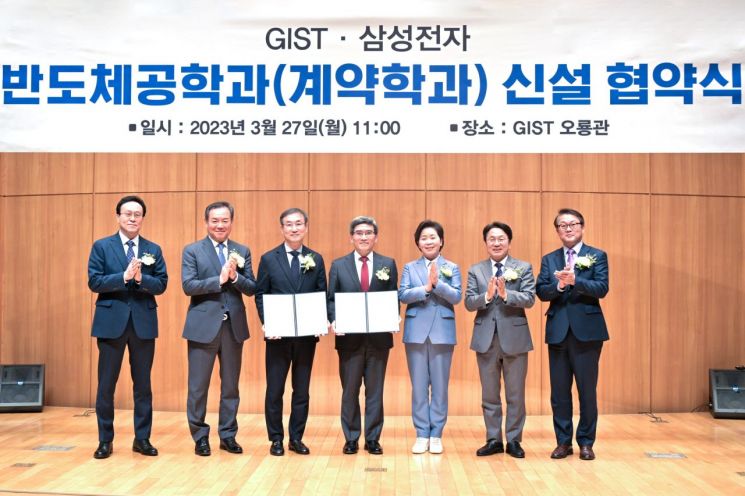 From the left, Jo Jeonghee, Dean of GIST University, Lee Hyeongseok, Member of the National Assembly, Park Raegil, Acting President of GIST, Song Jaehyeok, President and CTO of Samsung Electronics DS Division, Yang Hyangja, Member of the National Assembly, Kang Gijeong, Mayor of Gwangju Metropolitan City, and Park Seunghui, President in charge of Samsung Electronics CR, are taking a commemorative photo after the agreement ceremony. / Photo by Samsung Electronics
"By 2029, a Total of 450 Talents Expected to Graduate from Seven Contract Departments"
Samsung Electronics currently operates four contract departments: Sungkyunkwan University (since 2006), Yonsei University (2021), Korea Advanced Institute of Science and Technology (KAIST, 2022), and Pohang University of Science and Technology (POSTECH, 2023). The company plans to increase the enrollment capacity of some existing contract departments. Including the three newly established contract departments, a total of seven contract departments will be able to graduate 450 talents annually by 2029.
Samsung Electronics provides semiconductor contract department students with internship opportunities at semiconductor industry sites to help them grow into talents equipped with both theoretical and practical capabilities. The company fully covers tuition fees and provides scholarships so that students can focus on their studies. Samsung Electronics employees participate as mentors to support the students' growth. Employment at Samsung Electronics' semiconductor division is guaranteed after graduation.
In addition to semiconductors, Samsung Electronics is accelerating the nurturing of future talents by operating display contract departments. Including industry-academia projects and support for regional national universities, the company invests over 100 billion KRW annually solely in talent development. In fields such as basic science and core technologies, Samsung operates the "Samsung Future Technology Development Program" to support innovative research by domestic emerging researchers.
© The Asia Business Daily(www.asiae.co.kr). All rights reserved.
![Clutching a Stolen Dior Bag, Saying "I Hate Being Poor but Real"... The Grotesque Con of a "Human Knockoff" [Slate]](https://cwcontent.asiae.co.kr/asiaresize/183/2026021902243444107_1771435474.jpg)


















