"Legislation and Budget Bills Not Accompanied by Policies, Emphasis on Close Consultation"
Presidential Office Facing Veto of Grain Act, Deliberates on Nongshim Persuasion
President Yoon Suk-yeol on the 27th instructed to strengthen the consultation between the ruling party and the government as well as the public opinion gathering process regarding policy implementation. This measure was taken in response to criticisms that there was insufficient public opinion collection on various policies, including the recent labor hour reform plan that proposes a maximum of 69 working hours per week. It is interpreted as an intention to establish safeguards during the three major reforms in labor, education, and pensions to achieve early policy acceptance and results.
On the morning of the same day, President Yoon told his aides, "Even policies that do not involve bills or budgets must be closely coordinated between the ruling party and the government," according to Lee Do-woon, spokesperson for the Presidential Office, in a written briefing.
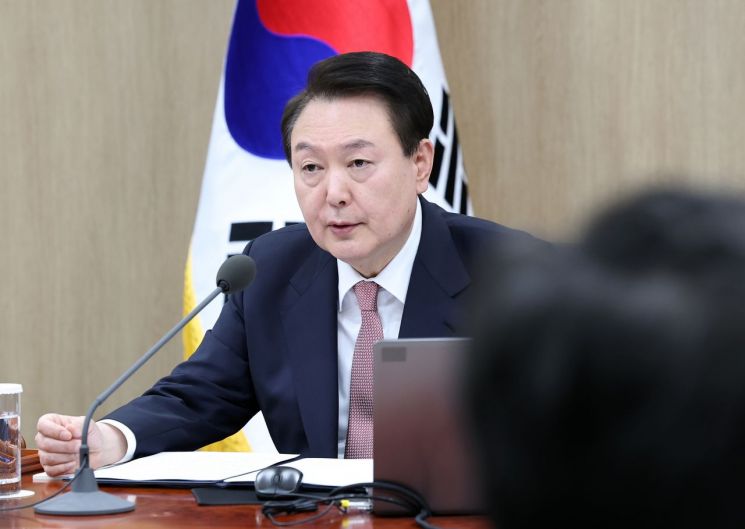
In particular, President Yoon emphasized, "Ensure that public opinion is sufficiently reflected in the process." He ordered active consultation with the ruling party and thorough public opinion gathering throughout the entire policy process, including policy discovery, public opinion collection, and legislation. On the 21st, during a Cabinet meeting, President Yoon also instructed the preparation of a new reform plan based on public opinion procedures and national promotion of state affairs aligned with the public perspective.
It is also interpreted that, with the leadership of the People Power Party now established, it is an opportune time to strengthen cooperation between the party and the government. After the People Power Party’s party convention, party leader Kim Ki-hyun has already proposed regular meetings with President Yoon, and high-level party-government consultations involving key members from the party, government, and the Presidential Office will be held frequently. Additionally, a hotline between Lee Kwan-seop, the Senior Secretary for National Planning who oversees policy at the Presidential Office, and Park Dae-chul, the newly appointed chairman of the People Power Party’s Policy Committee, is expected to be activated soon. Through this, the three major reforms, which are expected to be controversial, will be tackled head-on with minimal friction based on future party-government consultations.
The Presidential Office’s initiation of a full-scale opinion gathering process regarding the Grain Management Act, on which President Yoon is likely to exercise his veto power, is in the same context. With the possibility of President Yoon exercising his veto at the Cabinet meeting as early as next week increasing, the strategy is to follow the prescribed legal procedures while actively responding to public opinion to minimize backlash.
Currently, the Presidential Office is reviewing all petitions submitted by farmers’ organizations to both the Ministry of Agriculture, Food and Rural Affairs and the Presidential Office. A key official from the Presidential Office stated, "The bill amendment is expected to be transferred to the government within this week. Although the process is still ongoing, opinions expressing concerns from various sectors continue to be received. Together with the relevant ministry, we will review all these opinions and explain to the public in a way that enables our farmers to gain competitiveness."
At present, farmers’ organizations are submitting their opinions on the Grain Management Act amendment to the Presidential Office in the form of petitions. These include concerns about President Yoon’s potential veto as well as requests to consider ways for farms to independently build competitiveness. Some groups have submitted opinions stating that even if rice is overproduced, the government’s signal to purchase it would make it difficult to prevent structural oversupply of rice. They also pointed out side effects such as budget reductions in other sectors like livestock and youth farming development.
Another official from the Presidential Office said, "Since there are quite a few opinions from groups that issued statements opposing the ruling party’s unilateral passage of the bill in the National Assembly, we plan to engage in sufficient consultations with the ruling party and government to establish a balanced grain policy from a mid- to long-term perspective so that agricultural policy does not become politicized. We will carefully persuade the public about what measures are necessary to enhance farm competitiveness," he added.
© The Asia Business Daily(www.asiae.co.kr). All rights reserved.

















