Dogs, Goats, and Mongooses Also Found
Presumed to Have Been Used as Sacrifices
About 2,000 ram-headed mummies estimated to be 2,000 years old were excavated at an Egyptian temple.
According to Yonhap News on the 26th (local time), the Egyptian Ministry of Tourism and Antiquities announced that an archaeological excavation team from New York University in the United States discovered at least 2,000 ram-headed mummies at the Temple of Ramesses II in Abydos, located in central Egypt.
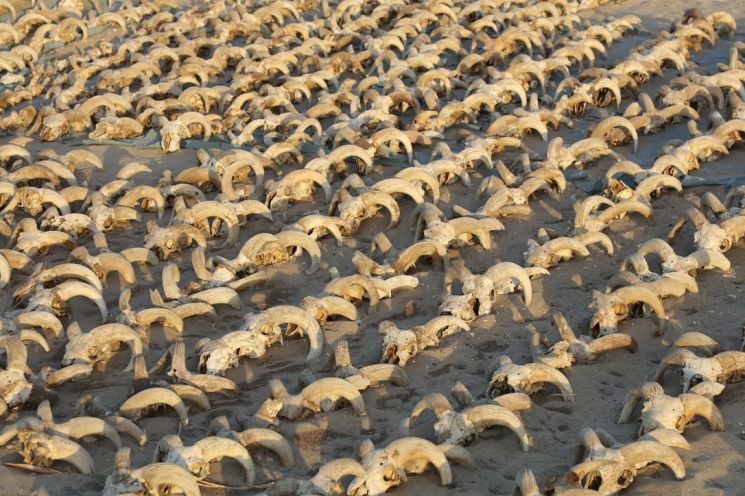 Over 2,000 Ram-headed mummies excavated from the Temple of Ramses II in Egypt [Photo by Reuters·Yonhap News]
Along with the ram heads, mummies of dogs, wild goats, cattle, gazelles, and mongooses were also found at the site. Additionally, large structures such as a wall approximately 5 meters thick, believed to have been built during the 6th Dynasty of the Old Kingdom of Egypt, as well as statues, papyrus, leather clothing, and shoes were uncovered.
The animal mummies excavated this time are presumed to have been used as offerings. The Ministry of Tourism and Antiquities explained that this suggests that worship rituals continued even 1,000 years after the death of Ramesses II (reigned 1279 BC?1213 BC), the third pharaoh of the 19th Dynasty of the New Kingdom of ancient Egypt.
The Ministry of Tourism and Antiquities added, "This excavation can expand the understanding of the Abydos site area up to the Ptolemaic period."
Sameh Iskander, who led the excavation team, explained, "The wall structure can help reconstruct the appearance of ancient Abydos before the construction of the Temple of Ramesses II."
Ramesses II ruled Egypt for about 70 years from 1304 BC to 1237 BC. Abydos, where the Temple of Ramesses II is located, is an archaeological city about 430 km south of Cairo, the capital of Egypt. Abydos, a necropolis from the early period of the ancient Egyptian kingdom, is known as a region that worshipped the god Osiris.
In addition, the Egyptian Ministry of Tourism and Antiquities announced that a nearly perfectly preserved zodiac was discovered for the first time at the Esna Temple in southern Luxor. The zodiac was found during the investigation by a joint excavation team from the Egyptian Center for Antiquities Documentation and the University of T?bingen in Germany.
© The Asia Business Daily(www.asiae.co.kr). All rights reserved.
![Clutching a Stolen Dior Bag, Saying "I Hate Being Poor but Real"... The Grotesque Con of a "Human Knockoff" [Slate]](https://cwcontent.asiae.co.kr/asiaresize/183/2026021902243444107_1771435474.jpg)
















