Establishment of Ammonia and Hydrogen Maritime Transport Infrastructure
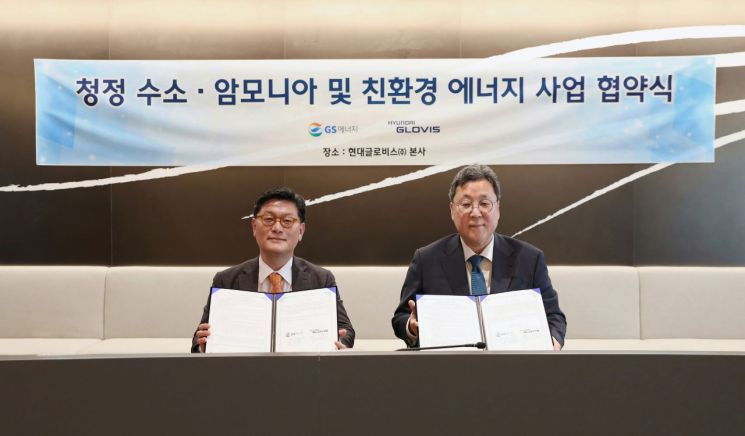
Hyundai Glovis announced on the 27th that it has signed a 'Clean Hydrogen, Ammonia, and Eco-friendly Energy Business Agreement (MOU)' with GS Energy. The signing ceremony was attended by Hyundai Glovis CEO Lee Gyubok, GS Energy Vice President Kim Seongwon, and other representatives from both companies.
Hyundai Glovis will provide maritime transportation services for the entire scope of the project. GS Energy will be responsible for the production of ammonia and hydrogen as well as the construction of related import terminals. Both companies agreed to cooperate on joint investments for raw material production and the development of demand markets.
To secure a leading position in the eco-friendly gas transportation market, Hyundai Glovis is investing 200 billion KRW to build two ultra-large gas carriers (VLGCs). Each vessel will have a cargo capacity of 86,000㎡ and is scheduled for delivery in 2024.
The company's VLGCs are equipped with cargo tanks made from special materials, enabling them to transport not only LPG but also ammonia. Currently, there are about 20 VLGCs worldwide capable of carrying ammonia, which accounts for less than 10% of the total VLGC fleet.
Ammonia transportation is proposed as an alternative to liquefied hydrogen transport methods. To transport and store hydrogen, gaseous hydrogen must be converted into liquid form. Gaseous hydrogen has limited transport capacity, and liquefied hydrogen (hydrogen in liquid state at an ultra-low temperature of minus 253 degrees Celsius) has low storage density and is not yet commercialized.
On the other hand, ammonia is produced by combining hydrogen with nitrogen. Ammonia transportation involves maritime shipping in this form, with hydrogen being extracted from ammonia at the demand sites. Unlike liquefied hydrogen, ammonia can be liquefied relatively easily (at minus 33 degrees Celsius) and can store 1.7 times more hydrogen per unit volume, making large-scale transportation easier.
The two companies also plan to jointly pursue projects related to liquefied carbon dioxide and used batteries. In fact, last November, they signed an agreement for CCUS (Carbon Capture, Utilization, Storage) business cooperation along with GS Caltex and Korea East-West Power.
A Hyundai Glovis official stated, “In the era of energy transition, we plan to play an important role as a global shipping company,” adding, “Through collaboration with GS Energy, we will demonstrate global competitiveness in the eco-friendly business sector as well.”
© The Asia Business Daily(www.asiae.co.kr). All rights reserved.
!["The Woman Who Threw Herself into the Water Clutching a Stolen Dior Bag"...A Grotesque Success Story That Shakes the Korean Psyche [Slate]](https://cwcontent.asiae.co.kr/asiaresize/183/2026021902243444107_1771435474.jpg)
















