President Yoon's Approval Rating at 36.0%
People Power Party Up 0.9%p to 37.9%
Democratic Party Down 1.0%p to 45.4%
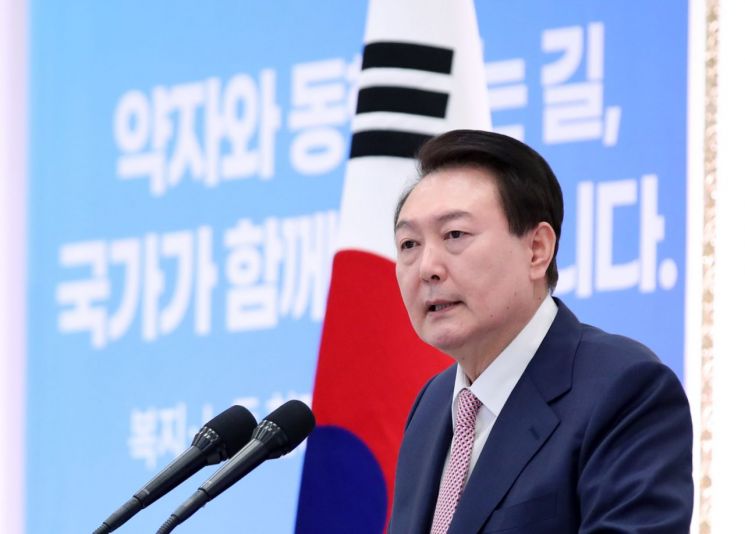
President Yoon Suk-yeol's approval rating for his administration has fallen for three consecutive weeks, dropping to the mid-30% range.
According to a regular public opinion poll conducted by Realmeter (commissioned by Media Tribune, conducted from the 20th to the 24th over five days, targeting 2,506 adults aged 18 and over nationwide using an ARS automated response method), President Yoon's positive evaluation of his administration decreased by 0.8 percentage points from the previous survey to 36.0%. Since reaching 42.9% in the first week of March, President Yoon's approval rating has shown a decline for three consecutive weeks. Conversely, the negative evaluation of his administration rose by 0.8 percentage points from the previous survey to 61.2%. The negative rating has also increased for three consecutive weeks since recording 53.2% in the first week of March.
Looking at ideological tendencies, the approval rating declined among moderates (down 3.8 percentage points, from 34.7% to 30.9%) and progressives (down 3.8 percentage points, from 16.3% to 12.5%), while conservatives showed signs of consolidation (up 1.6 percentage points, from 63.3% to 64.9%, with a negative rating of 32.1%).
President Yoon's approval rating notably declined in Daejeon, Sejong, and Chungcheong regions (down 5.6 percentage points, from 41.1% to 35.5%), among people in their 40s (down 6.1 percentage points, from 27.3% to 21.2%), and those aged 70 and above (down 4.4 percentage points, from 57.7% to 53.3%). Conversely, it rose in Daegu and Gyeongbuk (up 6.9 percentage points, from 51.1% to 58.0%)
and among people in their 30s (up 5.3 percentage points, from 25.4% to 30.7%).
Regarding party support, the Democratic Party's approval rating fell by 1.0 percentage point to 45.4%, while the People Power Party's rating rose by 0.9 percentage points to 37.9%. Although the gap between the two parties' support rates slightly narrowed, the Democratic Party still leads the People Power Party beyond the margin of error.
The Democratic Party saw notable declines in Daegu and Gyeongbuk (down 6.7 percentage points, from 33.7% to 27.0%), Gwangju and Jeolla (down 6.1 percentage points, from 66.9% to 60.8%), among people in their 30s (down 9.8 percentage points, from 51.1% to 41.3%), and those in their 20s (down 4.6 percentage points, from 44.6% to 40.0%). The People Power Party experienced increases in Daegu and Gyeongbuk (up 6.3 percentage points, from 51.6% to 57.9%) and Incheon and Gyeonggi (up 4.8 percentage points, from 33.6% to 38.4%).
Park Soo-young, head of the People Power Party's Yeouido Research Institute, commented on CBS Radio regarding the ruling party's weak support, saying, "First of all, the Japan relationship, the Korea-Japan relationship, is opposed by 65% of the public, which I believe contributed to the drop in approval ratings." He added, "There were various misunderstandings related to the 69-hour system that were not well known, and our communication was not well prepared. These factors overlapped, causing continuous negative impacts."
For more details, please refer to the website of the Central Election Survey Deliberation Commission.
© The Asia Business Daily(www.asiae.co.kr). All rights reserved.

















