140 Million Man-Days of Flood Recovery Work Over 135 Days
17 Plants Fully Operational... POSCO Achieves 'Complete Normalization'
Developing Eco-Friendly Steel Technologies to Meet Carbon Reduction Goals
Focus on Technological Innovation Including Smart Factories
"After 135 days since the flood damage caused by Typhoon Hinnamnor, 1.4 million people including employees of POSCO affiliates and partner companies, as well as military, fire services, and civilian volunteers, rolled up their sleeves to restore flood damage and normalize the Pohang Steelworks. This achievement was made possible thanks to those who readily rolled up their sleeves with the mindset of 'This is a factory we built ourselves...'. We are especially proud to have completed the restoration without any major accidents."
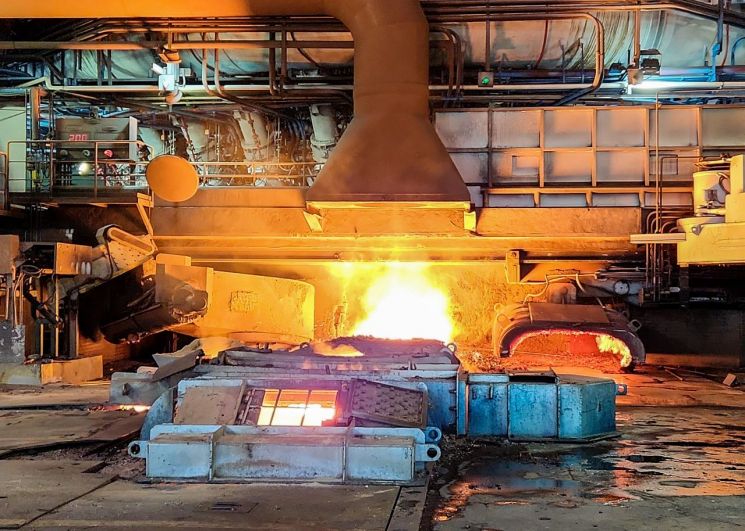 On the 23rd, the 'casting' operation, where molten metal flows out, began at the No. 2 blast furnace of Pohang Steelworks in Nam-gu, Pohang-si, Gyeongbuk. Photo by POSCO
These are the words of Cheon Si-yeol, Deputy Director in charge of Process Quality at POSCO, who led the flood recovery efforts at Pohang Steelworks, which was damaged by Typhoon Hinnamnor last September. On the 23rd, the Pohang Steelworks in Nam-gu, Pohang City, Gyeongbuk, visited half a year later, was pouring molten steel again as if forgetting the flood that paralyzed the plant. Even as recently as November last year, four months ago, evidence of the flood remained in the form of fences knocked down by debris carried by rainwater and muddy water stains on the factory exterior walls. Now, only a photo exhibition commemorating the flood damage and recovery efforts and a signboard indicating the water level at the time of the flood remain as evidence of the flood.
On September 6 last year, POSCO faced an unprecedented situation where most of the Pohang Steelworks was submerged due to Typhoon Hinnamnor and the flooding of Naengcheon Stream. Deputy Director Cheon recalled, "A record-breaking rainfall of up to 500mm coincided with high tide, causing the nearby Naengcheon Stream to overflow and flood the Pohang Steelworks," adding, "For the first time in 49 years since the first molten steel was produced, most areas of the Pohang Steelworks were submerged, halting molten steel production."
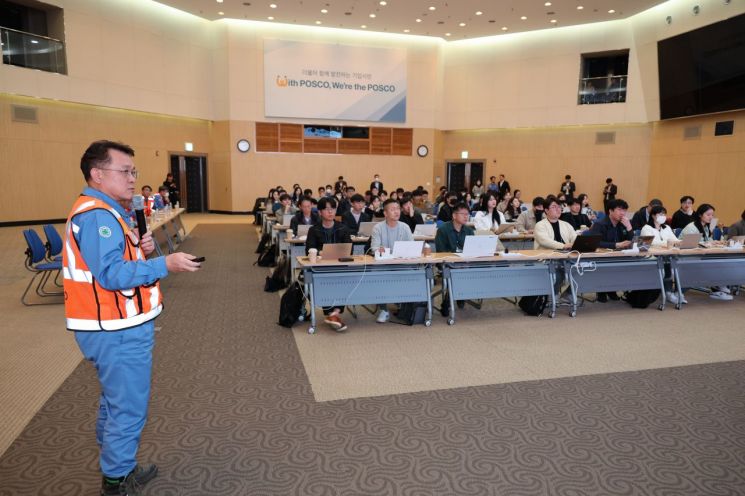 Cheon Si-yeol, Deputy Head of Process Quality at Pohang Steelworks, is speaking at a press briefing held on the 23rd. Photo by POSCO
The Pohang Steelworks restarted all three blast furnaces that had been shut down within a week. Within 100 days after the flood, the second hot rolling mill, through which 40% of Pohang Steelworks' products pass, was restarted. On January 19 this year, the remaining plating plant and Stainless Steel 1 cold rolling mill were restarted, completing the restoration of all 17 rolling mills at Pohang Steelworks, and from the 20th, full normal operation resumed. This was thanks to employees who sacrificed their vacations and leisure time to focus on normalizing the plant. The efforts of approximately 1.4 million people from civilian, government, and military sectors, as well as the operational and maintenance expertise of POSCO masters and professional engineers, also contributed to the process normalization.
POSCO has set a goal to accelerate carbon neutrality and smart factory construction, overcoming the flood damage to approach the dream of the 'steelmaking future.' Pohang Steelworks was selected as the world's first 'Lighthouse Factory' in South Korea at the World Economic Forum (Davos Forum) in 2019. A Lighthouse Factory is a factory that, like a lighthouse shining light to guide ships in the dark night sky, actively adopts core technologies of the 4th Industrial Revolution such as the Internet of Things (IoT), Artificial Intelligence (AI), and Big Data to innovatively lead the future of global manufacturing.
A representative example is the No. 2 blast furnace. POSCO began researching smart blast furnaces in 2016, and the No. 2 blast furnace was the first to undergo digitalization. It is a massive facility standing 110 meters tall, with internal temperatures reaching up to 2300℃. The variables of this enormous blast furnace, which cannot be visually inspected, were digitalized. Various indicators of the blast furnace, previously managed based on the operator's skill, were standardized and datafied. The operational methods of technical artisans were learned by AI through deep learning. Currently, the No. 2 blast furnace is equipped with an AI system that controls the furnace most efficiently. Kwon Min-rak, Section Chief of Technology Development in the Ironmaking Department at Pohang Steelworks, said, "It is expected to reduce human errors and detect subtle changes in information that humans cannot perceive in advance, enabling efficient and stable operation."
POSCO is also accelerating the development of hydrogen reduction steelmaking technology to realize 'Carbon Neutrality 2050.' Hydrogen reduction steelmaking uses hydrogen instead of coal gas in the reduction process that separates oxygen from iron ore. Since it does not produce greenhouse gases, it is considered an essential technology for eco-friendly steelmaking. POSCO has established a plan to gradually transition existing production methods such as blast furnaces to hydrogen reduction steelmaking production systems. POSCO plans to introduce the 'HyREX' pilot plant for hydrogen reduction steelmaking in 2026 to verify its commercialization potential. After completing commercial technology development by 2030, POSCO aims to gradually convert the existing blast furnace facilities at Pohang and Gwangyang Steelworks to hydrogen reduction steelmaking by 2050 to achieve 'Carbon Neutrality 2050.'
Choi Jeong-woo, Chairman of POSCO Group, said at the International Forum on Hydrogen Reduction Steelmaking, "Everyone knows that hydrogen reduction steelmaking is the key to solving the carbon emission problem in the steel industry, but it is a very challenging goal itself," adding, "If you unite your will and embark on that path together, the era of carbon neutrality will come sooner, and humanity will once again leap forward toward a better future."
© The Asia Business Daily(www.asiae.co.kr). All rights reserved.
![Clutching a Stolen Dior Bag, Saying "I Hate Being Poor but Real"... The Grotesque Con of a "Human Knockoff" [Slate]](https://cwcontent.asiae.co.kr/asiaresize/183/2026021902243444107_1771435474.jpg)

















