Ministry of Land Holds Resident Meeting on Sanbon New Town Redevelopment
Won Hee-ryong: "We Will Ensure No Losses from Remodeling"
Residents of Gunpo City, Gyeonggi Province, voiced their concerns to Won Hee-ryong, Minister of Land, Infrastructure and Transport, about the severely insufficient parking spaces and the aging of permanent rental housing, which is the most abundant among the first-generation new towns, particularly highlighting the issues in Sanbon New Town. They especially urged support for remodeling projects.
Minister Won Hee-ryong met with Gunpo City residents at the Gunpo Cultural and Arts Center on the 26th. This meeting was held to assess the housing conditions in the first-generation new towns and listen to residents' voices, marking the second such meeting following his visit to Ilsan New Town in Goyang City on the 21st.
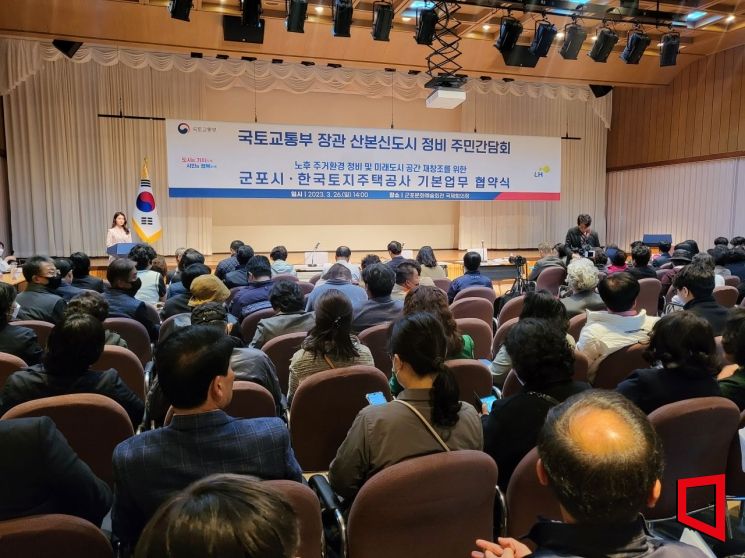
No Seung-man, head of the remodeling association for Ureuk Jugong Complex 7, pointed out, "Support for remodeling projects under the 'Special Act on Aging Planned Cities' appears to be insufficient," and questioned, "Isn't it too focused on reconstruction?" This complex recently became the first remodeling site in Sanbon to pass the urban planning review.
In Sanbon, remodeling is more active than reconstruction. Only two sites?Halla Jugong Complex 4 Phase 1 (1,248 households) and Jugong Complex 11 (1,400 households)?have passed the preliminary safety diagnosis for reconstruction. In contrast, there are seven remodeling complexes: ▲Ureuk Jugong Complex 7 (1,312 households) ▲Yulgok Jugong Complex 3 (2,042 households) ▲Gaenari Jugong Complex 13 (1,788 households) ▲Mugunghwa Jugong Complex 1 (1,329 households) ▲Seorak Jugong Complex 8 (1,471 households) ▲Toegye Jugong Complex 3 (1,992 households) ▲Chungmu Jugong Complex 2 (476 households).
However, the current special act does not include provisions regarding the range of household increases for remodeling projects. This has caused unrest among remodeling complexes. Park Hye-jin, general director of the remodeling association for Gaenari Jugong Complex 13, expressed curiosity about whether the special act would include how to cooperate well with frontline local governments, referring to Minister Won’s earlier statement in Ilsan that "regulations on remodeling will be eased as much as reconstruction."
They also inquired about future plans such as the relocation of over 3,000 permanent rental households. At the same time, attention was drawn to the old downtown area. A resident of Jeokseong Apartment complained, "It is a 5-story old apartment built 36 years ago, with rusty water coming from the water supply and cracks in the ceiling. Parking spaces are extremely insufficient, and there are also issues with fines."
In response, Minister Won said, "The special act allows for the development of aging old downtown areas adjacent to new towns," and urged, "Please gather opinions through a general planner who connects the government and residents." He emphasized that although residents’ interests and thoughts may differ, the faster opinions are gathered, the quicker progress can be made.
Regarding support for remodeling projects, he said, "I understand there are many regulations on vertical extensions and increasing the number of households, but if it aligns with the direction of accompanying surrounding infrastructure, we will try to accommodate as much as possible," adding, "We will ensure that no one says they suffered huge losses from remodeling."
Additionally, he announced a policy to develop permanent rental housing in an integrated manner. Surrounding complexes sharing land parcels with Korea Land & Housing Corporation (LH) will have integrated plans led by LH, the building and land owner, during the establishment of the basic maintenance plan. Lee Han-jun, president of LH, stated, "Our goal is to supply high-quality public housing without inter-floor noise," and added, "We will not only increase floor height but also expand unit sizes to ensure comfortable living, and change construction methods to prevent confusion like that occurring 30 years from now. Permanent rental housing will also be developed in an integrated manner."
Meanwhile, Sanbon, developed as part of the government's 2 million housing construction project, has the highest population density among the first-generation new towns, with 399 people per hectare. Forty-seven percent of Gunpo City's population lives in Sanbon. However, compared to Ilsan and Bundang, the green space ratio is low at 15.4%, and the number of parking spaces per household is only 0.6. Currently, there are nine apartment complexes with a total of 8,571 households that have passed 30 years since completion, accounting for about 20% of the total.
© The Asia Business Daily(www.asiae.co.kr). All rights reserved.
![Clutching a Stolen Dior Bag, Saying "I Hate Being Poor but Real"... The Grotesque Con of a "Human Knockoff" [Slate]](https://cwcontent.asiae.co.kr/asiaresize/183/2026021902243444107_1771435474.jpg)
















