KCCI, Analysis of Wage Increase Characteristics by Company Size and Industry in 2022
During the COVID-19 period, workers' wages increased, but the rate and amount of increase varied widely. The gap in special payments such as performance bonuses was cited as the main cause.
According to the "2022 Analysis of Wage Increase Characteristics by Company Size and Industry" released by the Korea Employers Federation, the average annual total wage of regular workers (the average of fixed wages and special payments, excluding overtime pay) rose by 10.7% from 2020 to 2022. In 2022, it was 46.5 million KRW, an increase of 2.27 million KRW (5.2%) compared to the previous year (44.23 million KRW).
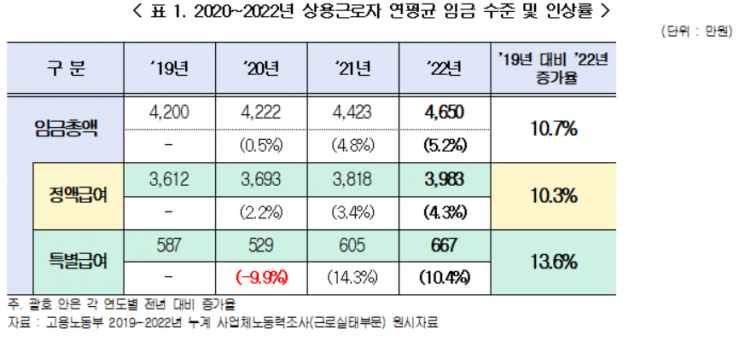
By wage component, the increase rate of special payments last year was 10.4% compared to the previous year (2021), which was 6.1 percentage points higher than the fixed wage increase rate (4.5%).
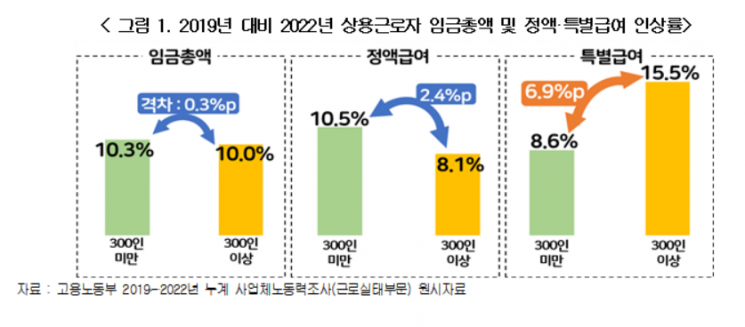
Wage increase rates also showed significant differences by company size. The average annual total wage for companies with fewer than 300 employees last year was 41.87 million KRW, while for companies with 300 or more employees it was 68.06 million KRW. Over the past three years (2020?2022), these increased by 3.92 million KRW (10.3%) and 6.18 million KRW (10%), respectively. Last year, the amount and rate of increase were higher for companies with 300 or more employees. By component, the fixed wage increase rate was higher for companies with fewer than 300 employees, while the special payment increase rate was higher for companies with 300 or more employees.
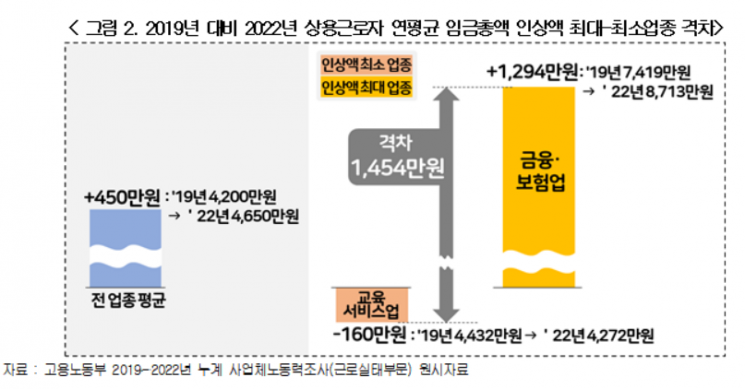
By industry, the gap between the highest and lowest wage increases reached 14.54 million KRW in amount and 21.1 percentage points in rate. Last year, the average annual total wage in the finance and insurance industry was 87.13 million KRW. Compared to 2019 (74.19 million KRW), it increased by 12.94 million KRW (17.5%), recording the highest increase in both amount and rate. The education services industry saw a decrease in annual total wages from 44.32 million KRW in 2019 to 42.72 million KRW in 2022, a reduction of 1.6 million KRW (-3.6%).
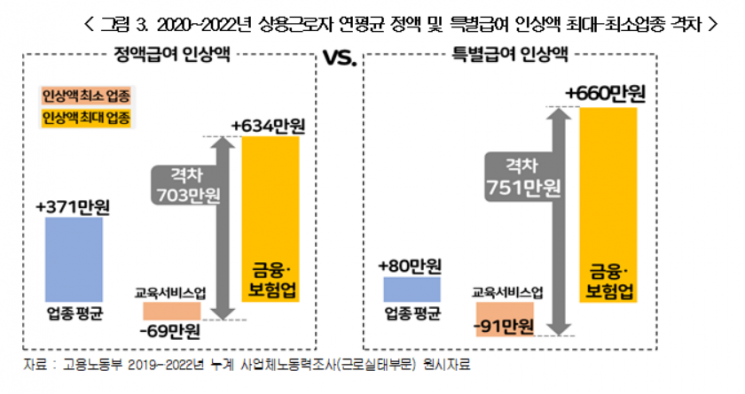
The gap in increase amount and rate by industry was more pronounced in special payments than in fixed wages. Over the past three years, fixed wages in the education services industry decreased by 690,000 KRW (1.8%), and special payments decreased by 910,000 KRW (19%). In the finance and insurance industry, fixed wages increased by 6.34 million KRW (12%), and special payments increased by 6.6 million KRW (31.2%).
© The Asia Business Daily(www.asiae.co.kr). All rights reserved.
![Clutching a Stolen Dior Bag, Saying "I Hate Being Poor but Real"... The Grotesque Con of a "Human Knockoff" [Slate]](https://cwcontent.asiae.co.kr/asiaresize/183/2026021902243444107_1771435474.jpg)


















