Emergency Welfare Support Project for Low-Income Households' Livelihood, Medical Care, and Housing
Focused Identification of Over 10,000 Households with Financial Delinquency and Suspected Poverty
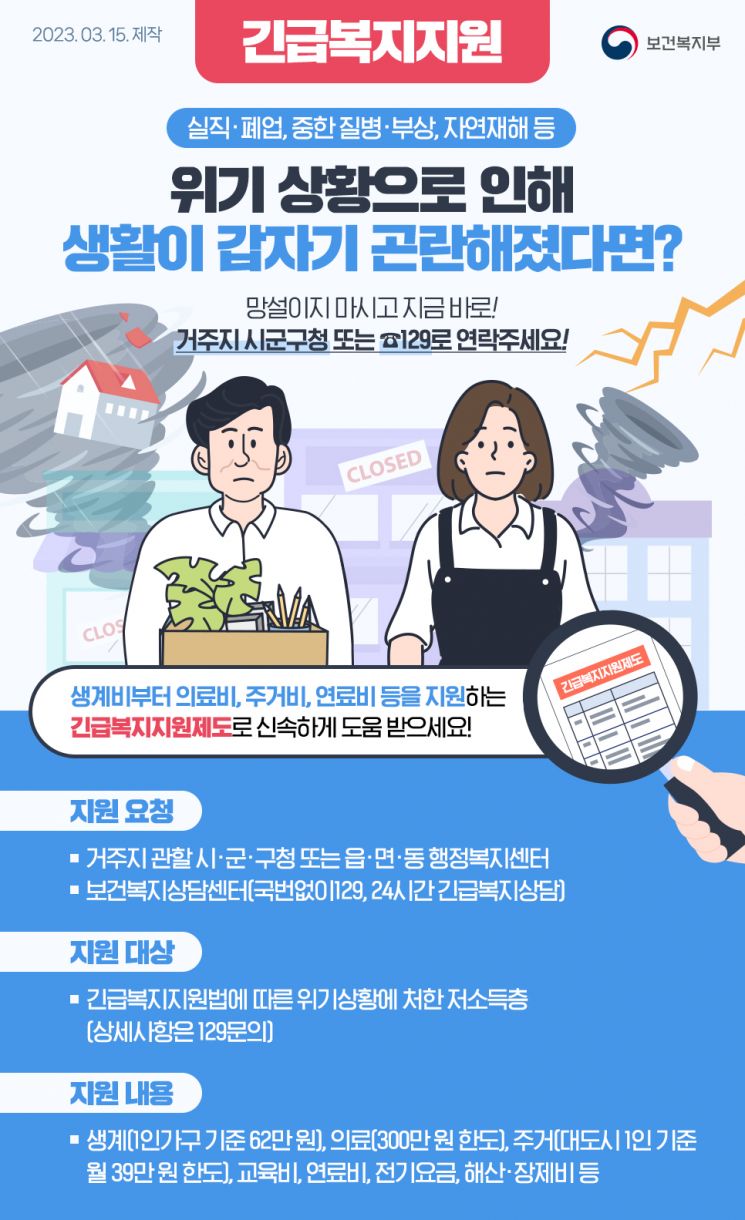
Gyeongnam Province is launching emergency welfare support for low-income households facing sudden crisis situations.
According to Gyeongnam Province, 'Emergency Welfare Support' is a program that quickly provides emergency living expenses, housing costs, medical expenses, and more to low-income households struggling to maintain their livelihood due to sudden crisis reasons such as the death, unemployment, or illness of the main income earner, helping them overcome the crisis.
Gyeongnam Province plans to invest 24.4 billion KRW to eliminate welfare blind spots for low-income groups and support difficulties in living and housing.
The eligibility criteria for emergency welfare support are ▲households with income at or below 75% of the median income (monthly income of 4,050,723 KRW for a family of four) ▲households with assets below 152 million KRW in small and medium-sized cities, 130 million KRW in rural fishing villages, and financial assets below 6 million KRW.
Emergency welfare support is provided within 72 hours, and fulfillment of income and asset criteria is determined during post-investigation.
Emergency living support has been increased by 5.47% compared to last year, providing up to 1.62 million KRW per month for a family of four, for a maximum of six times.
Housing support is 430,000 KRW per month in urban areas, up to 12 times, and medical support is up to 3 million KRW.
Additionally, education benefits, fuel costs, childbirth and funeral expenses are also supported.
Those wishing to apply for support can consult at the city/county or eup/myeon/dong Happy Welfare Centers or the Health and Welfare Counseling Centers in their area of residence.
Last year, the province provided 19.9 billion KRW to 48,000 low-income crisis households through the emergency welfare support program.
Through discovering welfare blind spots, 1,733 people were designated as basic livelihood security recipients, and 608 as near-poverty class, enabling them to receive public support.
This year, emergency welfare support is being promoted in connection with discovering crisis households in welfare blind spots, while also using big data to intensively identify welfare blind spots in six rounds.
From January 25 to March 17 this year, 13,000 cases were identified, and the second regular welfare blind spot discovery is ongoing from March 20 to May 12.
In this second discovery, the focus will be on about 10,000 households including ▲households suspected of poverty due to overdue loans in the private lending sector ▲households with changes in residence type presumed to have worsened housing conditions ▲households whose registered residence and actual residence do not match according to resident registration fact-finding.
Lee Do-wan, Director of the Welfare and Health Bureau, said, “We will proactively respond to quickly find crisis households facing difficulties due to unemployment, business suspension or closure, illness, or injury through community attention so that emergency welfare support can be provided promptly. We will also do our best to ensure that vulnerable groups do not miss applying for welfare services by linking with projects such as the Gyeongnam-type crisis household search.”
© The Asia Business Daily(www.asiae.co.kr). All rights reserved.

















