Constitutional Court: "No Reason to Discriminate Against Bereaved Families in Korea and Foreign Bereaved Families Residing Domestically"
The Constitutional Court has ruled that the legal provision stating that the bereaved family of a foreign construction worker who died while working in Korea cannot receive retirement benefits paid by the Construction Workers Mutual Aid Association (Mutual Aid Association) if they are "non-Korean nationals residing overseas" is unconstitutional.
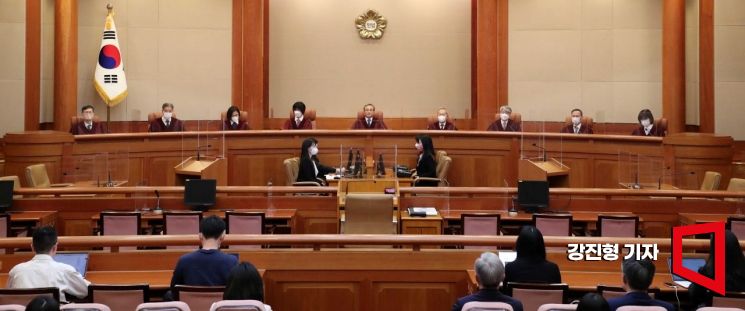 On the 23rd, the day of the Constitutional Court's ruling on the authority dispute regarding the complete removal of the prosecution's investigative rights (Geomsu Wanbak) bill, Yoon Nam-seok, Chief Justice of the Constitutional Court, is seated with the constitutional justices at the Constitutional Court in Jongno-gu, Seoul. Photo by Kang Jin-hyung aymsdream@
On the 26th, the Constitutional Court announced that it unanimously decided the unconstitutionality of Article 14, Paragraph 2 of the former Act on the Improvement of Employment for Construction Workers in a constitutional complaint case filed by B, a Vietnamese national and wife of A, who died while working as a construction worker in Korea.
A died in September 2019 in an accident where his head was caught between unmanned rail cars at a tunnel construction site while working as a construction worker in Korea. B was maintaining her livelihood with the money regularly sent by her husband.
Subsequently, B requested the Mutual Aid Association to pay the retirement benefits, but the Mutual Aid Association refused payment on the grounds that B fell under the category of "foreign nationals residing overseas" according to Article 14, Paragraph 2 of the former Act on the Improvement of Employment for Construction Workers. In response, B filed a lawsuit against the Mutual Aid Association claiming her husband's retirement benefits and also filed a constitutional complaint.
The provision under review limits the eligibility to receive survivor compensation pensions to spouses and others among the bereaved who were living with the worker at the time of death, excluding bereaved family members who were non-Korean nationals residing overseas at the time of the worker's death.
The Constitutional Court judged, "Even if retirement benefits are paid to 'foreign bereaved family members residing overseas,' it will not affect the state's finances, nor will it cause additional financial burdens on employers or problems securing resources for the Construction Workers Mutual Aid Association," and added, "Since the eligibility of the bereaved family to receive retirement benefits can be sufficiently proven, there will be no particular difficulty in the Mutual Aid Association's payment operations."
Furthermore, the Court stated, "Retirement benefits are paid as a lump sum, so only whether the bereaved family existed at the time of the construction worker's death needs to be confirmed. Therefore, the fact that foreign bereaved family members residing overseas are foreigners or reside abroad cannot be a reasonable basis for treating them differently from Korean national bereaved family members or foreign bereaved family members residing domestically in terms of eligibility for retirement benefits."
© The Asia Business Daily(www.asiae.co.kr). All rights reserved.
![From Hostess to Organ Seller to High Society... The Grotesque Scam of a "Human Counterfeit" Shaking the Korean Psyche [Slate]](https://cwcontent.asiae.co.kr/asiaresize/183/2026021902243444107_1771435474.jpg)
















