"Bill Valid" Constitutional Court Points Out Procedure
Opposition Raises Concerns Over 'Anjo Committee Neutralization'
Ruling Party Claims "President's Veto Legitimacy Secured"
The Constitutional Court ruled that the so-called 'Geomsu Wanbak Act,' which reduces the prosecution's investigative authority, is valid, while pointing out procedural issues in the National Assembly's bill processing process, drawing attention to whether it will curb the legislative dominance of the major opposition party.
On the 23rd, the Constitutional Court dismissed the power dispute filed by the People Power Party against the Speaker of the National Assembly who passed and promulgated the law, with a 5 to 4 decision by the justices. Although it partially acknowledged the infringement of the People Power Party lawmakers' rights due to the chairman of the Legislation and Judiciary Committee's meeting conduct, it found no problem with the Speaker of the National Assembly's act of announcing the passage of the amended law itself.
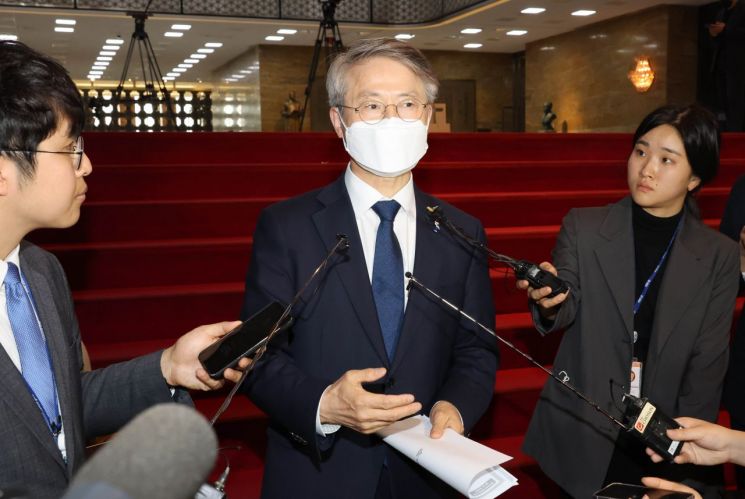
In a political situation where the opposition party holds fewer seats, the ruling Democratic Party's behavior of leading the passage of various bills with the power of the majority party was legally recognized as having no issues. As a result, various bills such as the Broadcasting Act amendment bill, the Nursing Act enactment bill, the Yellow Envelope Act (amendments to Articles 2 and 3 of the Labor Union Act), and special investigation bills on Daejang-dong and Kim Geon-hee, which the opposition party pushed to be directly referred to the plenary session in the March-April extraordinary session, are also expected to continue to be forcibly processed. Park Hong-geun, the floor leader of the Democratic Party, said at a press briefing immediately after the Constitutional Court's decision the day before, "It is a positive decision that respects the National Assembly's legislative authority and the legislative intent of prosecutorial reform based on the spirit of the Constitution."
The problem lies in the fact that the Constitutional Court pointed out procedural issues. The Constitutional Court accepted the power dispute request filed by the People Power Party against the chairman of the Legislation and Judiciary Committee with a 5 to 4 decision. The court explained, "The chairman of the Legislation and Judiciary Committee, departing from the neutral position of the meeting chair, pre-set conditions for approval regarding the coordination committee, allowing the coordination plan to be passed without substantive coordination review, and did not provide an opportunity for debate in the full committee meeting," adding, "This violated the majority rule principle under the National Assembly Act and the Constitution."
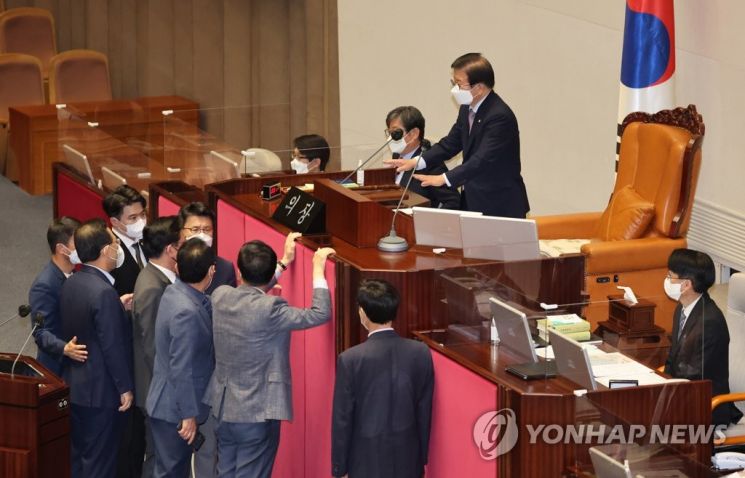 (Seoul=Yonhap News) Reporter Baek Seung-ryeol = On the 27th, Park Byeong-seok, Speaker of the National Assembly, is talking with members of the People Power Party who raised objections to the opening of the plenary session to pass the so-called 'Prosecution Investigation and Prosecution Authority Separation' bill, which separates the prosecution's investigation and prosecution rights, at the National Assembly plenary session. 2022.4.27
Last April, during the passage of the bill through the Legislation and Judiciary Committee, the Democratic Party was criticized for forcing independent lawmaker Min Hyung-bae to leave the party to neutralize the agenda coordination committee. At the time of the committee's formation, the Democratic Party assigned Min, who voluntarily left the party, to the independent member quota, effectively ending the committee in 17 minutes with 4 out of 6 members (3 from the Democratic Party + Min).
Therefore, after this Constitutional Court decision, it is likely that the Democratic Party will face burdens in the agenda coordination committee process for other bills it is promoting. The government and ruling party are also expected to strongly oppose this. Currently, excluding Speaker Kim Jin-pyo, there are six independent lawmakers with Democratic Party leanings, and if the agenda coordination committee is formed in standing committees including them, other bills are likely to pass under the Democratic Party's leadership. Last year, in the National Assembly's Agriculture, Food, Rural Affairs, and Fisheries Committee, independent lawmaker Yoon Mi-hyang, formerly of the Democratic Party, was included as a committee member to pass the 'Grain Management Act Amendment Bill.'
Moreover, since the Constitutional Court's decision is partly dismissed and partly accepted, there is criticism that the decision could be reversed depending on the next Constitutional Court's composition, making procedural issues even more significant. In fact, the terms of justices Lee Seon-ae and Lee Seok-tae, who were appointed by past governments, expire next month, and different decisions could be made depending on the justices' leanings and composition thereafter.
The People Power Party emphasized that it has acquired the legitimacy to exercise the 'presidential veto.' Kim Mi-ae, the floor spokesperson for the People Power Party, said in a statement the day before, "Since the Constitutional Court decided that the chairman of the Legislation and Judiciary Committee infringed on the deliberation and voting rights of minority party lawmakers, the 'legitimacy' of the president's veto power over laws passed through parliamentary violence, such as the Grain Management Act, has naturally been acquired."
A presidential office official said that day, "Since the president has already clearly stated his position on the veto several times, a result consistent with principles will come out," adding, "The aides' time to reconfirm the president's judgment has passed." This implies that President Yoon Seok-yeol intends to exercise the veto power on the Grain Management Act.
© The Asia Business Daily(www.asiae.co.kr). All rights reserved.


















