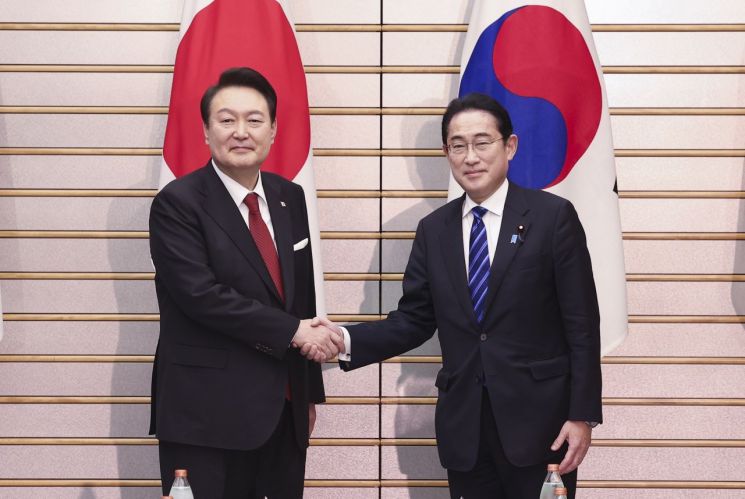
Amid South Korea's initiation of the procedure to restore Japan to its whitelist (preferred export control countries) following the Korea-Japan summit, some critics are calling it hasty diplomacy. Unlike the South Korean government, which began the restoration process immediately after the summit, Japan has not yet made a final decision on whether to restore South Korea to its whitelist. Due to differences in the restoration processes, there are concerns that if only South Korea proactively normalizes the whitelist, Japan might take the lead in the export sector involving about 1,000 items in the future.
According to the Ministry of Trade, Industry and Energy on the 27th, the government announced the draft amendment to the strategic goods export-import notification for the restoration of Japan's whitelist on the 23rd. The public notice period lasts until the 12th of next month. Considering that South Korea's whitelist can be amended immediately after the public notice through the Ministry's notification, it is expected that the procedure will be completed within about one month.
The whitelist refers to countries that are given preferential treatment in permits and procedures when exporting advanced technologies and electronic components that could threaten national security. Once restoration is complete, the review period for exporting strategic goods to Japan will be reduced from the current 15 days to 5 days, and the required application documents will be simplified from 3-5 types to 1-3 types. In effect, the export process will be about three times faster.
The problem is that, unlike the South Korean government which has entered the amendment process, the Japanese side has not yet started the whitelist restoration procedure. Statements from the Japanese government also raise concerns. Japan's Minister of Economy, Trade and Industry, Nishimura Yasutoshi, said in an interview with local media, "We want to thoroughly verify the effectiveness of South Korea's export control system and its operational status across a wide range of about 1,000 items." This means Japan intends to make a judgment after closely monitoring South Korea's restoration process.
There is also a difference in the speed of restoration between the two countries. Unlike South Korea, Japan requires amendments to laws such as presidential decrees, and it is expected that it will take more than two months to pass the cabinet meeting. This means Japan's whitelist restoration could be delayed by at least one month compared to South Korea. In this case, Japan might selectively restore whitelist items for South Korea, which number about 1,000. The Ministry of Trade, Industry and Energy stated that although there is a time difference in the amendment procedures between the two countries, they will continue consultations while proceeding with the process. Ahn Deok-geun, the head of the Trade Negotiations Bureau, said, "We will continue to negotiate with the Japanese side to expedite the procedure."
There are also concerns about the export impact on South Korean 소재·부품·장비 (SoBuJang, materials, parts, and equipment) companies. Since Japan intensified export regulations in 2019, South Korea has focused on fostering SoBuJang companies to promote localization. Significant progress has been made in reducing dependence on Japanese SoBuJang products. For example, the import dependence on photoresist, one of the three core items in semiconductor production, improved by 15.8 percentage points from 93.2% in 2018 to 77.4% last year. Imports of hydrogen fluoride and fluorinated polyimide from Japan also decreased by 11.4 percentage points and 34.2 percentage points, respectively. Amid this, there are concerns that lifting export regulations might harm domestic SoBuJang companies.
The Ministry of Trade, Industry and Energy analyzed that even if Japan lifts export regulations, it is unlikely that Korean companies will revert to using Japanese products instead of domestic SoBuJang. Furthermore, it is expected that small and medium-sized enterprises in South Korea will find it easier to trade with Japan, leading to positive effects such as improved trade balance and exports. Some interpret the recent Korea-Japan whitelist restoration and the withdrawal of the World Trade Organization (WTO) complaint regarding the three core items as having symbolic significance for mutual trust recovery. Professor Cho Jin-man of the Department of Political Science and Diplomacy at Duksung Women's University said, "Given the special relationship between our countries, it is difficult to achieve a clear result all at once, but this is meaningful as a step to open a new future by breaking the deadlock in Korea-Japan relations."
© The Asia Business Daily(www.asiae.co.kr). All rights reserved.

















