OECD·Ministry of Economy and Finance Fiscal Seminar on the 10th of Last Month
'Korean Structural Reform Discussions' Absent from Government Announcement Ignite
Korea Officer: "Dual Labor Market Must Be Addressed"
Deputy Minister Choi Sang-dae Also Says "Long-term Fundamental Reform Needed"
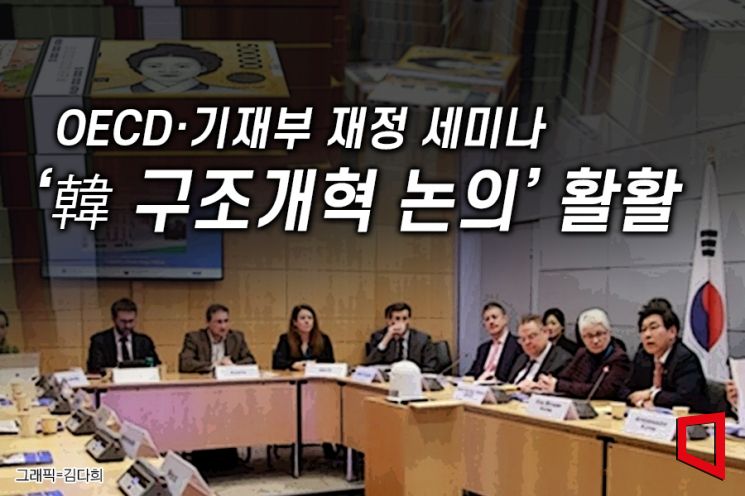
The Organisation for Economic Co-operation and Development (OECD) conveyed the opinion that structural reforms are necessary to resolve South Korea's fiscal issues during a seminar held with the Ministry of Economy and Finance. The implication was that to prevent the rapidly increasing debt, changes must occur throughout society beyond just the legislation of fiscal rules. Choi Sang-dae, the 2nd Vice Minister of the Ministry of Economy and Finance who attended the seminar, expressed a similar view.
According to the OECD and related ministries on the 24th, the Ministry of Economy and Finance held a joint seminar on the theme of "Long-term Fiscal Reform for Fiscal Sustainability" at the OECD headquarters in Paris on the 10th of last month. Attendees included Jon Pareliusen, OECD Korea Desk Officer, Robert Chote, former Chair of the Budget Responsibility Office, and Kamran Kazemzadeh, Austrian Counsellor. The Ministry of Economy and Finance issued a press release stating that "participants highly appreciated South Korea's efforts to pursue fiscal reform," but in reality, discussions were held about the need for reforms across Korean society.
Jon Pareliusen, who participated as a panel discussant and is the Korea Desk Officer, stated, "It should be recalled that Japan maintained a national debt ratio of around 50% until the 1990s," and agreed on the necessity of a long-term fiscal vision. He added, "Measures must be established to respond to the decline in the working-age population, such as improving the seniority-based wage system in the labor market and increasing women's labor participation," emphasizing that "structural reforms such as resolving the dual structure of the labor and production markets must be implemented."
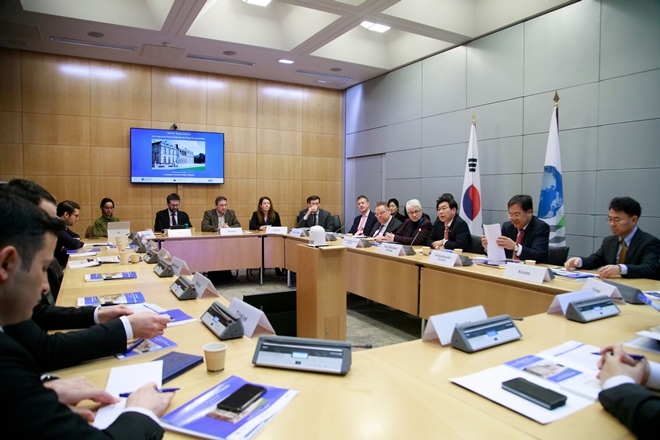 On the 10th of last month, the Ministry of Economy and Finance and the OECD jointly held a seminar on the theme of 'Long-term Fiscal Reform for Fiscal Sustainability' at the OECD headquarters in Paris. Photo by OECD
The Korea Desk Officer is responsible for preparing the OECD Korea Economic Report and forecasting South Korea's economic growth rate. It was also Pareliusen who recommended the introduction of fiscal rules and the establishment of energy-saving measures for Korea in last year's report. This means that a Korean economic expert working within an international organization pointed out the need for restructuring the labor market. It is known that Pareliusen also conveyed to the Ministry of Economy and Finance measures to address the issues he raised.
Pareliusen cited Japan's case as a cautionary example because the situation is similar to South Korea's. According to the Korea Economic Research Institute, Japan's national debt-to-GDP ratio was 66.1% in 1990. Currently, it is about 250%, the highest in the world. The causes cited?rapid aging, increased welfare spending, and an inefficient seniority-based labor market?are problems South Korea is currently facing. This is why there is analysis urging South Korea, whose national debt ratio is around 50% this year, to be vigilant.
"South Korea's Education and Success Values Must Change; Long-term Reform Vision Should Be Concrete"
Another panel discussant, Kamran Kazemzadeh, Austrian Counsellor, stressed, "The most important thing for South Korea is to increase the birth rate," and emphasized, "In this regard, the social value system related to education and success must be transformed." He explained that in a low birthrate society, fiscal conditions inevitably worsen, and South Korea's excessive enthusiasm for education and pressure regarding success are lowering the birthrate.
Xavier De Bruyn, Director of the Research Department at the National Bank of Belgium, who gave a presentation, said, "Belgium's debt ratio is expected to continue increasing due to fiscal pressures from aging," and lamented, "Efforts must be made to address long-term challenges." Eddie Casey, Chief Economist of the Irish Fiscal Advisory Council, advised, "The recent plan to raise the pension eligibility age from 66 to 67 was withdrawn," adding, "Structural reform is not easy, and the long-term vision and related messages must be concrete, not abstract."
Vice Minister Choi Sang-dae also voiced opinions similar to those of the participants. In his opening remarks, Vice Minister Choi said, "To overcome the fiscal risks South Korea faces and resolve accumulated fiscal maladies, fundamental reforms with a long-term perspective are necessary." It is known that Vice Minister Choi presented to the participants the fiscal risks arising from structural problems such as changes in South Korea's population structure due to declining birthrates, low growth, and worsening polarization.
While advanced countries that have introduced fiscal rules are deeply considering structural reforms, South Korea has yet to even legislate fiscal rules. The review of the amendment to the National Finance Act, which includes fiscal rule measures, was also stalled at the Economic and Fiscal Subcommittee of the National Assembly's Planning and Finance Committee on the 21st. Vice Minister Choi appealed, "The amendment to the National Finance Act for the legislation of fiscal rules has not passed the National Assembly, making it difficult to establish a sound fiscal policy stance," and stressed, "Cooperation and support from the National Assembly are urgently needed."
© The Asia Business Daily(www.asiae.co.kr). All rights reserved.


















