Jeon Ju-hye, a member of the People Power Party, criticized the Constitutional Court's decision that the 'Geomsu Wanbak (Complete Removal of Prosecutorial Investigation Authority) Law' is valid, calling it a "biased decision by biased justices."
On the 24th, Jeon said on YTN's 'News King Park Ji-hoon' that "the neutral composition of the Constitutional Court is extremely important." Jeon is also one of the petitioners who filed a constitutional dispute against the Geomsu Wanbak Law targeting the Speaker of the National Assembly and the Chairperson of the Legislation and Judiciary Committee.
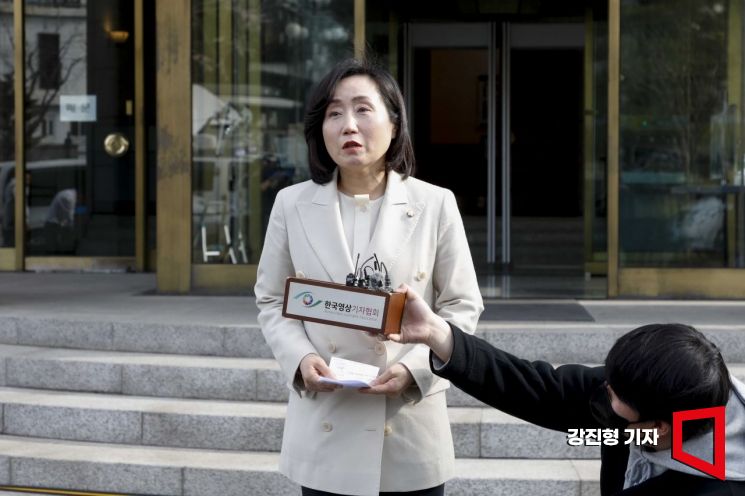 On the 23rd, in front of the Constitutional Court in Seoul, Jeon Ju-hye, a member of the People Power Party, expressed her position regarding the ruling by the Constitutional Court on the 'Geomsu Wanbak' (Complete Removal of Prosecutorial Investigation Rights) law, which passed the National Assembly plenary session last year. The court ruled that although there were unconstitutional elements during the voting process, the law is not ultimately invalid. Photo by Kang Jin-hyung aymsdream@
He said, "Since the 21st National Assembly, the Democratic Party has forcibly passed laws by ignoring procedures through the power of numbers. However, the institution that can currently put a brake on such acts that infringe on parliamentary democracy is ultimately the Constitutional Court's constitutional dispute adjudication system," adding, "Despite having such authority, the Constitutional Court ultimately sided with the Democratic Party, thereby maintaining this practice of ignoring procedures."
He continued, "Whether it is disguised party switching, splitting sessions, or trick after trick, and despite the severe procedural violations, the law was declared passed, thereby legitimizing it," and criticized, "The Constitutional Court, which should have put a stop to parliamentary dictatorship, instead gave wings to it, making this a cowardly decision."
Regarding the Constitutional Court's 5:4 dismissal of the Ministry of Justice's constitutional dispute, he said, "The five justices ruled that since the prosecutor's investigative authority is not explicitly stated, it cannot be considered a constitutional right, thus dismissing the case, while the four justices judged that based on the constitutional provisions such as the warrant request right, the prosecutor's investigative and prosecutorial authority is indeed a constitutional right," and raised his voice, "The five justices are from groups with specific leanings such as the Uri Law Research Association, the People's Solidarity for Participatory Democracy (Minbyun), and the International Human Rights Law Research Association." This implies that the justices' leanings influenced the dismissal of the Ministry of Justice's constitutional dispute.
The Democratic Party is also pointing out problems with Minister Han's 'Geomsu Wonbok (Restoration of Prosecutorial Investigation Authority) Enforcement Decree' based on this Constitutional Court ruling. In response, Jeon said, "The enforcement decree itself is not problematic," and countered, "At the time of passing the Geomsu Wanbak Law, the Democratic Party itself created and unilaterally passed the law in that way."
Voices calling for Minister Han's accountability are also emerging mainly from the opposition. Jeon said, "To hold Minister Han responsible for this decision, which was made through a biased ruling, is, in my view, fundamentally wrong."
© The Asia Business Daily(www.asiae.co.kr). All rights reserved.

















