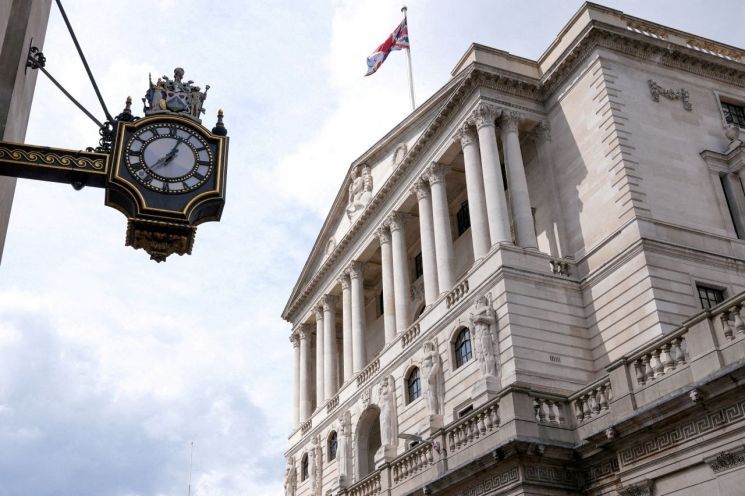
Despite the turmoil in the financial markets triggered by the collapse of the U.S. Silicon Valley Bank (SVB), the UK and Switzerland proceeded with interest rate hikes to curb inflation.
On the 23rd (local time), the Bank of England (BOE), the UK's central bank, announced at its monetary policy meeting that it would raise the benchmark interest rate by 0.25 percentage points to 4.25%.
This is the highest level since the 2008 global financial crisis, and the BOE has raised rates 11 consecutive times since December 2021. However, the rate hike magnitude is the smallest since June last year.
The BOE's rate hike was almost certain after the UK's consumer price index broke a three-month downward trend and rose 10.4% year-on-year. Contrary to experts' expectations that the UK's inflation rate would fall to single digits, it rebounded from 10.1% in January to 10.4% in February.
Despite the recent turmoil in the financial markets caused by SVB's collapse, the BOE appears to have judged that controlling inflation is more urgent and decided to raise rates.
However, the BOE maintained its previous forecast that inflation would decline rapidly. In particular, for the second quarter, it predicted that inflation would rise less than market expectations due to the government's extension of energy price support.
Major foreign media reported that experts also see inflation as having peaked and believe the BOE's tightening cycle is nearing its end.
Andrew Bailey, Governor of the BOE, said, "What I can say is that there are signs that inflation is peaking now," adding, "Still, inflation is too high, and we need to see it start to fall to reach the target (2%)."
He also stated that he does not see the current financial market turmoil leading to a second financial crisis.
On the same day, the Swiss National Bank (SNB), Switzerland's central bank, also took a big step by raising its benchmark interest rate by 0.5 percentage points from the previous 1.5%.
Recently, Switzerland experienced financial market turmoil as Credit Suisse (CS), the country's second-largest investment bank, fell into a financial crisis, but the decision was made considering only the inflation trend. Switzerland's annual average inflation rate last year was 2.8%, the highest in 30 years since 1993 (3.4%).
The SNB stated in a press release that the Swiss government mainly prevented a financial crisis by having UBS acquire CS.
Thomas Jordan, Governor of the SNB, said in an interview with major foreign media, "Looking at recent inflation forecasts, it is clear that there is a need to strengthen monetary policy," and added that the SNB is willing to actively intervene in the foreign exchange market if necessary.
Additionally, the Norwegian central bank also decided to raise its benchmark interest rate by 0.25 percentage points from 3.0% on the same day.
Earlier, the European Central Bank (ECB) raised its benchmark interest rate by 0.5 percentage points on the 16th.
© The Asia Business Daily(www.asiae.co.kr). All rights reserved.
![From Bar Hostess to Organ Seller to High Society... The Grotesque Con of a "Human Counterfeit" [Slate]](https://cwcontent.asiae.co.kr/asiaresize/183/2026021902243444107_1771435474.jpg)

















