Notice to Press Corps States Fundamental Position
Yoon Still May Exercise Veto Power
Ruling Party and Government Plan to Request Yoon to Exercise Veto Power
The Presidential Office on the 23rd expressed a general stance of "consideration" regarding the passage of the Grain Management Act amendment, which includes a regulation mandating the government to purchase surplus rice, led by the Democratic Party of Korea in the National Assembly plenary session.
A spokesperson for the Presidential Office stated in a press release distributed to the press corps in the afternoon, "Once the amended law is transmitted to the government, we plan to listen to opinions including concerns from various sectors and carefully consider them."
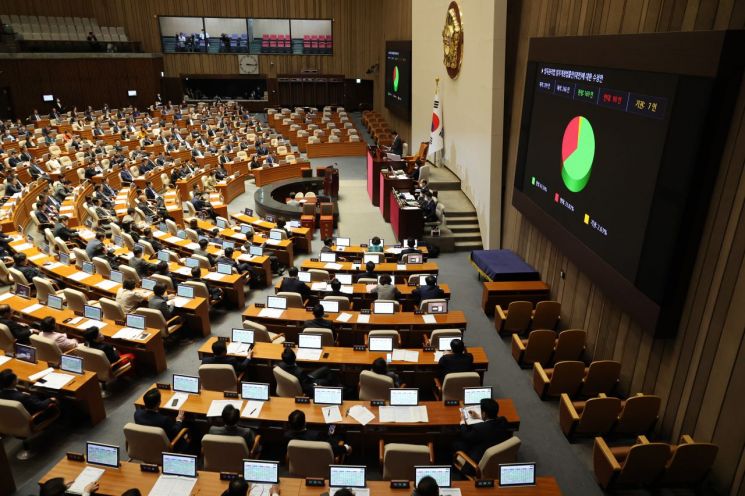
On the same day, the National Assembly held a plenary session and passed the amendment with 169 votes in favor, 90 against, and 7 abstentions out of 266 members present. The Grain Management Act originally passed the National Assembly's Agriculture, Food, Rural Affairs, Oceans and Fisheries Committee in October last year but did not pass the Legislation and Judiciary Committee for more than 60 days, leading to a direct referral to the plenary session.
Initially, the bill was scheduled for a vote in the plenary session on the 27th of last month, but Speaker Kim Jin-pyo postponed the vote by requesting additional negotiations between the ruling and opposition parties.
Subsequently, the ruling and opposition parties held further discussions but failed to reach a consensus, resulting in the vote being held on this day.
The Democratic Party, through consultations with the Speaker who sought a compromise with the government and ruling party, strengthened the surplus production requirement for mandatory purchase from 3% to 5%, and widened the rice price decline threshold from 5% to 8%. They also prepared an amendment allowing exemption from mandatory purchase if the rice cultivation area increases.
However, the People Power Party opposed the mandatory purchase clause, arguing that it would deepen the structural oversupply of rice by increasing cultivation incentives, and no compromise was reached.
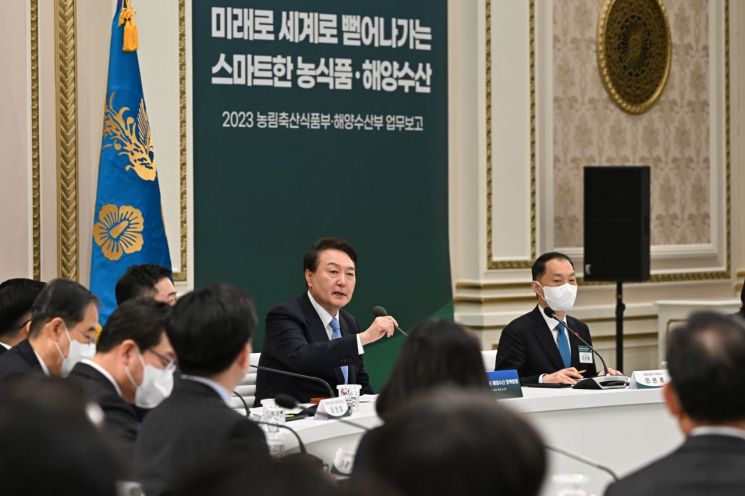
Despite the Presidential Office's stance of consideration, the possibility of President Yoon exercising his veto power remains high.
In his remarks during the joint briefing by the Ministry of Agriculture, Food and Rural Affairs and the Ministry of Oceans and Fisheries on January 4, President Yoon expressed opposition to the direct referral of the Grain Management Act amendment to the National Assembly plenary session led by the opposition party, stating, "This kind of Grain Management Act, which mandates the government to purchase all rice produced regardless of how much is absorbed by the market, does not help farmers."
He also proposed, "It is reasonable for the government to intervene to some extent to ensure autonomous supply and demand adjustment through market functions, provide predictability for our farmers regarding production, and stabilize prices."
The ruling party and government intend to request President Yoon to exercise his veto power.
Kim Mi-ae, the floor spokesperson for the People Power Party, commented, "The Grain Management Act is an anti-market socialist populist bill that forces the government to compulsorily purchase rice when prices fall or surplus exceeds a certain threshold," urging President Yoon to exercise his veto.
Jung Hwang-geun, Minister of Agriculture, Food and Rural Affairs, also held a briefing at the Government Complex Seoul on the same day, stating, "The provision mandating the government to compulsorily purchase surplus rice does not help the future of farms and agriculture at all. As the minister in charge, I deeply regret and feel disheartened that the amendment was unilaterally processed under the opposition party's leadership," expressing his intention to propose a veto to President Yoon.
© The Asia Business Daily(www.asiae.co.kr). All rights reserved.


















