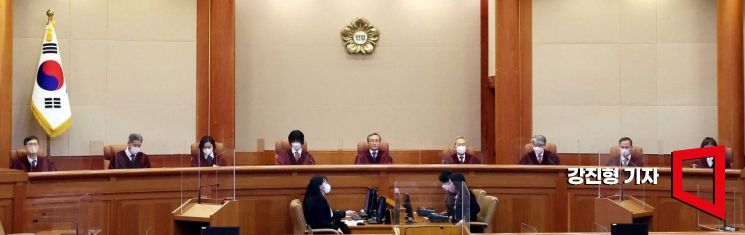
 On the 23rd, the day of the Constitutional Court's ruling on the constitutional dispute over the complete removal of the prosecution's investigative authority (Geomsuwanbak) bill, Yoon Nam-seok, Chief Justice of the Constitutional Court, entered the courtroom with the constitutional justices and took their seats at the Constitutional Court in Jongno-gu, Seoul. Photo by Kang Jin-hyung aymsdream@
On the 23rd, the Constitutional Court dismissed most of the petitions filed by the People Power Party (PPP) lawmakers regarding the 'Complete Stripping of Prosecutorial Investigation Authority' (검수완박, Geomsu Wanbak) law, which was led by the Democratic Party of Korea (DPK) last year. Additionally, the court dismissed the petitions filed by Minister of Justice Han Dong-hoon and prosecutors.
The Constitutional Court partially accepted the PPP lawmakers' request for confirmation of infringement of authority against Park Kwang-on, then Chairman of the Legislation and Judiciary Committee, but ruled that the act of proclaiming the passage of the bill was not invalid, thereby maintaining the effectiveness of the amended Prosecutors' Office Act and the amended Criminal Procedure Act.
All Petitions Against the Speaker from PPP Dismissed... Partial Acceptance of Petition Against Legislation Committee Chairman
On the afternoon of the same day, at the Constitutional Court's grand courtroom in Jaedong, Jongno-gu, Seoul, the court held a hearing on the petitions for adjudication of authority filed by PPP lawmakers, Minister Han, and prosecutors concerning the amended Prosecutors' Office Act and the amended Criminal Procedure Act. The court dismissed all petitions filed by the PPP against the Speaker of the National Assembly for confirmation of infringement of authority and invalidation of the act of proclaiming the passage of the bills.
Five justices, including Chief Justice Yoo Nam-seok, Lee Seok-tae, Kim Ki-young, Moon Hyung-bae, and Lee Mi-sun, stated, "There is no violation of the Constitution or the National Assembly Act by the Speaker of the National Assembly in the act of proclaiming the passage of the bills in this case, and it cannot be considered that the petitioners' rights to deliberate and vote on the bills were infringed."
As the basis for this judgment, the justices noted, "Since the Constitution and the National Assembly Act do not provide regulations on the minimum duration of a session, a short session cannot be considered unconstitutional or illegal. The properly decided session ended, concluding the unlimited debate, so the right to unlimited debate was not infringed."
They also concluded, "The amendments in this case include matters actually discussed in the Legislation and Judiciary Committee, so it is a lawful amendment motion that can be recognized as directly related to the original bill. Since no infringement of authority is recognized, the petition for invalidation based on this premise is unfounded."
The Constitutional Court also dismissed the PPP lawmakers' petition for invalidation of the act of proclaiming the passage of the bills against the Legislation and Judiciary Committee Chairman.
However, by a 5 (acceptance) to 4 (dismissal) vote, the court accepted the petition, recognizing that Park Kwang-on, then Chairman of the Legislation and Judiciary Committee, infringed on the petitioners' rights to deliberate and vote on the bills by proclaiming the passage of the amended Prosecutors' Office Act and the amended Criminal Procedure Act as the committee's bills at the 4th plenary meeting of the 385th National Assembly temporary session on April 27, 2022.
Lawmaker Min Hyung-bae's 'Disguised Resignation' and Park Kwang-on's Toleration Deemed 'Unconstitutional and Illegal'
The four justices who issued the acceptance opinion?Lee Seon-ae, Lee Eun-ae, Lee Jong-seok, and Lee Young-jin?pointed out that Lawmaker Min Hyung-bae, who initially supported the Geomsu Wanbak bill as a member of the DPK, resigned from the party and was appointed as a member of the Agenda Coordination Committee. This was a de facto 'disguised resignation' intended to neutralize the Agenda Coordination Committee, which is required by the National Assembly Act to be composed of an equal number of members from the ruling and opposition parties. They judged that Park Kwang-on, then Chairman of the Legislation and Judiciary Committee, who tolerated this and submitted the bill to the committee and proclaimed its passage, acted unlawfully and against the Constitution.
At that time, the DPK initially tried to neutralize the Agenda Coordination Committee through Yang Hyang-ja, an independent lawmaker formerly from the DPK who was assigned to the Legislation and Judiciary Committee. However, when Yang opposed the forced passage of the Geomsu Wanbak bill, Min resigned from the party and was assigned to the Agenda Coordination Committee of the Legislation and Judiciary Committee.
The four justices explained, "Lawmaker Min Hyung-bae, as a member of the DPK, had already introduced the original amendment bill deleting provisions related to prosecutors' investigative authority. Furthermore, in accordance with the DPK's party line to separate prosecutors' investigative and prosecutorial powers and limit prosecutors' direct investigative authority, he participated as a supporter of the amended Prosecutors' Office Act and the amended Criminal Procedure Act proposed by Park Hong-geun, the DPK's chief negotiator, along with other DPK lawmakers. He was appointed to the Legislation and Judiciary Committee from the Political Affairs Committee on April 18, 2022, when the review of the original amendment bills began in the Legislation and Judiciary Committee's first subcommittee."
They continued, "However, on April 20, 2022, when it became known that Yang Hyang-ja, the only member of the Legislation and Judiciary Committee not affiliated with a negotiating group, expressed opposition to the legislative approach of the original amendment bills, Min resigned from the DPK and later, along with eight others including DPK member Kim Jin-pyo, requested the formation of the Coordination Committee."
The four justices further noted, "Park Kwang-on, then Chairman of the Legislation and Judiciary Committee and a DPK member, had previously supported the bill proposed by Park Hong-geun, which aimed to limit prosecutors' direct investigative authority, along with Min Hyung-bae. Considering the circumstances of Min's resignation, the appointment of coordination committee members by the respondent chairman, and the composition of the Legislation and Judiciary Committee, it is reasonable to infer that Min resigned from the DPK in consultation with the party to be appointed as a coordination committee member representing non-negotiating groups, thereby ensuring the quorum for the Coordination Committee's decisions with DPK members. The respondent chairman knowingly appointed Min as a coordination committee member to facilitate the swift legislative process of the bill limiting or abolishing prosecutors' investigative authority according to the DPK's party line."
These justices viewed that Park Kwang-on, then Chairman of the Legislation and Judiciary Committee, departed from neutrality and artificially formed the Agenda Coordination Committee.
They stated, "The respondent chairman, as the presiding officer of the meeting, departed from his neutral position and preconditioned the approval of the Coordination Committee, which is part of the committee's activities. The Coordination Committee skipped substantive review, questioning, and debate, and the Coordination Committee's resolution was passed without real deliberation. Furthermore, the Legislation and Judiciary Committee plenary meeting proclaimed the passage of the amended bills exactly as per the Coordination Committee's resolution without providing a review report or substantive debate."
"This violates Article 57-2, Paragraph 4 of the National Assembly Act, which requires equal numbers of coordination committee members from the largest negotiating group and others. It also nullifies the function of Article 57-2, Paragraph 6, which sets the quorum to prevent unilateral legislative attempts by the majority in the National Assembly, by satisfying the quorum with only three DPK members and Min Hyung-bae, totaling four out of six members. It further violates Article 58 of the National Assembly Act, which regulates the committee's agenda review procedures," they added. "Moreover, by doing so, the respondent chairman departed from his neutral position as the presiding officer and nullified the opportunity for substantive debate in the Legislation and Judiciary Committee, violating Article 49 of the Constitution."
The justices emphasized that, given the sharp disagreements between the ruling and opposition parties over the amended bills, substantive review in the Agenda Coordination Committee was essential.
They stated, "Even if it is acknowledged that there was review of the bill contents up to the first subcommittee meeting before the formation of the Coordination Committee, the fact that the Coordination Committee was requested due to unresolved disagreements means that substantive review must have taken place thereafter."
They added, "Even if there was political agreement outside legal procedures among lawmakers regarding the bill contents, such agreements must be disclosed and sufficiently discussed and debated in committee meetings following the procedures prescribed by the National Assembly Act. Otherwise, secret political agreements risk nullifying the procedures established by the National Assembly Act for democratic control, undermining the principle of due process applied to legislative acts and the principle of open parliamentary proceedings stipulated in Article 50 of the Constitution."
Justice Lee Mi-sun, who also issued an acceptance opinion, agreed that Min Hyung-bae's resignation from the DPK was a 'disguised resignation' to enter the Agenda Coordination Committee in place of Yang Hyang-ja.
She stated, "Considering the circumstances of Min Hyung-bae's resignation, it is evident that he resigned from the DPK to be appointed as a coordination committee member representing non-negotiating groups for the purpose of processing the original amendment bills in the April temporary session. The respondent chairman, also a DPK member, must have been fully aware of this and appointed Min as a coordination committee member representing non-negotiating groups."
She added, "This effectively changed the composition from an equal 3:3 ratio between the largest negotiating group and others to 4:2, enabling the passage of the coordination committee's resolution without substantive review. This violates Articles 57-2 (4) and (6), 57-2 (10), 57 (8), and 58 (1) of the National Assembly Act, which require equal numbers, substantive review, and debate in the Coordination Committee."
Justice Lee Mi-sun also pointed out that Park Kwang-on's actions were illegal and unconstitutional.
She said, "Despite the Coordination Committee's resolution being passed without substantive review, the respondent chairman convened the 4th plenary meeting of the Legislation and Judiciary Committee nine minutes after the committee adjourned, submitted the amended bills, and proceeded with the vote without any review report or debate. This violates Article 58 (1) of the National Assembly Act concerning committee review procedures."
She concluded, "The Coordination Committee's resolution violates Articles 57-2 (4) and (6), 57-2 (10), 57 (8), and 58 (1) of the National Assembly Act, and the voting procedure at the 4th plenary meeting also violates Article 58 (1). Therefore, the respondent chairman's act of proclaiming the passage of the amended bills based on these resolutions infringes on the petitioners' rights to deliberate and vote on the bills."
On the other hand, the justices who dissented argued that there was no violation of the Constitution or the National Assembly Act by the respondent chairman's act of proclaiming the passage, and thus no infringement of authority. They concluded that the petition for invalidation based on this premise was also unfounded.
Although the Constitutional Court accepted a very limited number of petitions, it ruled that the act of proclaiming the passage of the amended Prosecutors' Office Act and the amended Criminal Procedure Act was not invalid. Therefore, unless a conflicting decision arises in the adjudication of authority filed by the Ministry of Justice, the effectiveness of these laws is expected to be maintained.
Amended Prosecutors' Office Act Narrows Crimes Subject to Prosecutors' Investigation... Amended Criminal Procedure Act Limits Prosecutors' Investigation Authority
Earlier, lawmakers from the Democratic Party of Korea introduced an amendment to the Prosecutors' Office Act on April 15 last year, just before former President Moon Jae-in's term ended. The amendment reduced the scope of crimes for which prosecutors could initiate investigations from six to two categories, including corruption and economic crimes. They also introduced amendments to the Criminal Procedure Act, including a provision prohibiting separate investigations by prosecutors, narrowing the scope of prosecutors' supplementary investigations of cases transferred from the police, and removing the complainant's right to object to the police's decision not to prosecute. These bills were passed in the plenary sessions on April 30 and May 3, respectively.
In response, the People Power Party and the Ministry of Justice each filed petitions for adjudication of authority with the Constitutional Court. The court has been hearing the two cases separately without consolidation.
On April 29 last year, PPP lawmakers Yoo Sang-beom and Jeon Ju-hye filed petitions for adjudication of authority with the Constitutional Court against the Chairman of the Legislation and Judiciary Committee and the Speaker of the National Assembly. They claimed that the DPK neutralized the Agenda Coordination Committee through Lawmaker Min Hyung-bae's 'disguised resignation' during the amendment process and undermined the unlimited debate (filibuster) in the plenary session by splitting the session, thereby infringing on the PPP lawmakers' rights to deliberate and vote on the bills.
The two petitioners sought confirmation that the following acts infringed on their rights to deliberate and vote on the bills under the Constitution and the National Assembly Act and requested invalidation of these acts: the Chairman of the Legislation and Judiciary Committee's proclamation of passage of the amended Prosecutors' Office Act as the committee's bill on April 27, 2022; the same chairman's proclamation of passage of the amended Criminal Procedure Act as the committee's bill on the same day; and the Speaker's submission of the amended bills to the plenary session on the same day.
Minister Han Dong-hoon and Prosecutors' Petitions Dismissed... "Prosecutors' Investigation and Prosecution Rights Are Not Constitutional Rights"
Meanwhile, the Constitutional Court dismissed the petitions filed by Minister Han and prosecutors by a 5 (dismissal) to 4 (acceptance) vote.
The court ruled that Minister Han, among the petitioners, had no authority restricted by the Geomsu Wanbak law and thus lacked standing to file the petition.
For the remaining six prosecutors, the court dismissed the petitions on the grounds that there was no possibility of infringement of authority.
The prosecutors claimed that their investigative and prosecutorial rights were infringed by the amended laws. However, the court held that these rights are statutory, not constitutional, and thus cannot be infringed by the National Assembly's legislative acts.
Five justices stated, "The amended laws mainly restrict prosecutors' authority, so the Minister of Justice, who does not directly exercise investigative or prosecutorial powers, lacks standing as a petitioner."
They added, "The amended laws revise the legislation to adjust and allocate investigative and prosecutorial powers, which are legislative matters, among state agencies within the executive branch. Therefore, there is no possibility of infringement of prosecutors' constitutional rights."
However, four justices?Lee Seon-ae, Lee Eun-ae, Lee Jong-seok, and Lee Young-jin?dissented, recognizing infringement of authority.
These four justices opined that the petitions filed by Minister Han and the prosecutors were all proper and that the amended laws infringed on the prosecutors' constitutional prosecutorial and investigative rights and the Minister of Justice's authority over prosecutors' investigative and prosecutorial affairs in both procedure and substance.
Regarding the request for invalidation of the National Assembly's legislative acts, three justices?Lee Eun-ae, Lee Jong-seok, and Lee Young-jin?stated that it was necessary to immediately restore the petitioners' infringed rights by removing the legal effect of the amended laws. However, considering legal stability when the amended laws have already been enforced and balancing with constitutional review, they suggested annulling the acts rather than declaring them invalid to avoid affecting those subject to the amended laws.
Justice Lee Seon-ae stated, "Although the amended laws are legislative acts of the National Assembly, it is necessary to exceptionally extinguish their effect to restore the damaged constitutional order of authority. However, to ensure smooth state functions through restoration and maintenance of the constitutional objective order of authority, the acts should be annulled rather than declared invalid."
Minister of Justice Han Dong-hoon, Kim Seok-woo, Director of the Legal Affairs Office at the Ministry of Justice, and six prosecutors including Kim Seon-hwa, Head of the Public Trial Department at the Supreme Prosecutors' Office, filed petitions for adjudication of authority with the Constitutional Court on June 27 last year. They argued that the amended Prosecutors' Office Act infringed on the essential parts of prosecutors' investigative and prosecutorial rights, violated the constitutional majority rule and due process principles during the National Assembly's approval process, and undermined the multi-party system.
They sought confirmation that the legislative acts amending the Prosecutors' Office Act, approved by the plenary session on April 30, 2022, and the Criminal Procedure Act, approved on May 3, 2022, infringed on prosecutors' investigative and prosecutorial rights and the Minister of Justice's authority over prosecutors and were invalid.
Han Dong-hoon: "Difficult to Agree with Conclusion"... Supreme Prosecutors' Office: "Regret Over Formal Judgment Without Substantive Review"
Regarding the Constitutional Court's decision, Minister Han said, "I find it difficult to agree with the conclusion that it is unconstitutional and illegal but valid. I deeply regret not receiving a substantive answer to constitutional questions that greatly affect the lives of the people."
He added, "The reasoning of the five justices sounds as if it is acceptable to continue such session splitting and disguised resignation legislation in the future. However, I find it meaningful that four justices recognized the unconstitutionality and completely denied the effectiveness of the Geomsu Wanbak law."
The Supreme Prosecutors' Office stated, "We respect the Constitutional Court's decision and believe it is meaningful that the court confirmed the unconstitutionality and illegality in the legislative procedure of the National Assembly."
They added, "However, we regret that the court dismissed the petitions by a 5:4 vote with a formal judgment without substantive review of the constitutionality of the law, which directly relates to the protection of the people's fundamental rights. The prosecution will steadfastly perform its fundamental duties to protect the people's fundamental rights from crime under any laws and systems."
© The Asia Business Daily(www.asiae.co.kr). All rights reserved.

















