Stock Price Soars but Operating Profit Expected to Grow Steadily
“Stock Price Rise Attributed to Inflow of Institutional Passive Funds” Also Noted
Amid increased market volatility due to the Silicon Valley Bank (SVB) and Credit Suisse (CS) incidents, the battery materials sector has shown a notable upward trend. This is attributed to a large volume of orders driven by the rise in electric vehicles and expected benefits from the U.S. Inflation Reduction Act (IRA) and the Critical Raw Materials Act (CRMA), known as the European version of the IRA.
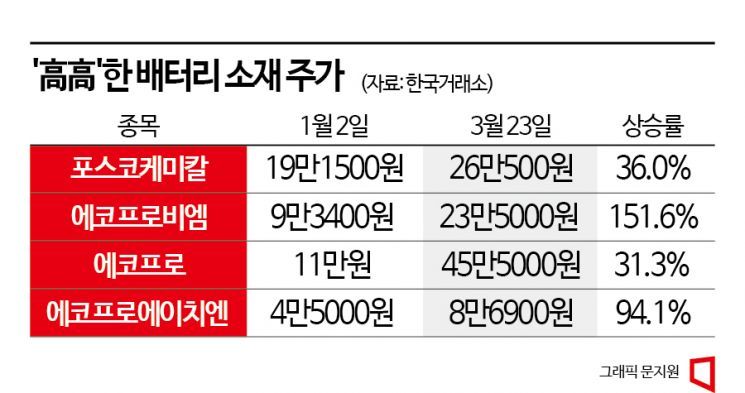
According to the Korea Exchange on the 24th, Posco Chemical's stock price rose 36.0% this year (January 2 to March 23), from 191,500 KRW to 260,500 KRW. EcoPro BM surged 151.6% (93,400 KRW → 235,000 KRW), EcoPro increased 31.3% (110,000 KRW → 455,000 KRW), and EcoPro HN jumped 94.1% (45,000 KRW → 86,900 KRW). During the same period, the KOSPI and KOSDAQ indices rose by only 8.9% (2,225.67 → 2,424.48) and 20.9% (671.51 → 812.19), respectively.
Except for EcoPro, foreign investors and institutions largely drove the stock price increases. In the case of Posco Chemical, institutions have net purchased 81.7 billion KRW worth of shares since the beginning of the year. For EcoPro BM, individuals and foreigners bought 307.5 billion KRW and 283.8 billion KRW, respectively. Foreign investors net purchased 32.7 billion KRW of EcoPro HN shares. Only individuals bought 750.9 billion KRW worth of EcoPro shares.
There are two main reasons for the strong performance of the battery materials sector. First, it is still considered a high-growth industry. Since the electric vehicle market is still in its early stages, battery cell and materials companies have significant potential for expanding orders. No Woo-ho, a researcher at Meritz Securities, said, "Posco Chemical's stock price carries a premium due to the advantage of vertical integration linked with Posco Holdings' lithium business," adding, "With the implementation of the IRA, there is a high possibility of new contracts with domestic companies planning investments in the U.S. throughout this year, and expectations for a revaluation of the graphite anode business have increased following the announcement of detailed IRA enforcement ordinances."
The securities industry estimates Posco Chemical's average operating profit for this year to be 349.5 billion KRW, a 110.69% increase compared to the same period last year. It is expected to grow further to 575.2 billion KRW in 2024 and 1.0231 trillion KRW in 2025.
The securities industry's view on the EcoPro group stocks is divided between 'overvaluation' and 'potential for growth.' Ian Na, a researcher at Yuanta Securities, explained, "Although the recent sharp rise in EcoPro BM's stock price has raised market concerns about valuation, the stock is trading at about 15 times EV/EBITDA based on 2024 enterprise value. Considering an average annual growth rate of over 33% from 2022 to 2025, the valuation remains attractive."
Researcher Ian Na added, "Automobile OEMs and battery cell companies prefer contracts with materials companies that have well-established supply chains outside China, considering the increasingly stringent U.S. IRA policies each year. Expectations for orders within the U.S. are also high, so if order contracts continue, the valuation attractiveness will increase further." EcoPro BM's average operating profit estimate for this year is 606 billion KRW, a 59.18% increase from the previous year. The securities industry forecasts 840.7 billion KRW in 2024 and 1.2571 trillion KRW in 2025, expecting operating profits to surpass 1 trillion KRW within three years.
Second, the fact that it is virtually the only sector benefiting from the IRA also stimulates investor sentiment. Before the IRA's implementation, it was expected that domestic semiconductor and automobile sectors would receive spillover benefits, but the situation is moving in the opposite direction.
The semiconductor sector's earnings forecasts continue to decline due to reduced demand and increased inventory. Moreover, the U.S. Department of Commerce announced a 'guardrail' clause in the CHIPS Act, stipulating that semiconductor companies receiving investment subsidies cannot expand semiconductor production capacity in China by more than 5% over the next 10 years, which is seen as an additional negative factor.
The automobile sector has also become complicated due to the IRA calculations. To receive electric vehicle subsidies in the U.S., batteries and other components must be produced domestically. It is assessed that battery materials are practically the only sector with high growth potential and no IRA-related risks.
However, there is also a view that the rapid rise of battery materials stocks may not continue indefinitely. A battery sector researcher pointed out, "The stock price increase may be separate from the valuation assessment of the battery industry," adding, "Foreign and institutional investors tend to operate passively, focusing on indices like KOSDAQ150, so buying pressure on stocks with large market capitalization can lead to stock price increases."
© The Asia Business Daily(www.asiae.co.kr). All rights reserved.

![Clutching a Stolen Dior Bag, Saying "I Hate Being Poor but Real"... The Grotesque Con of a "Human Knockoff" [Slate]](https://cwcontent.asiae.co.kr/asiaresize/183/2026021902243444107_1771435474.jpg)
















