Analysis of R&D Investment by Samsung, SK, Hyundai Motor, and LG Groups
LG Affiliates Show Relatively High Growth Rate in R&D Investment
"Tax Credit Improvements Needed to Expand R&D Investment"
Despite last year's economic downturn, domestic major companies increased their research and development (R&D) investment. Affiliates of the four major groups?Samsung, SK, Hyundai Motor, and LG?have increased their R&D investments over the past three years. Although market conditions remain unfavorable this year, companies' willingness to invest remains strong. Experts advise that to revitalize this investment atmosphere, the government should take proactive measures such as reforming tax credits.
Asia Economy recently analyzed the business reports disclosed last year by affiliates of the four major groups. As a result, it was confirmed that the R&D investment amounts of many companies all increased. Among Samsung affiliates, Samsung SDI showed a relatively high growth rate by investing 1.0764 trillion KRW, up 22.64% from the previous year. Samsung Electronics invested 24.9292 trillion KRW, up 10.32%, and Samsung Electro-Mechanics invested 557.1 billion KRW, up 1.75%, in R&D.
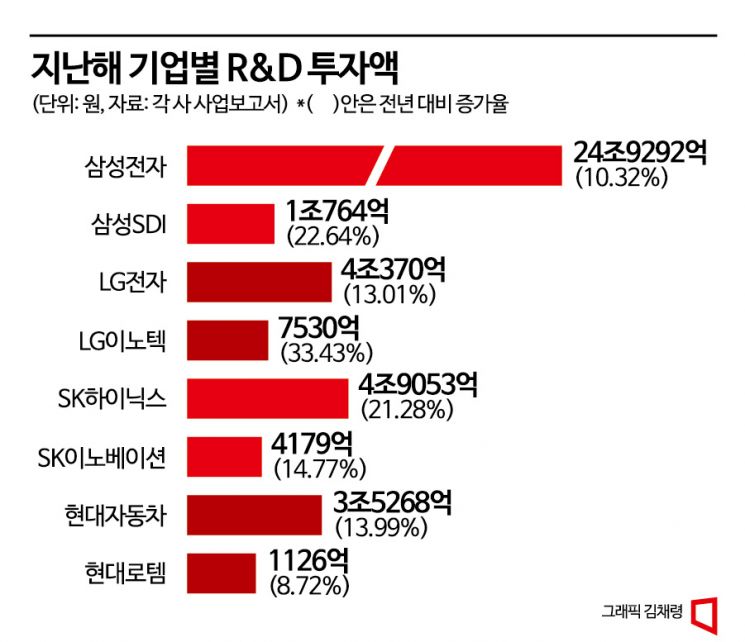
LG affiliates showed higher R&D investment growth rates compared to other group affiliates. LG Energy Solution (876.1 billion KRW) and LG Innotek (753 billion KRW) increased by 33.95% and 33.43%, respectively, last year. LG Chem also invested 1.78 trillion KRW, with a growth rate reaching 27.97%. The eldest sibling, LG Electronics, invested 4.037 trillion KRW, up 13.01%.
SK Hynix spent 4.9053 trillion KRW on R&D last year despite many difficulties due to the semiconductor industry downturn. The investment amount increased by 21.28% compared to the previous year. SK Innovation also recorded 417.9 billion KRW, up 14.77%. Hyundai Motor invested 3.5268 trillion KRW, up 13.99%, and Hyundai Rotem invested 112.6 billion KRW, up 8.72%.
Companies are showing a willingness to expand investments this year as well. As competition intensifies by industry, they are focusing on developing leading technologies to seize the initiative. This year, Hyundai Motor will invest 4.1502 trillion KRW in R&D, an increase of 17.68% compared to last year. The growth rate this year compared to last year is 3.69 percentage points higher. Samsung Electronics and SK Hynix, whose performance shrank due to the sharp drop in semiconductor prices, are also focusing on advanced R&D investments. On the 15th, Lee Jung-bae, President of Samsung Electronics Memory Business Division, said at the shareholders' meeting, "We will continue essential R&D and future investments this year."
The government is also striving to secure R&D budgets to enhance domestic industrial competitiveness. On the 15th, the Ministry of Trade, Industry and Energy announced the 'National Advanced Industry Promotion Strategy' and stated that it will invest a total of 25 trillion KRW over five years in R&D for 12 national strategic technologies, including quantum and artificial intelligence (AI). However, considering the five-year period, the budget is evaluated as insufficient. Incentives to expand private R&D investment are also necessary alongside direct government support.
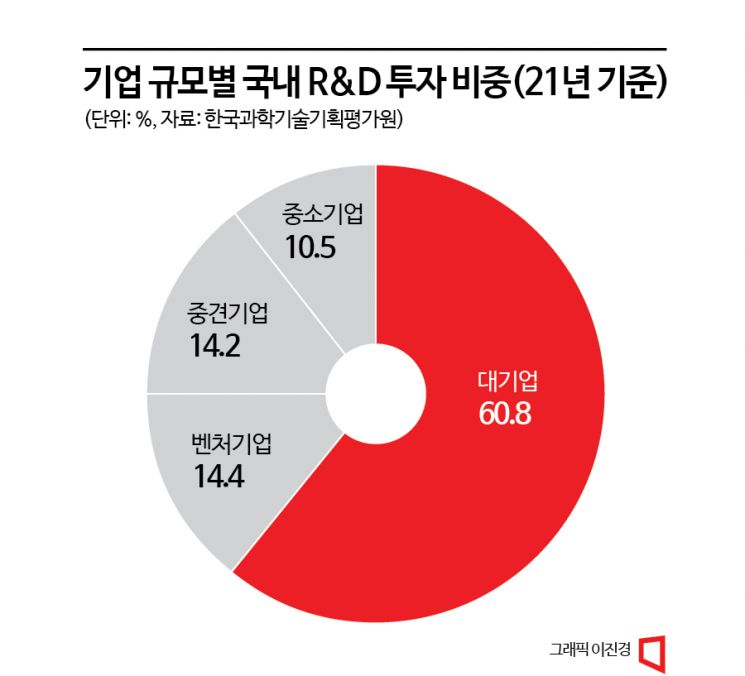
The industry is demanding improvements to the R&D investment tax credit. Currently, even large companies can receive a 30-40% tax credit for R&D investments in national strategic technologies. In contrast, the credit rate for general technologies is only 2%, which is significantly different from the 25% rate for small and medium-sized enterprises. This also differs from major countries such as France (30%), the UK (13%), and the US (up to 10%). Since 60.8% of domestic R&D investment came from large companies as of 2021, there are calls for adjusting the credit rate.
Lee Sang-ho, head of the Economic Policy Team at the Federation of Korean Industries, said, "R&D investment is a high-risk business regardless of company size, so active government support is essential," adding, "It is unreasonable to excessively differentiate tax support levels just because a company is large." The Federation of Korean Industries has submitted a tax law amendment proposal to the Ministry of Economy and Finance this month, arguing that the general industrial R&D tax credit rate should be raised to 6% for large companies.
© The Asia Business Daily(www.asiae.co.kr). All rights reserved.
![Clutching a Stolen Dior Bag, Saying "I Hate Being Poor but Real"... The Grotesque Con of a "Human Knockoff" [Slate]](https://cwcontent.asiae.co.kr/asiaresize/183/2026021902243444107_1771435474.jpg)













