In the nationwide high school joint academic assessment (March mock exam) conducted simultaneously across the country, the Korean language section was analyzed to be easier than the previous CSAT.
According to the Etoos Education Evaluation Research Institute on the 23rd, the Korean language section was designed in a format similar to last year's CSAT, with no new question types, and the overall difficulty, especially the difficulty of elective subjects, was slightly easier compared to last year's CSAT.
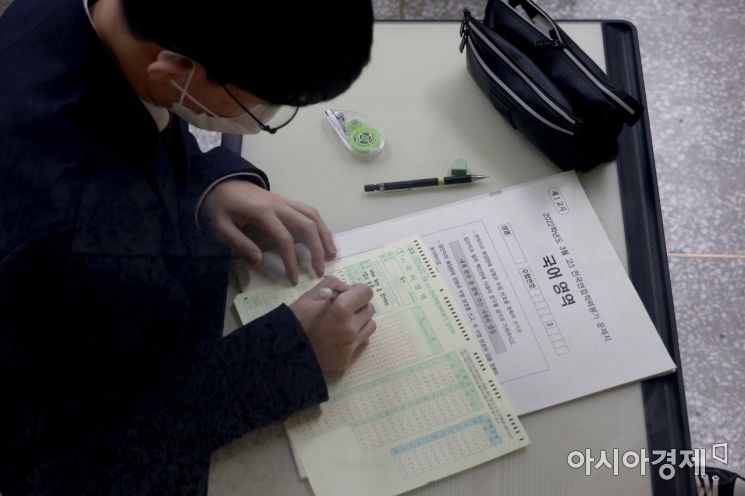 On the 24th, the 2022 academic year March National Joint Academic Achievement Test was conducted for 950,000 high school students from grades 1 to 3 nationwide. Students in grade 3 at Jamsin High School in Songpa-gu, Seoul, are filling out their answer sheets. This academic achievement test is being held simultaneously nationwide on the same day for the first time in three years since the COVID-19 pandemic. Photo by Joint Press Corps
However, it was explained that since this is the first exam taken after entering the third grade, students' adaptation will likely determine the perceived difficulty.
First, in the 'Korean Common' section, the question order placed 17 reading questions first, followed by 17 literature questions. The number of passages, questions, and points for literature and reading were each set to 4 passages, 17 questions, and 38 points.
The 'Korean Common' reading section consisted of 4 passages (including one with 6 questions). In reading, three questions were related to 'reading ability using higher cognition' theory. The humanities passages included texts on '(a) Understanding the concept of imitation through mirror neurons' and '(b) Meme theory explaining cultural transmission from the perspective of memes,' with 6 questions. The social studies passage was about 'registration as information on real estate rights,' with 4 questions, and the science passage covered 'crystallization processes using supercritical fluids,' with 4 questions.
In 'Korean Common' literature, modern poetry included (a) Jeong Ji-yong's "Jangsu Mountain 1" and (b) Go Jae-jong's "Listening to Silence," grouped for 3 questions. Classical poetry included (a) Gu Gang's "Chongseokgok," (b) Jang Bok-gyeom's "Gosanbyeolgok," and modern essays included (c) Baek Seok's "East Sea," grouped for 6 questions. Classical novels featured the anonymous "I Daebongjeon" with 4 questions, and modern novels included Lee Seung-woo's "Old Diary" with 4 questions. Unlike last year's CSAT literature questions, which were distributed as 4, 5, 4, and 4 questions per set, this exam had 3, 6, 4, and 4 questions per set.
Although 'view' questions using illustrations appeared in literature, they are not considered a new type since they focus on understanding the content of the works. No works linked to EBS textbooks were included, and although many unfamiliar works were presented, the question types were similar to previous CSAT and mock exams, so the difficulty is expected to be not high.
In the 'Korean Elective' section, 11 questions each for Speech and Composition, and Language and Media were arranged from questions 35 to 45. In Speech and Composition, 3 questions were based on a career lecture related to traditional architecture, 5 questions on students' conversations for writing a reflection on a healing agriculture trip and a promotional text for the trip, and 3 questions used a draft text about safety accidents at a camping site.
In Language and Media, 5 language questions covered rules related to abbreviations in Korean spelling, honorific expressions, phonological changes, and case particles in Middle Korean. The media section was composed of 3+3 questions: 3 questions based on an internet broadcast about short-form content, and 3 questions based on SNS posts about an eco-friendly experience event and the use of online video conferences.
Kim Byung-jin, director of the Etoos Education Evaluation Research Institute, explained, “It is important to analyze the question formats and the process of finding answers focusing on this mock exam and last year's CSAT questions, and based on this, set the direction for future learning.”
© The Asia Business Daily(www.asiae.co.kr). All rights reserved.
![Clutching a Stolen Dior Bag, Saying "I Hate Being Poor but Real"... The Grotesque Con of a "Human Knockoff" [Slate]](https://cwcontent.asiae.co.kr/asiaresize/183/2026021902243444107_1771435474.jpg)
















