The Korea Forest Service will expand cooperation and contributions with the international community in line with South Korea's elevated status in the global forestry sector. Ultimately, the underlying strategy is to strengthen the nation's competitiveness through forestry and emerge as a pivotal global country.
On the 23rd, the Korea Forest Service announced the "2nd International Forestry Cooperation Promotion Strategy" (hereinafter referred to as the Promotion Strategy). This mid- to long-term strategy, set for five-year intervals, outlines South Korea's goals and directions in international forestry cooperation from 2023 to 2027.
The core objective is to increase South Korea's contribution to addressing global issues such as climate change in the forestry sector, while generating national benefits through securing overseas carbon emission rights and expanding exports of forest products.
Recently, as the COVID-19 pandemic shifts toward an endemic phase, the importance of the forestry sector has also increased. Forestry is recognized as a key means to address global issues such as green recovery and climate change response.
In particular, South Korea's status has risen from a recipient country of international aid in the late 2000s to a donor country. In this context, the Korea Forest Service has actively engaged in forestry aid activities through various international forestry cooperation projects, including the Mongolian Green Belt creation project, Indonesia peatland restoration project, and Vietnam mangrove forest restoration project.
Furthermore, following the successful conclusion of the 15th World Forestry Congress held in Seoul last year, South Korea's standing in the international forestry sector has been further elevated. The Korea Forest Service explains that there is growing international demand for South Korea to serve as a bridge between developed and developing countries as a leading nation in land greening.
The Promotion Strategy was established with a focus on responding to these international demands and enhancing national interests.
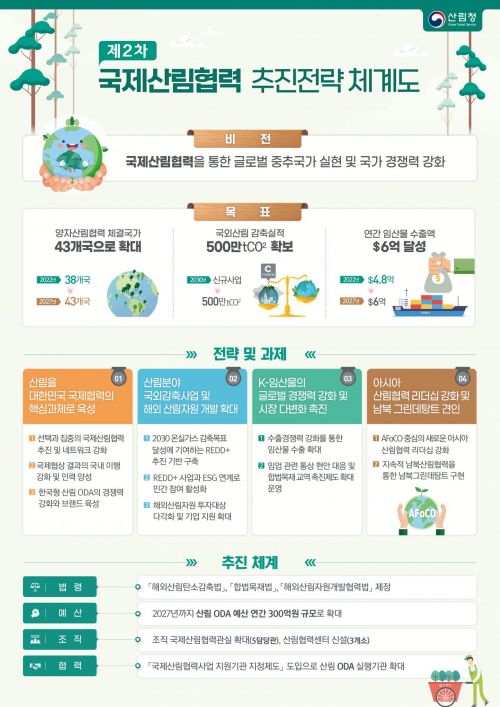
With the vision of "Realizing a Global Pivotal Country and Strengthening National Competitiveness through International Forestry Cooperation," this strategy pursues three main goals: expanding bilateral forestry cooperation countries, securing greenhouse gas reduction achievements through REDD+ (Reducing Emissions from Deforestation and forest Degradation Plus), and increasing forest product export volume.
First, the Korea Forest Service aims to newly include countries in Latin America, Africa, and other regions as targets for bilateral forestry cooperation.
South Korea opened the door to international forestry cooperation starting with Indonesia in 1987. To date, it has established bilateral cooperation relationships in forestry with a total of 38 countries. However, these bilateral cooperation relationships have mainly been centered in Asia. Moving forward, the Korea Forest Service plans to expand the base to Latin America and Africa, increasing the number of bilateral forestry cooperation countries to 43.
Securing greenhouse gas reduction achievements focuses on utilizing overseas forests through REDD+ to raise greenhouse gas reduction results to 5 million tons of CO2 by 2030. REDD+ is a project that reduces greenhouse gas emissions by utilizing forests in developing countries and is recognized by international organizations such as the United Nations as "the most efficient and capable of securing large-scale greenhouse gas reduction results."
Accordingly, the Korea Forest Service plans to concentrate on establishing domestic legal and institutional foundations for the full-scale promotion of REDD+ projects and preparing support measures for participating companies.
The final goal of expanding forest product exports aims to achieve an annual export volume of 600 million USD by 2027.
South Korea's annual forest product export volume has steadily increased from 300 million USD in 2012 to 480 million USD last year over the past decade. However, recent global economic downturns and consumption contractions present unfavorable conditions, making future export prospects uncertain.
Reflecting this situation, the Korea Forest Service plans to focus on developing new strategic forest product items and pioneering emerging markets such as the European Union and Southeast Asia. Additionally, it will implement strategies to strengthen competitiveness by fostering organizations supporting forest product export companies, establishing export hubs, discovering strategic items, and diversifying export markets.
Nam Sung-hyun, Administrator of the Korea Forest Service, stated, "The Korea Forest Service has established the mid- to long-term international forestry cooperation strategy (Promotion Strategy) with the purpose of realizing global value through forestry, fulfilling national policy tasks, and creating national interests. We will make every effort to execute the Promotion Strategy so that Korea's forestry policies contribute to global forest greening while providing opportunities to enhance national interests in economic, social, and environmental sectors."
© The Asia Business Daily(www.asiae.co.kr). All rights reserved.


















