Despite the bankruptcy crisis of Silicon Valley Bank (SVB) in the United States, Christine Lagarde, President of the European Central Bank (ECB), who implemented a big step (a 0.5 percentage point increase in the benchmark interest rate), has warned of 'wage-driven inflation.' On the 22nd (local time), following the U.S. Federal Reserve's (Fed) 0.25 percentage point rate hike, the ECB, which has not eased its tightening stance despite the SVB collapse, is expected to raise interest rates again at its next monetary policy meeting.
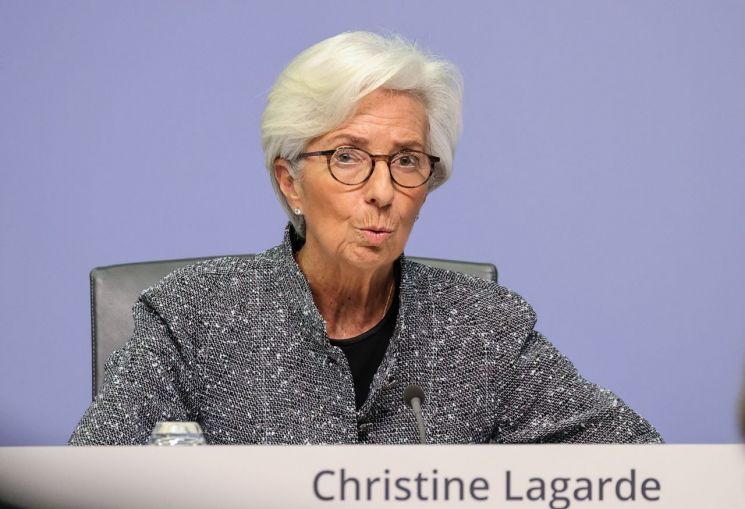
Christine Lagarde, ECB President, stated on the day, "There is no clear evidence that core inflation has entered a downward trend," adding, "Inflation remains high and uncertainty is increasing."
She explained, "The recent rate hikes by the ECB have now begun to take effect," and "The signal that inflation remains high means that interest rates need to be raised to sufficiently restrictive levels to slow demand."
As President Lagarde mentioned, European prices are hardly easing. In February, the Eurozone's core Consumer Price Index (CPI), excluding food and energy, rose by 5.6%, up from 5.3% the previous month. The increase in core inflation, which shows the underlying trend of prices, indicates that upward pressure on prices may expand further. This was the background for the ECB's surprise 0.5 percentage point rate hike at the monetary policy meeting held on the 16th, despite the impact of the SVB bankruptcy.
President Lagarde particularly expressed concern that the power struggle between companies and workers could act as an additional inflationary pressure in the future. She said, "Workers and companies must fairly share the losses caused by inflation," adding, "This will ease wage and price pressures." She further stated, "If both sides try to minimize losses unilaterally, corporate profits, wages, and prices could all rise simultaneously," adding, "The risk of a tit-for-tat dynamic is increasing."
Regarding the future interest rate path, she said that due to high uncertainty, the ECB will rely on 'data.' She explained, "The higher the uncertainty, the more important it is to base decisions on indicators," and "This means we will neither promise to raise rates further nor to end rate hikes." The ECB is scheduled to hold a monetary policy meeting in May.
Krishna Guha, Head of Policy and Strategy at U.S. investment bank Evercore ISI, analyzed in this regard, "Lagarde's remarks suggest a stronger confidence that recent turmoil in the banking sector will not disrupt the ECB's rate hike plans."
Voices within Europe also call for the ECB to maintain its tightening stance for the time being. Joachim Nagel, President of the German Central Bank, recently stated in an interview with a British media outlet, "Eurozone monetary authorities must firmly continue raising interest rates to curb inflation."
In particular, the swift resolution of the Credit Suisse (CS) crisis in Europe, which fell into trouble after the SVB bankruptcy, is also expected to influence the decisions of monetary policy authorities. Initially, there were many opinions predicting the ECB would hold rates due to concerns that financial instability might spread, but with active intervention by financial authorities quickly resolving the situation, there is also analysis that the central bank may place more emphasis on the fight against inflation.
© The Asia Business Daily(www.asiae.co.kr). All rights reserved.

















