Sharp 9.7 Won Drop in Exchange Rate Amid Fed Easing Outlook
High-Intensity Tightening Difficult Due to Significant Financial Instability
Largest Ever US-Korea Interest Rate Gap
Possibility of Holding Rates Steady if Exchange Rate and Capital Outflows Stabilize
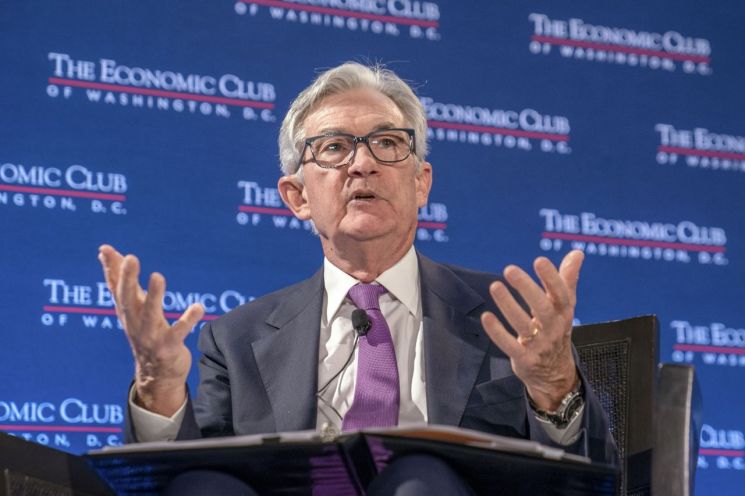
The U.S. Federal Reserve (Fed) continued its tightening stance by raising the benchmark interest rate by 0.25 percentage points, but the won-dollar exchange rate plunged sharply. This is interpreted as a result of the dollar's strength weakening as many now believe that the U.S. tightening is nearing its end amid recent global financial crisis concerns. Although the interest rate gap between Korea and the U.S. widened to a record high of 1.5 percentage points, the exchange rate stabilized, increasing the likelihood that the Bank of Korea will keep its benchmark rate unchanged at the Monetary Policy Committee meeting on April 11. The Bank of Korea maintains that it needs to monitor the exchange rate, capital outflows, and inflation trends further.
Won-Dollar Exchange Rate Plummets Despite U.S. Rate Hike
On the 23rd, in the Seoul foreign exchange market, the won-dollar exchange rate opened at 1,298 won, down 9.7 won from the previous trading day, falling below the 1,300 won level. This is the lowest intraday low since the 20th (1,299 won). The exchange rate dropped to as low as 1,297.1 won early in the session and has been fluctuating below the 1,300 won level since. Despite nine consecutive rate hikes by the Fed, the growing view that the U.S. tightening monetary policy is entering its final phase is analyzed as a factor behind the won-dollar exchange rate decline.
On the day, the Fed stated that "inflation remains elevated," but removed the phrase about the "continued increase" of the benchmark rate from its policy statement, leaving open the possibility of halting further hikes. This was interpreted as meaning that, given the recent financial instability such as the Silicon Valley Bank (SVB) collapse, aggressive rate hikes are no longer feasible. The market expects the Fed to raise rates by one more 0.25 percentage point before stopping at a final range of 5.00?5.25%.
If the U.S. tightening halts, the won-dollar exchange rate is likely to stabilize. The dollar index, which measures the dollar's value against six major currencies, currently stands at 102.41 and is on a downward trend. This is a lower level compared to early this month when it surged above 105 due to the 'King Dollar' effect. However, if financial instability causes foreign investors to withdraw funds from the domestic stock market and won selling increases, the decline in the won-dollar exchange rate could be limited.
Seunghyuk Kim, a researcher at NH Futures, explained, "Fed Chair Jerome Powell officially acknowledged risks in the banking system and mentioned that a rate freeze is possible, so downward pressure on the exchange rate is expected to continue. However, won weakness due to risk aversion sentiment, payment demand from importers, foreign investors' exit from the domestic stock market, and increased won selling are expected to offset the downward pressure on the exchange rate."
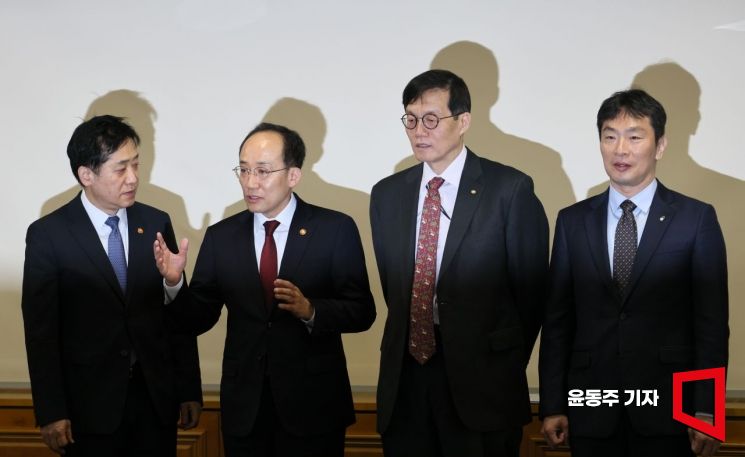 Deputy Prime Minister for Economy Choo Kyung-ho, Bank of Korea Governor Lee Chang-yong, Financial Services Commission Chairman Kim Ju-hyun, and Financial Supervisory Service Governor Lee Bok-hyun attended the "Emergency Macroeconomic and Financial Meeting" held on the 23rd at the Korea Federation of Banks building in Jung-gu, Seoul, and were talking before the meeting started. Photo by Yoon Dong-joo doso7@
Record High Korea-U.S. Interest Rate Gap... Bank of Korea on Alert
Due to the Fed's rate hikes, the Korea-U.S. benchmark interest rate gap widened to 1.5 percentage points, the largest in over 22 years since May?October 2000. Although foreign capital outflows have slowed this month and the exchange rate has remained relatively stable around 1,300 won, the widening interest rate gap could still lead to increased financial instability in the future. For the Bank of Korea, the widening Korea-U.S. interest rate gap is a factor that increases pressure to raise the benchmark rate. However, if concerns about exchange rates or capital outflows are not significant due to recent financial instability such as real estate project financing (PF), there is room to maintain the current 3.5% rate.
Bank of Korea Governor Changyong Lee said at a press conference after last month's Monetary Policy Committee meeting, "If the (Korea-U.S.) gap widens too much, it could be a factor that increases volatility, so we are considering it. When the (Korea-U.S.) monetary policy gap widens, our task is to carefully decide monetary policy by considering all options, such as how much exchange rate fluctuation to tolerate, whether to use foreign exchange reserves to prevent concentration, or whether it is better to raise interest rates."
The extent to which the Fed's rate hikes and U.S.-originated financial instability spread will be an important variable in the Bank of Korea's benchmark rate decision at next month's Monetary Policy Committee meeting. On the same day, the Bank of Korea held a 'Market Situation Review Meeting' chaired by Deputy Governor Seunghun Lee to assess the international financial market and domestic financial and foreign exchange market conditions. The Bank of Korea judged that the Fed's dovish (monetary easing preference) decision was in line with expectations and that the U.S. dollar is weakening, but volatility could increase in the future.
Deputy Governor Lee emphasized, "In the current situation where market caution about financial instability remains high following the SVB and Credit Suisse (CS) incidents, volatility in domestic and international financial markets can expand frequently depending on developments in financial stability and changes in expectations regarding U.S. monetary policy. We will closely monitor changes in external conditions, domestic price variables, and capital inflow/outflow trends and take proactive market stabilization measures if necessary."
© The Asia Business Daily(www.asiae.co.kr). All rights reserved.


















