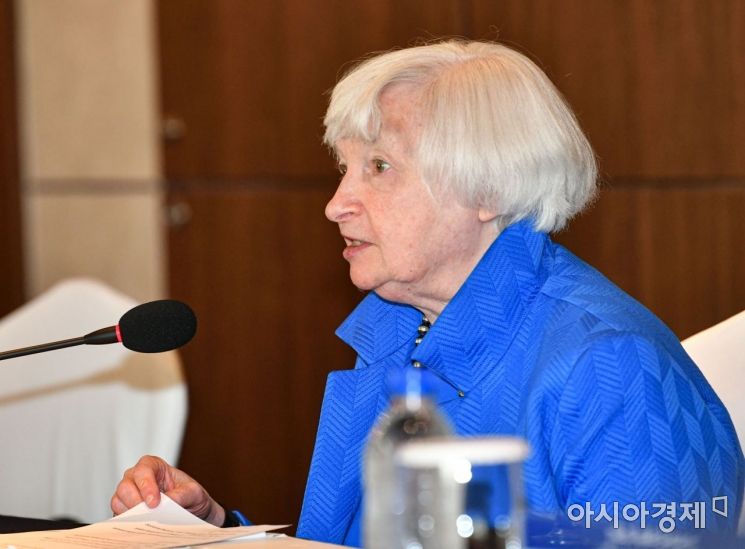
U.S. Treasury Secretary Janet Yellen stated that she is not considering "blanket insurance" that would uniformly protect all bank deposits in response to financial market instability caused by the collapse of Silicon Valley Bank (SVB). The New York stock market fluctuated after Yellen reversed her previous suggestion the day before that full coverage of bank deposits might be possible.
On the 22nd (local time), Yellen appeared at a Senate Appropriations Committee financial subcommittee hearing and said, "Nothing has been discussed or considered regarding blanket insurance that protects all bank deposits." However, she responded that discussions could be held regarding the current deposit insurance limit of $250,000.
The market was shocked when Yellen, who had indicated the day before that additional support could be provided if necessary to prevent the SVB-related negative impact from spreading to the entire banking sector, shifted to a more conservative stance within a day. On the 22nd, the Dow Jones Industrial Average closed down 1.63% at 32,030.11, while the S&P 500 and Nasdaq indices fell 1.65% and 1.60%, respectively.
Previously, Yellen had expressed willingness to guarantee payments again if other banks besides SVB and Signature Bank faced liquidity crises. The market interpreted this as the U.S. government showing intent to assume all bank deposits, leading to a rebound in the New York stock market.
However, on this day, Yellen drew a line by stating, "Full protection of all deposits can only be allowed when the banking crisis is considered a systemic risk, such as a chain reaction bank run," and added, "Systemic risk of banks will be diagnosed and decided on a case-by-case basis." In other words, she indicated that full deposit guarantees would only be considered for banks facing crises due to systemic financial system problems.
According to Bloomberg, the U.S. Treasury is currently reviewing a plan to temporarily raise the insured deposit limit of $250,000 without congressional approval.
While permanent changes to the Federal Deposit Insurance Corporation (FDIC) deposit insurance limit require congressional consent, temporarily relaxing the limit can be covered by the Treasury's $30 billion Exchange Stabilization Fund.
© The Asia Business Daily(www.asiae.co.kr). All rights reserved.
!["The Woman Who Threw Herself into the Water Clutching a Stolen Dior Bag"...A Grotesque Success Story That Shakes the Korean Psyche [Slate]](https://cwcontent.asiae.co.kr/asiaresize/183/2026021902243444107_1771435474.jpg)
















