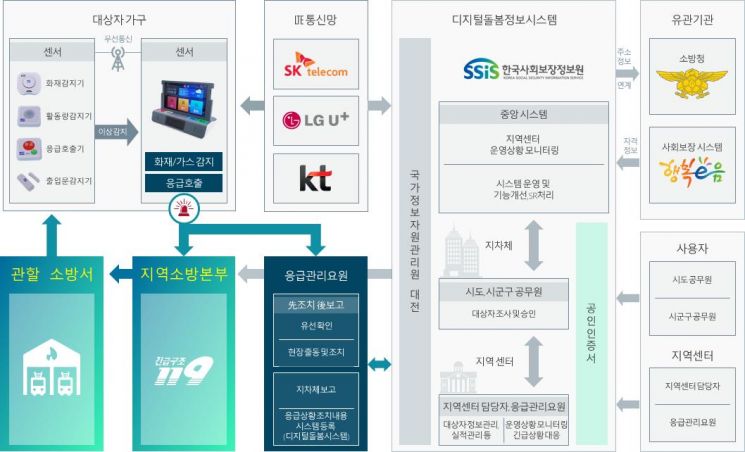
Gyeonggi Province will increase the number of recipients of the 'Emergency Safety and Security Service,' which installs and manages emergency call devices linked to 119 for vulnerable groups in case of emergencies, to 30,987 this year.
The Emergency Safety and Security Service is a project that installs ICT-based equipment in the homes of vulnerable groups such as elderly living alone or people with disabilities to assist rapid rescue by 119 in emergencies such as fires or falls.
It also monitors hourly activity levels (heart rate and respiration) regularly and conducts periodic welfare checks and safety education. Installed devices include door opening sensors (tablet PC, radar sensor), fire, activity, and door detectors, and emergency call devices.
Since 2012, when the number of service recipients was 6,364, the province has expanded the service to currently provide it to 26,687 people. By the end of this year, an additional 4,300 people will be added, expanding the total to 30,987.
In 2022 alone, the Emergency Safety and Security Service identified 3,243 actual emergency situations together with 119, minimizing damage.
To ensure thorough management of recipients, the province will invest 380 million KRW of its own budget to hire 12 additional emergency management personnel in April. Once recruitment is complete, a total of 98 emergency management personnel will be active. During the first half of the year, joint consultations with city and county offices will be held to listen to the difficulties of emergency management personnel and improve their working conditions.
Those wishing to use the Emergency Safety and Security Service can apply by visiting administrative welfare centers or city, county, and district regional centers (such as senior welfare centers and social welfare centers) or by phone.
Eligible applicants are elderly aged 65 or older who live alone and are basic livelihood security recipients, lower-income bracket, basic pension recipients, or elderly recognized by the basic local government head as requiring constant protection considering their living conditions and health status.
Among people with disabilities, those with activity support grades of 13 or higher who live alone or in vulnerable households, or those recognized by the basic local government head as requiring constant protection considering their living conditions, are also eligible.
Kim Neungsik, Director of the Welfare Bureau of the province, emphasized, "We have strengthened a 24/7 emergency response system for the safety of elderly and disabled people living alone," adding, "We will continue to expand the number of recipients and improve services to enhance support."
© The Asia Business Daily(www.asiae.co.kr). All rights reserved.
![Clutching a Stolen Dior Bag, Saying "I Hate Being Poor but Real"... The Grotesque Con of a "Human Knockoff" [Slate]](https://cwcontent.asiae.co.kr/asiaresize/183/2026021902243444107_1771435474.jpg)











