The U.S. central bank, the Federal Reserve (Fed), continued its benchmark interest rate hike trajectory at the March Federal Open Market Committee (FOMC) meeting but clearly signaled that it could end the rate hike cycle sooner than expected due to recent heightened concerns over banking risks. A key hint was that the Fed did not raise the ‘dot plot’ reflecting future rate projections and removed the phrase 'ongoing increases' from the policy statement. Market analysis widely suggests that about one more rate hike remains.
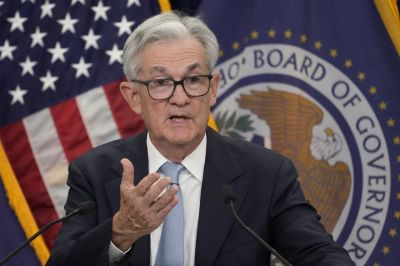
◆Looking at the new dot plot...year-end rate unchanged at 5.1%
The dot plot released by the Fed on the afternoon of the 22nd (local time) immediately after the rate decision showed the year-end rate forecast at 5.00?5.25% (median 5.1%), the same level as the December dot plot forecast last year. Considering that the U.S. benchmark rate entered the 5% range with a baby step (0.25 percentage point increase) on this day, this signals that one more 0.25 percentage point hike remains.
This FOMC attracted market attention as the Fed’s first rate decision following the recent Silicon Valley Bank (SVB) collapse, which heightened concerns about a banking system crisis. The rapid tightening since last year was confirmed to have directly worsened the asset quality of banks including SVB, putting the Fed’s tightening path on hold. Contrary to Fed Chair Jerome Powell’s earlier warning that the terminal rate could be higher, the dot plot was not raised. The median year-end rate presented is even lower than the market consensus of 5.375% compiled by Bloomberg.
Bank of America (BoA) stated, "It appears the Fed acknowledged credit tightening due to regional bank stress and deemed it appropriate to lower the terminal rate forecast from a few weeks ago," adding, "An early end to the tightening cycle is expected." BoA revised its previous forecast of 0.25 percentage point hikes in both May and June to a single hike in May. Morgan Stanley also predicted the cycle would end with a 0.25 percentage point hike in May, with a terminal rate of 5.0?5.25%.
However, the dot plot’s forecast for next year’s rate was raised from 4.1% to 4.3%. Due to persistent inflation, it is expected that the Fed will maintain a relatively high rate level for a considerable period even after ending the hike cycle within the year. The Fed’s Summary of Economic Projections (SEP) released that day also raised the inflation forecast (Personal Consumption Expenditures, PCE) for this year from 3.1% to 3.3%. The real Gross Domestic Product (GDP) growth forecast for this year was lowered by 0.1 percentage point to 0.4%.
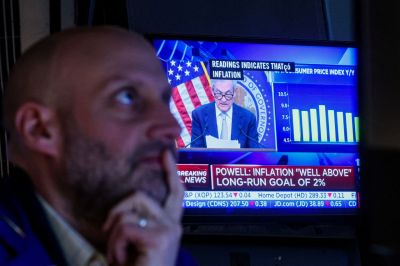
◆Removal of 'ongoing increases' leads Wall Street to call it 'dovish'
On Wall Street, the policy statement released immediately after the March FOMC is widely seen as signaling the final phase of rate hikes. The most notable change in the statement was the removal of the phrase 'ongoing increases are appropriate.' This phrase had been expected to be removed when the Fed signaled a slowdown last month. Mark Zandi, former economic advisor to the George W. Bush administration, said it "opened the door to the possibility of the last rate hike."
Instead, the phrase ‘some additional policy firming may be appropriate’ was added. Typically, 'policy firming' implies tightening, but in this statement, it is interpreted as policy flexibility allowing a pause in rate hikes if necessary (Bloomberg) or indicating about one or two more 0.25 percentage point hikes (BoA). Chair Powell emphasized, "Please pay attention to the words 'some' and 'may,'" explaining that replacing 'ongoing' reflects uncertainty.
Additionally, phrases such as 'inflation has eased somewhat' and references to the impact of the Ukraine war were removed, while new phrases like 'the banking system is sound and resilient' and 'credit conditions for households and businesses will tighten due to recent events' were added. Investment bank RBC commented, "The Fed unanimously raised rates by 0.25 percentage points, but the tone on further hikes weakened," calling it "dovish" (favoring monetary easing).
In particular, the banking system crisis concerns triggered by the recent SVB collapse highlight that the Fed’s key policy tasks include not only 'inflation stabilization' but also 'financial system protection.'
At the post-FOMC press conference, Chair Powell acknowledged that the SVB fallout led the Fed to "consider pausing rate hikes before the meeting" when asked about stopping rate increases. He noted, "Events in the banking system over the past two weeks are likely to cause credit tightening for households and businesses," pointing out that such credit tightening could substitute for rate hikes. However, he added, "It is too early to know the full extent of these effects," and made clear that the Fed will respond with policy actions depending on future developments.
The Wall Street Journal (WSJ) warned, "The Fed is walking a tightrope between inflation and financial instability," adding, "While the financial system is not as vulnerable as during the 2008 global financial crisis, the Fed will find it difficult to separate these two challenges."
© The Asia Business Daily(www.asiae.co.kr). All rights reserved.

![A Woman with 50 Million Won Debt Clutches a Stolen Dior Bag and Jumps... A Monster Is Born [Slate]](https://cwcontent.asiae.co.kr/asiaresize/183/2026021902243444107_1771435474.jpg)
















