Democratic Party Holds Party Affairs Committee Meeting on Day of Indictment, Decides to Retain Party Leader
From Prosecutor's Timeline to Court's Timeline: Round 2
Concerns Raised That Situation May Worsen as Trial Intensifies
The Democratic Party of Korea swiftly decided to allow Representative Lee Jae-myung, who was indicted without detention on charges of ‘Wirye and Daejang-dong development corruption’ and ‘illegal donations to Seongnam FC,’ to retain his position as party leader by holding a party affairs committee meeting. Although this move appears to quickly settle the controversy over Lee’s position amid judicial risks, the party’s likelihood of being drawn deeper into Lee’s ‘trial quagmire’ has significantly increased.
On the 22nd, the Democratic Party held a party affairs committee meeting at the National Assembly and unanimously decided not to apply Article 80 of the party constitution to Representative Lee and lawmakers Ki Dong-min and Lee Su-jin. The charges against the three were deemed political oppression.
The Democratic Party’s Article 80, Paragraph 1, stipulates that party officials at all levels who are indicted for legal violations related to corruption, such as bribery and illegal political funds, shall have their duties suspended immediately upon indictment, and investigations may be requested from the respective ethics committees. However, following the party convention last August, an exception clause was added stating that “if it is recognized that there are unjust reasons such as political oppression, a different decision may be made through a resolution of the party affairs committee.”
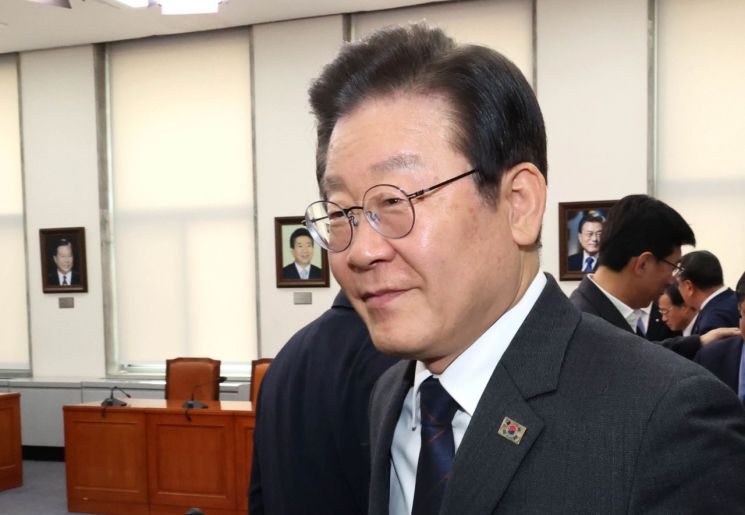
The Democratic Party responded unusually swiftly to this controversy. When the prosecution decided to indict Representative Lee without detention, the Supreme Council convened and summoned the party affairs committee, allowing Lee to maintain his position as party leader around 6 p.m.
Regarding the convening of the party affairs committee on the day of Lee’s indictment, Democratic Party spokesperson Kim Eui-gyeom explained to reporters, “It was already very clear that this was political oppression, and there was a consensus that the party needed to quickly show unity against this oppressive intent.” He added, “As Lee himself expressed, the prosecution’s indictment was a predetermined outcome. Since this was anticipated, the Supreme Council had long agreed that if an indictment occurred, the party affairs committee would be promptly convened to make a resolution.”
In a situation where controversy over Lee’s position was inevitable immediately after the indictment, the party affairs committee was swiftly convened to quell disputes over the leadership structure at an early stage.
Moreover, no one reportedly objected to defining the indictment of Lee and others as ‘political oppression,’ confirming the Democratic Party’s determination to quickly resolve the issue. Spokesperson Kim stated, “Thirty-nine members participated in writing, and 30 attended in person at the party affairs committee,” adding, “All 69 members agreed to apply the exception.”
Logically, the Democratic Party had already established the position that the prosecution’s investigation of Lee was political oppression. The party affairs committee essentially formalized this conclusion procedurally. Democratic Party lawmaker Woo Sang-ho said on CBS Radio regarding Lee’s indictment without detention, “This matter was already defined as political oppression at the party caucus,” and “According to Article 80, Paragraph 3 of the party constitution, it will be decided through the party affairs committee resolution to maintain party positions by defining it as political oppression.” He emphasized, “This issue is unlikely to become as serious a controversy as the media anticipated.”
However, Lee’s judicial risk seems to be moving from the first round to the second. After a large-scale defection within the Democratic Party was confirmed during the process of handling the motion to arrest Lee, the party leadership, including Lee, quickly moved to manage the situation internally. The party affairs committee also showed this unified consensus.
Within the Democratic Party, unlike the investigation phase where the prosecution held the initiative, it is expected that the trial phase will lead to disputes over facts due to defense arguments. However, skepticism about truth verification in court has also been raised.
Democratic Party lawmaker Kim Jong-min, in an interview with BBS Radio, referenced the time of former Justice Minister Cho Kuk, saying, “I thought the public would understand after the investigation ended and the trial began, but after the investigation ended and the trial started, things changed.” He added, “During the trial, even a small unfavorable fact had a huge negative impact on the defendant.” Kim said, “The trial should not be taken lightly; politically, it is an extremely burdensome process,” and “Various debates, conclusions, and fact-finding processes are not easy for Representative Lee.”
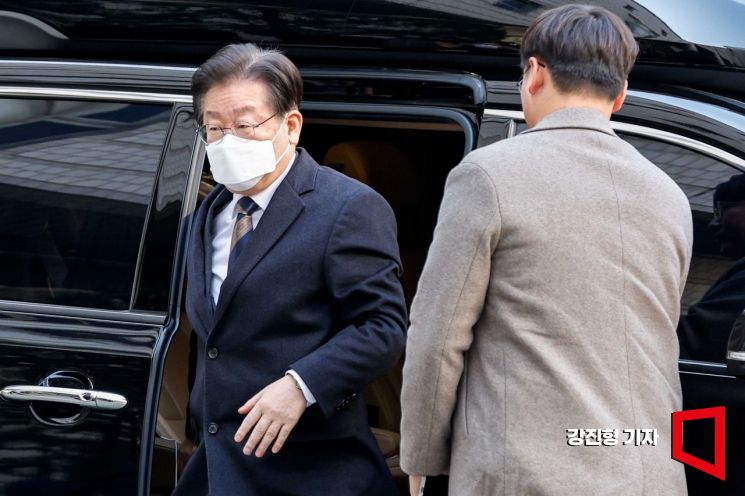 Lee Jae-myung, the leader of the Democratic Party of Korea, who is accused of making false statements during the presidential election process, is attending the first trial held at the Seoul Central District Court in Seocho-gu, Seoul on the 3rd. Photo by Kang Jin-hyung aymsdream@
Moreover, the burden of this controversy is not only on Lee but also on the Democratic Party. Kim said, “Lee must go all the way to the Supreme Court, and the party going together is a huge disturbance and burden,” adding, “Especially with elections approaching, it is even more so.” He continued, “There is no avoiding the question of whether it is appropriate to continue as party leader while undergoing this trial process until the general election,” and “The expectation that things will improve during the trial is even worse for the general public.”
As Kim pointed out, every move during Lee’s trial will directly translate into a risk for the Democratic Party’s general election. Furthermore, the trial schedule itself may restrict Lee’s ability to perform his duties as party leader. Already facing a trial under the Public Official Election Act, having another trial schedule underway imposes time constraints on Lee.
Additionally, the possibility of further investigations and indictments by the prosecution is a burdensome issue not only for Lee but also for the Democratic Party.
© The Asia Business Daily(www.asiae.co.kr). All rights reserved.


















