Ministry of Science and ICT to Announce Acquisition Strategy on the 22nd Afternoon
The government has decided to independently develop 100 future materials necessary for key strategic technologies over the next 10 years. This is to prepare for the increasingly intense competition for technological supremacy and the restructuring of supply chains.
On the afternoon of the 22nd, Lee Jong-ho, Minister of Science and ICT, announced the "Strategy to Secure Future Materials Supporting National Strategic Technologies" at the InterContinental COEX in Seoul, which contains these details. Earlier, the government had selected and decided to foster 12 essential national strategic technologies in October last year. In line with this, the necessity for research and development on materials was also raised.
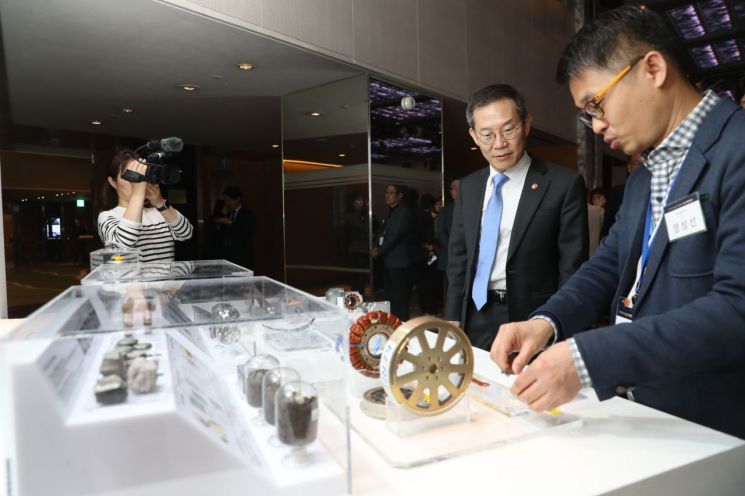 Minister of Science and ICT Jong-seop Lee (center) is examining materials displayed at the Future Materials Acquisition Strategy Presentation and Expert Meeting held at COEX, Seoul, on the afternoon of the 22nd. Photo by Ministry of Science and ICT
Materials are fundamental substances that constitute parts and products and determine their performance, representing a field that requires a multidisciplinary convergent approach. Considering the 12 national strategic technology fields, the Ministry of Science and ICT has identified 100 future materials needed in the future and established a technology roadmap to secure them within the next 10 years.
The Ministry of Science and ICT plans to operate mission-oriented research and development projects and continuously strengthen the digital-based materials ecosystem to successfully secure future materials. To this end, universities, government-funded research institutes, and companies will communicate regularly based on the value chain to simultaneously promote research and development, while annually identifying material technology challenges and updating technology goals.
Additionally, through the linkage of research by government-funded research institutes in the materials field with national research projects, inter-ministerial and inter-project cooperation, the public and private sectors will collaborate to seamlessly support the entire cycle of securing future materials and enhance the effectiveness of research and development. The National Materials Data Station (K-MDS) will be activated, and pilot projects will be promoted to accelerate material development using data and intelligent robots.
Minister Lee Jong-ho of the Ministry of Science and ICT stated, “To get ahead in the technological supremacy competition among major countries, securing future materials that realize technology is crucial,” and added, “We will continue to communicate closely with the market to discover impactful materials and provide support to secure technological superiority.”
© The Asia Business Daily(www.asiae.co.kr). All rights reserved.

















