Budget Allocation to Address High Inflation Ahead of Next Month's Election
Controversy Over 'Populist' Measures Like Cash Support for Low-Income Groups
Ahead of next month's local elections and by-elections, the Japanese government has decided to release 2 trillion yen (19.75 trillion won) under the pretext of alleviating high inflation. The funds are planned to be widely used for reducing electricity and gas tax burdens, among other measures, but the inclusion of cash handouts such as lump-sum payments to low-income households has drawn criticism within Japan as being 'election-oriented.' It is seen as a measure conscious of the support rate for the Kishida administration, which has just entered a recovery phase.
On the morning of the 22nd, Chief Cabinet Secretary Matsuno Hirokazu held a meeting of the "Comprehensive Measures Headquarters on Prices, Wages, and Living" at the Prime Minister's Office and announced these measures. The Japanese government decided to additionally spend about 2 trillion yen from the 2022 budget contingency funds.
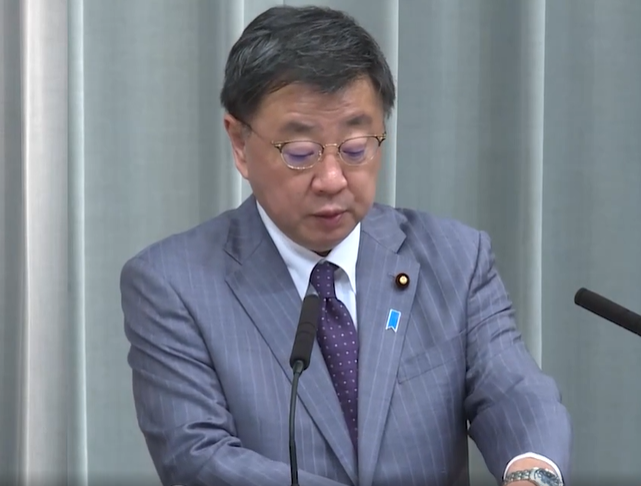 Matsuno Hirokazu, Chief Cabinet Secretary, is announcing the price countermeasures on the 22nd. (Photo by the Official Website of the Prime Minister's Office of Japan)
First, the government will increase the grants distributed to local governments by 1.2 trillion yen (11.8 trillion won). The distinctive feature is that local governments are allowed to respond according to their circumstances. Of the local government grants, 500 billion yen (4.9 trillion won) will be used for cash support to low-income households severely affected by high inflation. Looking into the details, low-income households will receive a lump-sum support payment based on 30,000 yen (296,000 won). Local governments are given discretion to reduce the amount of support in exchange for expanding the number of recipients, allowing autonomous responses. Additionally, a plan was passed to provide a separate payment of 50,000 yen (40,000 won) per child for low-income households with children. The remaining 700 billion yen (6.9 trillion won) will be used to reduce LP gas fees for households in rural areas and to reduce industrial electricity taxes.
Regarding electricity charges, from next month's billing, an average monthly discount of 800 yen (7,900 won) per household will be automatically applied. Furthermore, Chief Cabinet Secretary Matsuno announced that the government has instructed a review of recent successive electricity rate increase applications by power companies and will examine them under stricter standards. Japan's electricity pricing issue is serious. Public facilities such as universities and libraries have already shortened operating hours and stopped heating because they cannot afford electricity bills. Nevertheless, seven out of ten major Japanese power companies, which are already operating at a loss, have applied to the government for regulated electricity rate increases ranging from 28% to 46%.
The Japanese government also plans to allocate budget for securing COVID-19 hospital beds and reducing feed price burdens for livestock farmers.
In response, criticism has been raised that "the measures will be implemented after the elections in April anyway, so using contingency funds makes no sense," labeling the measures as vote-buying. Finance Minister Suzuki Shunichi responded to this question at a press conference by saying, "It means responding quickly to price trends."
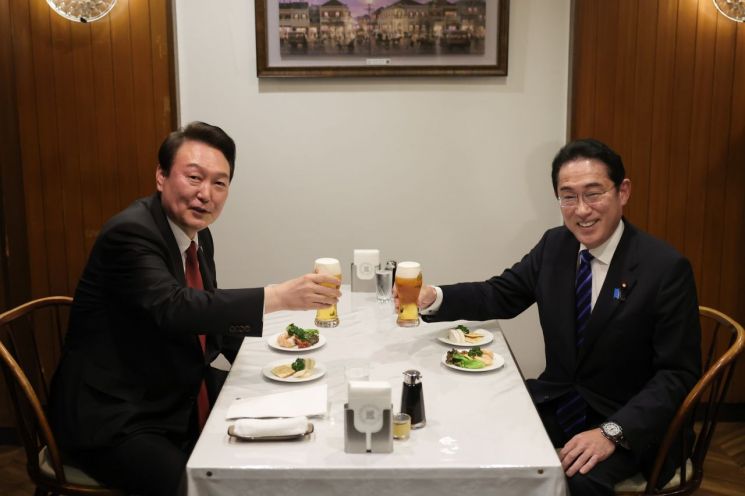
There is also analysis that the current high inflation measures and cash support are part of the Kishida administration's plan to drive a recovery in approval ratings ahead of the general election. Earlier, after recording historically low approval ratings in December last year and January this year, Prime Minister Kishida announced follow-up measures such as doubling the budget related to low birth rates. As a result, the previously sluggish approval ratings began to recover starting from the Korea-Japan summit on the 16th.
In a nationwide opinion poll conducted over two days on the 18th and 19th by Mainichi Shimbun, the administration's approval rating was 33%, a 7 percentage point increase from 26% in the previous month's survey. During the same period, an Asahi Shimbun survey recorded a 5 percentage point rise to 40% compared to the previous month.
In response, a senior official at the Prime Minister's Office told Mainichi, "It seems that the Korea-Japan summit, the decrease in COVID-19 cases, and bold measures against low birth rates have worked in combination," adding, "Prime Minister Kishida is confident in the recovery of approval ratings."
© The Asia Business Daily(www.asiae.co.kr). All rights reserved.


















