22nd National Assembly Planning and Finance Committee Full Meeting
Strategic Technology Tax Credit Rate 8·15%→16·25%
Hydrogen and Future Mobility Added to Industries
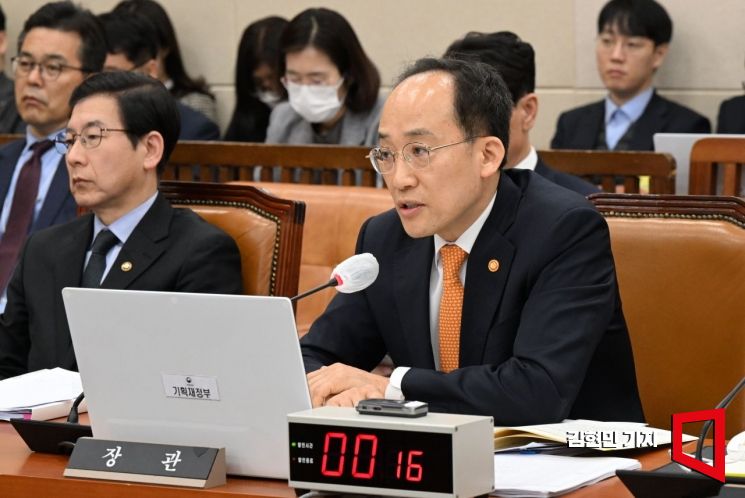 Deputy Prime Minister and Minister of Economy and Finance Choo Kyung-ho is responding to lawmakers' questions at the plenary meeting of the Planning and Finance Committee held at the National Assembly in Yeouido, Seoul, on the 22nd. Photo by Hyunmin Kim kimhyun81@
The Semiconductor Special Act, which strengthens tax support for investments in national strategic technologies, has passed the National Assembly's standing committee. According to the amendment, the tax credit rate will be expanded compared to the current rate, and the industries eligible for benefits will also increase. On the same day, an amendment to the Comprehensive Real Estate Tax Act, which excludes public housing project operators from the heavy taxation rate applied to multiple homeowners, was also passed.
The National Assembly's Strategy and Finance Committee held a plenary session at 10 a.m. on the 22nd and approved the "Restriction of Special Taxation Act Amendment (K-Chips Act)." The amendment mainly expands the tax credit rate for facility investments in national strategic technologies such as semiconductors from 8% to 15% for large and medium-sized enterprises, and from 16% to 25% for small and medium-sized enterprises. Currently, national strategic technologies include four categories: semiconductors, secondary batteries, vaccines, and displays, with hydrogen and future mobility added as two new categories.
For industries not classified as national strategic technologies, a temporary expansion of the temporary investment tax credit will be introduced this year. General facility investments will increase from 1%, 5%, and 10% for large, medium, and small enterprises respectively, to 3%, 7%, and 12%. For new growth and original technology commercialization facility investments, the rates will increase from 3%, 6%, and 12% to 6%, 10%, and 18% respectively.
The additional tax credit rate applied temporarily to this year's increased investments will also be raised. Currently, the general sector is set at 3%, and new growth, original technology, and national strategic technologies at 4%, but going forward, a uniform increase to 10% will be applied regardless of category. Industries corresponding to national strategic technologies will receive credits up to 25-35%.
The amendment also includes the establishment of tax benefits for high-risk, high-return bond investment trusts. If subscribed by December 31 next year, income generated from the fund will be subject to separate taxation at a 14% rate for investment amounts up to 30 million KRW per person. Interest income from government bonds for individual investors will also be separately taxed at 14%, with a purchase limit of 200 million KRW per person. Additionally, this year, the income deduction rate for public transportation usage under credit card income deductions will be increased from 40% to 80%, and the tax credit for hometown love donations will be adjusted to apply from January of this year.
Reduction of Comprehensive Real Estate Tax Rates for Corporations Including Public Housing Project Operators
The amendment to the Restriction of Special Taxation Act is expected to be addressed at the plenary session of the National Assembly on the 30th after passing through the Legislation and Judiciary Committee. Previously, the ruling and opposition parties agreed on December 23 last year to raise the tax credit rate for large corporations from 6% to 8%. However, criticism arose that the benefits were too small, and after President Yoon Seok-yeol ordered a review, the government submitted an amendment with higher credit rates to the National Assembly again.
The Democratic Party of Korea initially opposed the amendment, citing differences from the original agreement. However, after the passage of the U.S. CHIPS Act and the worsening semiconductor industry downturn, discussions rapidly moved toward accepting the government’s proposal. On the 15th, Park Hong-geun, the Democratic Party floor leader, stated at the Supreme Council meeting, "It is important for the ruling and opposition parties to join hands amid the economic crisis in the semiconductor industry," adding, "Despite policy confusion and concerns about tax revenue reduction, we accepted the additional semiconductor tax credit."
However, some opposition voices were raised on the same day. Jang Hye-young, a member of the Strategy and Finance Committee from the Justice Party, said, "I have never received a convincing explanation from the Ministry of Strategy and Finance, which is trying to pass a semiconductor investment tax credit that will certainly reduce tax revenue in a situation of insufficient tax revenue but whose effects are uncertain," and criticized, "We should not set a precedent of passing such a rushed review during a difficult time for the Korean economy."
Meanwhile, the government decided to lower the comprehensive real estate tax rates for corporations including public housing project operators. Public housing project operators, public interest corporations, housing cooperatives, redevelopment and reconstruction project implementers, private rental housing operators, social enterprises, and social cooperatives will be subject to the basic progressive tax rate (0.5% to 2.7%) regardless of the number of houses held. However, for public interest corporations, this is limited to cases where only houses for their inherent purposes are held.
On the same day, Deputy Prime Minister and Minister of Strategy and Finance Choo Kyung-ho appeared before the Strategy and Finance Committee and said, "Not only is domestic facility investment recently worsening, but countries around the world are fiercely competing to enhance competitiveness in advanced industries such as semiconductors," adding, "The amendment to the Restriction of Special Taxation Act is expected to greatly contribute to the expansion of facility investments by domestic strategic technology companies such as semiconductors."
© The Asia Business Daily(www.asiae.co.kr). All rights reserved.

















