Controversy Expected Over Semiconductor Expansion in China
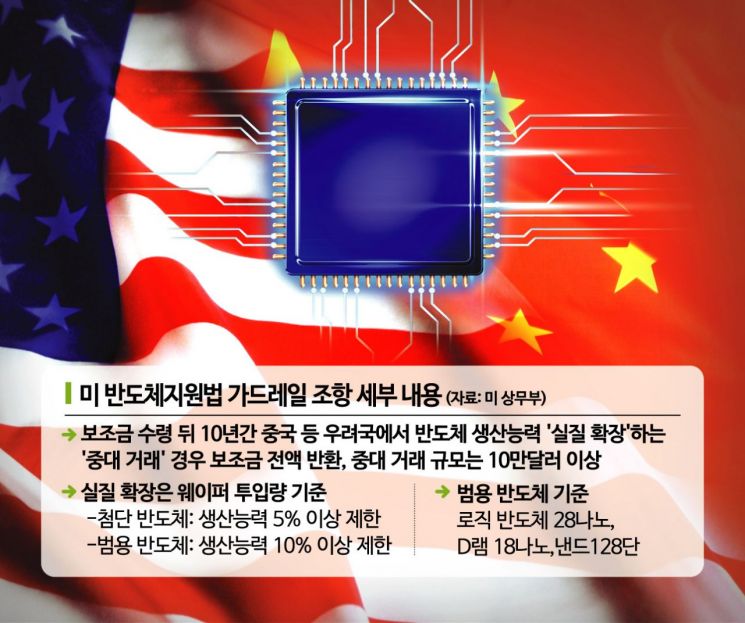
"As part of supporting the United States' security interests, recipients of the semiconductor support program under the CHIPS Act (including affiliates) must enter into agreements with the Department of Commerce that restrict any significant transactions, including material expansions of semiconductor production facilities, with foreign countries of concern."
This is the essence of the CHIPS guardrail provisions released by the U.S. Department of Commerce on the 21st (local time). Domestic companies have evaluated the guardrail provisions as better than expected, but if they actually invest in the U.S. and receive subsidies, a difficult journey is anticipated, including effectively having to give up investments in China. The key points in the original text of the bill can be analyzed into four main issues.
① The threshold for significant transactions is $100,000 (about 130 million KRW)... Advanced semiconductor facilities are limited to a 5% expansion in production capacity
"This regulation defines ‘significant transaction’ as a transaction valued at $100,000 or more, or the aggregate value of transactions during the required contract period reaching or exceeding $100,000. This includes both pending and completed investments. It encompasses mergers, acquisitions, and hostile takeovers."
"‘Material expansion’ refers to regulations including the construction of new production facilities or additions to production capacity, and uses a quantitative scope of 5% of existing (semiconductor plant) production capacity to provide a clear and predictable range. It means that technology upgrades are allowed to maintain competitiveness as long as the overall semiconductor production capacity is not expanded by more than 5%."
This is the most important provision of the guardrail. The U.S. has specifically targeted China to prevent its subsidies from being used to enhance semiconductor technology in foreign countries of concern such as China and North Korea. This provision is also expected to have a significant impact on domestic semiconductor companies that operate major memory semiconductor plants. Bloomberg reported that Taiwan's TSMC, the number one foundry in the industry, is likely to face difficulties expanding its 28nm and 16nm semiconductor production plants in Nanjing, China, due to this guardrail.
② Legacy semiconductor production in countries of concern cannot increase by more than 10%
"Production of legacy semiconductors in countries of concern is also restricted. Companies receiving subsidies are prohibited from expanding new production lines or increasing production capacity of existing facilities by more than 10%. If legacy semiconductors are already being produced in countries of concern, new general-purpose semiconductor production facilities may only be established exceptionally if 85% of the production is consumed within that country. Logic (non-memory) semiconductors are defined as 28nm or larger, DRAM as exceeding 18nm, and NAND flash as fewer than 128 layers."
The U.S. has banned not only the expansion but also the establishment of new legacy semiconductor facilities in countries of concern. It prevents subsidized companies from expanding new production lines or increasing production capacity of existing facilities by more than 10%. This means that the wafer input volume for existing legacy semiconductor production facilities cannot be increased by more than 10%. Domestic companies and others currently producing semiconductors in China at levels higher than the U.S.-defined legacy semiconductors will be subject to the 5% production capacity expansion limit for advanced semiconductors when receiving U.S. government subsidies. If legacy semiconductors are already produced in countries of concern, new general-purpose semiconductor production facilities may only be established exceptionally if 85% of the production is consumed within that country.
③ Semiconductors critical to national security
"Semiconductors critical to national security are not considered legacy semiconductors regardless of production technology."
The U.S. government has set a somewhat lower level of restrictions for legacy semiconductors based on national security criteria. This includes current generation or mature node (40nm or larger) semiconductors used in quantum computing, radiation-intensive environments, and special military functions. These were decided after consultation between the Department of Defense and the National Intelligence Agency. Regardless of the application of the latest technology, these semiconductors are not classified as legacy semiconductors. Accordingly, companies producing these semiconductors will be subject to stricter regulations than those applied to legacy semiconductors, which have limited expansion allowed in countries of concern.
④ Restrictions on joint research raising national security concerns
"Companies receiving support under the Semiconductor Act are restricted from joint research and patent licensing agreements with foreign organizations related to technologies and products that raise national security concerns."
Due to this provision, companies receiving subsidies are prohibited from conducting joint research or entering into patent licensing agreements with any companies subject to sanctions by the U.S. Departments of Commerce and Treasury, and the Federal Communications Commission. Notably, the concept of joint research is defined as any research and development involving ‘two or more persons,’ reflecting a strong intention to ban any form of exchange going forward. Recently, there was controversy over U.S. automaker Ford announcing a joint factory with Chinese electric vehicle battery maker CATL, which was seen as circumventing the Inflation Reduction Act (IRA) regulations. This provision is considered to have introduced even stronger restrictions in response to such concerns.
© The Asia Business Daily(www.asiae.co.kr). All rights reserved.
![Clutching a Stolen Dior Bag, Saying "I Hate Being Poor but Real"... The Grotesque Con of a "Human Knockoff" [Slate]](https://cwcontent.asiae.co.kr/asiaresize/183/2026021902243444107_1771435474.jpg)
















