Resolution for Direct Referral of Grain Management Act and Broadcasting Act Amendments
Yellow Envelope Act and Safe Freight System Also Announced
Direct Referral Possible Led by Democratic Party in 6 Standing Committees
The Democratic Party of Korea has been overusing the direct referral card this year. The opposition party's justification is that the People Power Party, to which Kim Do-eup, the chairman of the Legislation and Judiciary Committee, belongs, is blocking bills in the committee, but concerns are being raised as the legislative process is moving away from bipartisan cooperation.
The Democratic Party plans to pass the "Rice Management Act Amendment" related to the government's mandatory rice purchase at the National Assembly plenary session on the 23rd. This bill, which was passed by the Agriculture, Food, Rural Affairs, Oceans and Fisheries Committee last year under the leadership of the Democratic Party and then moved to the Legislation and Judiciary Committee, was not processed for over 60 days by Chairman Kim, leading to a resolution for direct referral and submission to the plenary session on January 30.
There is a queue of bills for which the Democratic Party is pushing for direct referral to the plenary session. The day before, the Science, Technology, Information and Broadcasting Committee passed a motion for direct referral of the "Broadcast Act Amendment," which includes improvements to the governance of public broadcasting, through a single-party initiative by the opposition. Seven bills, including the "Nursing Act Establishment Bill," which had been stuck in the Legislation and Judiciary Committee for eight months, were also directly referred to the plenary session on February 9 through the Health and Welfare Committee led by the opposition.
In addition, the Democratic Party has announced plans to directly refer the "Yellow Envelope Act (Amendments to Articles 2 and 3 of the Labor Union Act)" and the truck safety freight rate system to the plenary session. The "double special prosecution" for Kim Geon-hee and Daejang-dong, also being pursued by the Democratic Party, can be directly referred to the plenary session without going through the Legislation and Judiciary Committee if it is pushed as a fast-track bill, provided that three-fifths (180 seats) of the total members of the National Assembly agree, according to the National Assembly Act.
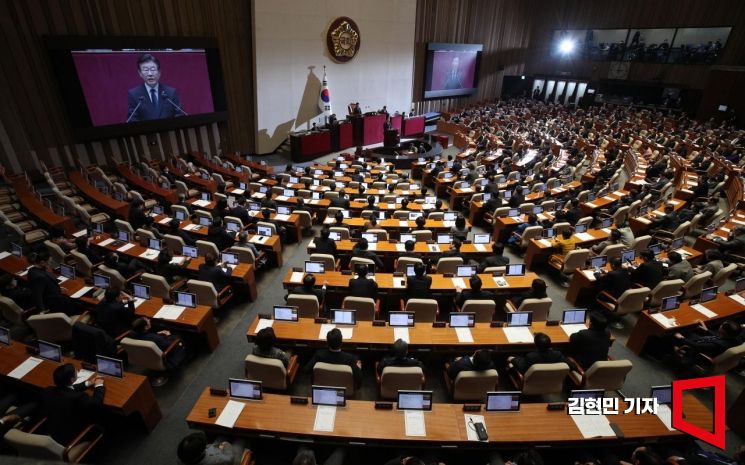 Lee Jae-myung, leader of the Democratic Party of Korea, is making a personal statement regarding the submission of a motion for his arrest at the plenary session held at the National Assembly in Yeouido, Seoul on the 27th. Photo by Kim Hyun-min kimhyun81@
According to Article 86 (Review of System and Substantive Provisions) of the National Assembly Act, if the Legislation and Judiciary Committee does not complete its review within 60 days from the date of referral, the chairman of the standing committee may request the Speaker of the National Assembly to directly refer the bill to the plenary session with the consent of at least three-fifths of the total members of the standing committee after consultation among the floor leaders. Since the Democratic Party holds a majority in most standing committees and mobilizes independent lawmakers with Democratic Party leanings, it has become possible to pass direct referral resolutions.
Currently, out of 17 standing committees excluding the Budget and Accounts Committee, direct referral is possible in six committees led by the Democratic Party. These include committees with independent lawmakers leaning toward the Democratic Party such as Yang Jeong-suk (Political Affairs Committee), Min Hyung-bae (Education Committee), Park Wan-joo (Science, ICT, Broadcasting and Communications Committee), Kim Hong-geol (Foreign Affairs and Unification Committee), Yoon Mi-hyang (Agriculture, Food, Rural Affairs Committee), and Yang Hyang-ja (Industry, Trade and Energy Committee). Except for the Foreign Affairs and Unification Committee, all these committees are chaired by Democratic Party members. Moreover, in these committees, it is highly likely that the agenda adjustment committee, formed to reconcile differences, will approve the motion with more than two-thirds of the adjustment members' consent. This creates conditions for bills to be submitted to the plenary session either after passing the full standing committee or directly without passing the Legislation and Judiciary Committee.
There are also cases where the Democratic Party persuades lawmakers from minor parties such as the Justice Party and the Basic Income Party to pass bills through standing committees. Lawmakers from the Justice Party include Kang Eun-mi (Welfare Committee), Lee Eun-joo (Environment and Labor Committee), Shim Sang-jung (Land, Infrastructure and Transport Committee), Lee Eun-joo (Steering Committee), Jung Hye-young (Strategy and Finance Committee), Ryu Ho-jeong (Culture, Sports and Tourism Committee), and Yong Hye-in (Gender Equality and Family Committee). Because of this, the Democratic Party is currently negotiating with the Justice Party to pass the special prosecution bill related to Daejang-dong.
While the ruling party counters the opposition's unilateral push with the "presidential veto," the political burden is not insignificant. Regarding the Broadcast Act Amendment, which was directly referred to the plenary session the day before, the People Power Party stated, "We will recommend the president to exercise the veto power in the name of the people." Article 53 of the current Constitution stipulates that a bill passed by the National Assembly is sent to the government and promulgated by the president within 15 days, and if the president has objections, they may return the bill to the National Assembly with a written objection within 15 days and request reconsideration.
Lee Kwang-jae, Secretary-General of the Manifesto Practice Headquarters, pointed out, "The National Assembly is basically a 'consultative body' as well as a majority rule or majority principle," adding, "Politics is about people with different opinions talking enough and reaching consensus, but the National Assembly is failing to show that, which is regrettable." He continued, "For smooth consultation in the National Assembly, the presidential office must show maximum respect to the National Assembly," and said, "To avoid mutual destruction of representative democracy, the National Assembly must also engage in dialogue."
© The Asia Business Daily(www.asiae.co.kr). All rights reserved.

















